



If you are comparing Upheal and Twofold Health for therapy documentation, you are likely looking for three things: accurate notes, a workflow that fits your sessions, and a compliance story you can confidently stand behind.
This guide compares both tools using publicly available product and pricing information, then closes with a clear recommendation.
Quick verdict
Choose Twofold Health if you want the strongest “all‑around” outcome for therapy notes: unlimited documentation volume, templates and treatment plans included, built‑in progress tracking, and a compliance‑forward workflow that is simple to operationalize across solo clinicians and teams.
Choose Upheal if you specifically want to pay a premium for a system that combines built‑in analytics and telehealth.
Overall winner: Twofold Health. It delivers the most complete set of high‑usage features in one predictable plan, making it the safer long‑term choice for most clinicians and most growing practices.
Category | Upheal | Twofold Health |
|---|---|---|
Best for | Session capture plus analytics for mental health | Fast, scalable therapy notes with an “assistant layer” workflow |
Note templates | Full set of templates on paid tiers (SOAP, DAP, GIRP, BIRP, EMDR, PIRP, SIRP, PIE, intake, more) | Common therapy formats (SOAP, BIRP, DAP, progress, intake) plus custom instructions and templates |
Treatment plans | Golden Thread treatment plans (paid usage-based plan; previously Premium-only) | Treatment plans included in Personal Plan |
Progress tracking | Positioned around analytics, treatment summaries, and treatment-plan sync to notes | Client progress tracking included in Personal Plan |
HIPAA posture | Publishes HIPAA compliance materials and a BAA | BAA at signup and consent templates, plus clear PHI controls |
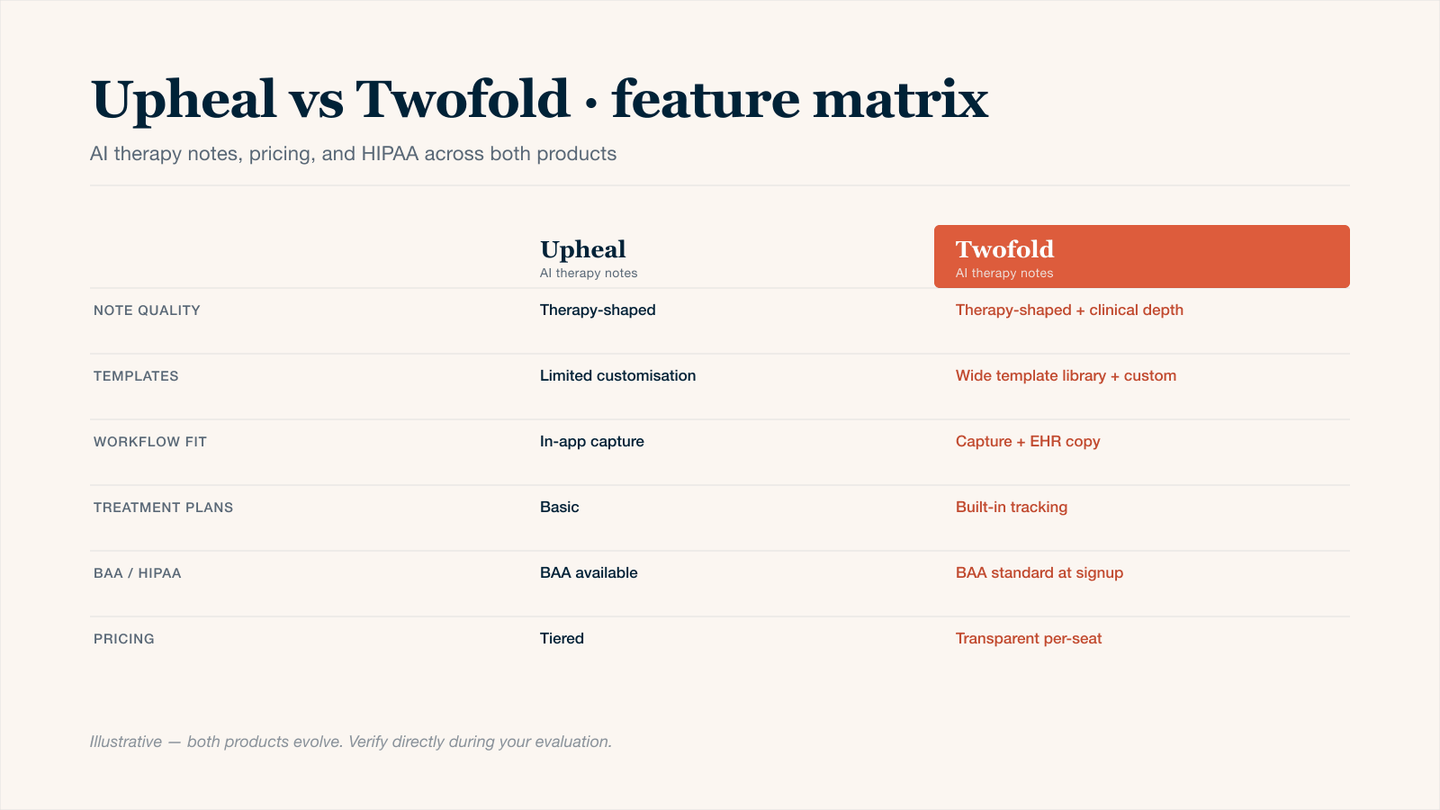
Upheal vs Twofold — six dimensions therapists weigh when picking AI therapy notes software.
What Upheal is
Upheal positions itself as an AI progress‑notes platform for mental health that supports multiple session types:
- In-person capture and virtual capture (including sessions held on “any platform or EHR”)
- A no-capture option where you write or dictate a summary and still generate structured notes
- A workflow that ends with “copy to EHR” using its browser extension
Upheal restructured its pricing in 2026 from the older Free / Starter ($19) / Premium ($69) tier ladder into a usage‑based model: a Free plan with unlimited (feature‑limited) notes plus an Individual / Group Practice plan at $1 per session capped at $69/mo per provider, and an Enterprise tier (custom). Features that were Premium‑tier add‑ons in the older model — Golden Thread treatment plans, compliance checker, advanced analytics — are now bundled into the paid usage‑based plan.
What Twofold Health is
Twofold Health is built as a HIPAA‑oriented AI scribe and clinician assistant that prioritizes speed, consistency, and rollout simplicity:
- Unlimited notes on the Personal Plan, plus treatment plans, custom templates, and client progress tracking
- BAA at signup and consent templates, with a workflow designed to make compliance easy to explain and implement
- A practical operating model for everyday clinics: record or summarize, generate notes fast, then copy into your EHR without complex setup
If your goal is to standardize documentation quality while keeping costs predictable, Twofold is intentionally optimized for that reality.
Note quality and template flexibility
Both tools cover the most common therapy note formats.
Upheal highlights a broad set of note types and template customization on paid plans, and it explicitly notes that its AI adapts to your writing style as you edit.
Twofold emphasizes payer‑ready structure, fast generation, and the ability to align output with your preferred format using custom templates and instructions, with those features included in the Personal Plan.
Why Twofold tends to win for most clinicians: template flexibility is only valuable if it is consistently available without pushing you into higher tiers as volume grows. Twofold’s plan design makes “best workflow” features available by default, which is a big deal for teams standardizing documentation.
Workflow fit: capture, summarize, and EHR copy
Upheal offers multiple capture modes and ends in an EHR copy step via extension. It also includes a clear distinction that its telehealth without AI notes does not generate transcripts, so your chosen workflow affects what gets produced.
Twofold also supports record or summarize workflows and centers around a fast, minimal‑friction path to getting the final note into any EHR.
Why Twofold is usually better in real practice: in high‑volume weeks, the best workflow is the one that stays fast and consistent with the fewest decision points. Twofold’s “one plan, unlimited notes” model makes the day‑to‑day predictable.
Treatment plans and progress tracking
Upheal's Golden Thread is designed to connect intake forms, treatment plans, and session notes into a single flow, and it aims to meet payer standards while syncing treatment plan progress into the note. Golden Thread is part of the paid usage‑based plan (it was previously a Premium‑tier feature in the older 2024 pricing).
Twofold includes treatment plans and client progress tracking in its Personal Plan, which matters if you want planning and tracking to be part of your default workflow rather than an add‑on.
Twofold advantage: for many practices, the question is not “does the tool have treatment plans?” It is “are treatment plans and progress tracking included without extra tiers, and can everyone on the team use them consistently?” Twofold’s bundled approach makes that easier.
Security, HIPAA, and BAAs
Upheal publishes a HIPAA compliance policy describing itself as a HIPAA Business Associate, and it also publishes a Business Associate Agreement.
Twofold highlights BAA at signup, consent templates, encryption and access controls, and a clear posture around PHI handling within the workflow.
Both vendors take HIPAA seriously based on their public materials. The practical difference for many clinicians is operational: Twofold’s compliance resources are designed to reduce rollout friction and simplify staff training.
Pricing and total cost of ownership
Upheal moved to usage‑based pricing in 2026 (verified May 2026):
- Free plan: $0 with unlimited (feature-limited) notes — replaces the older Starter tier.
- Individual / Group Practice plan: $1 per session, capped at $69/month per provider — the new usage-based model replaces the previous Premium tier and bundles features that used to be Premium-only.
Twofold has a single clear Personal Plan price point for individuals and small practices:
- Twofold Personal Plan (access to all features): $69 monthly or $49 monthly billed annually ($588) and includes unlimited notes
Why Twofold wins on value for most practices: once you price in the features clinicians actually use every week (notes, templates, treatment plans, tracking, apps, and compliance readiness), Twofold’s bundled unlimited plan tends to produce the lowest “cost per completed note” while still supporting growth.
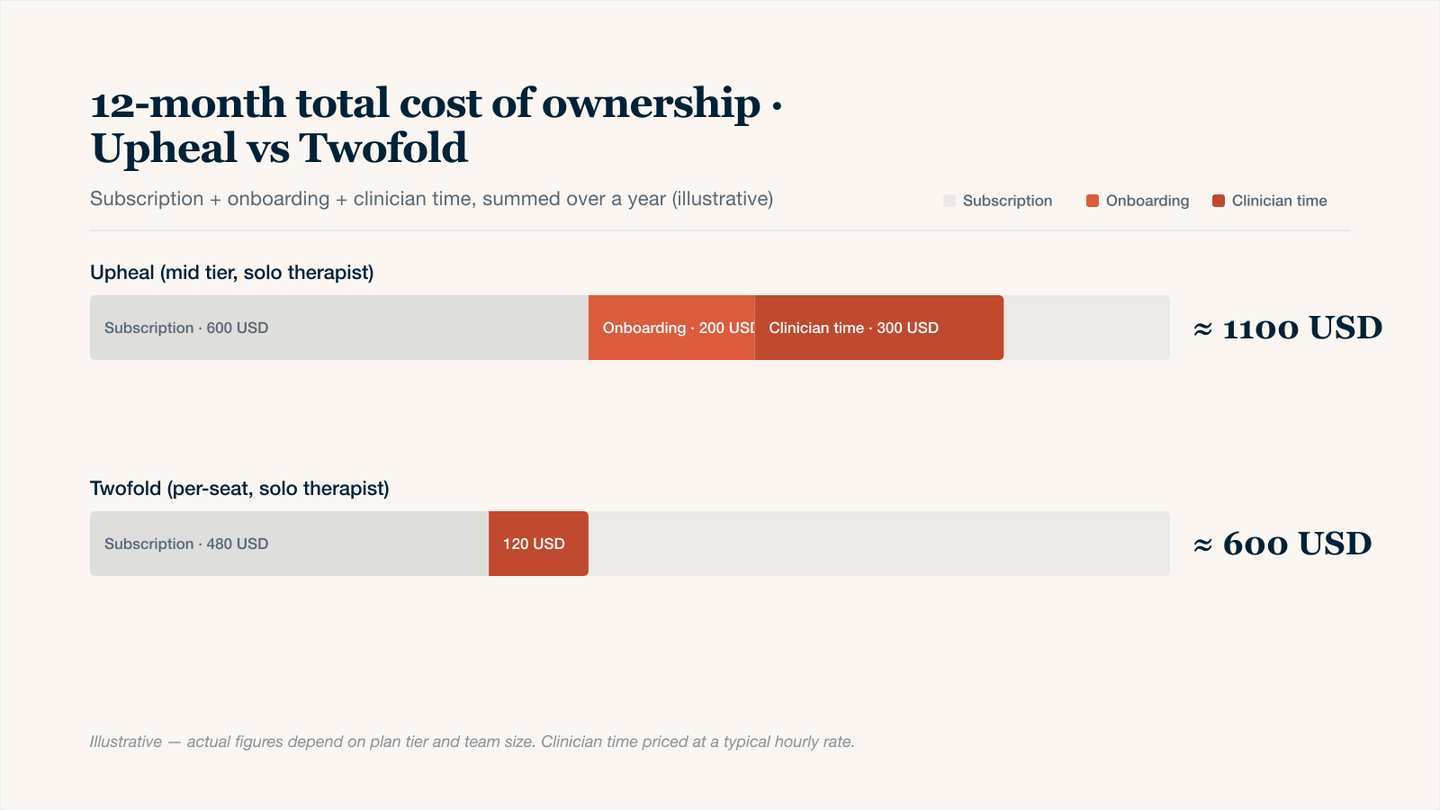
12-month total cost — subscription, onboarding, and clinician time summed up.
Summary
Twofold Health is the better overall option for most clinicians because it delivers the best combination of predictable pricing, unlimited notes, treatment plans, custom templates, client progress tracking, and a compliance‑ready onboarding workflow. It is the option that most reliably scales from solo documentation relief to practice‑wide standardization, without forcing you to rethink your workflow as you grow.
Upheal is a strong choice if your ideal AI therapy notes workflow is tightly tied to session capture, editing‑driven style learning, and advanced analytics, with the tradeoff that the most differentiated capabilities are concentrated in Premium.
Note: The information provided in this article is based on data available as of May 2026. Features and pricing are subject to change. Please consult the respective company websites for the most current information.
Disclaimer: This article is for informational purposes only and does not constitute legal or medical advice. Always consult professional guidelines and regulatory bodies for specific compliance requirements.