



Sunoh at a glance
Category | What you get |
|---|---|
Core capabilities | Ambient capture → transcript → SOAP draft; assists with order entry (meds, labs, imaging, referrals). |
EHR fit | “EHR‑agnostic” design; fully integrated with eClinicalWorks (imports to Progress Note; order pre‑fill). |
Platforms | iOS, Android, iPad + desktop EHR; official mobile apps on App Store and Google Play. |
Languages | Multilingual support; examples include Spanish and multi‑party visits. |
Security and Compliance | HIPAA posture with BAA on request; industry‑standard encryption; 2‑factor auth in mobile apps. |
Pricing signals | $149/user/month listed as limited-time (originally $199/month). Third-party listings (e.g. SoftwareAdvice) show $149+. Older blog posts cited $1.25/visit usage pricing; that language no longer appears on Sunoh's current pricing page. |
Scale claim | “Trusted by 80,000+ providers.” |
Customization | Template customization for SOAP, DAP, and specialty-specific notes. |
Last verified May 2026.
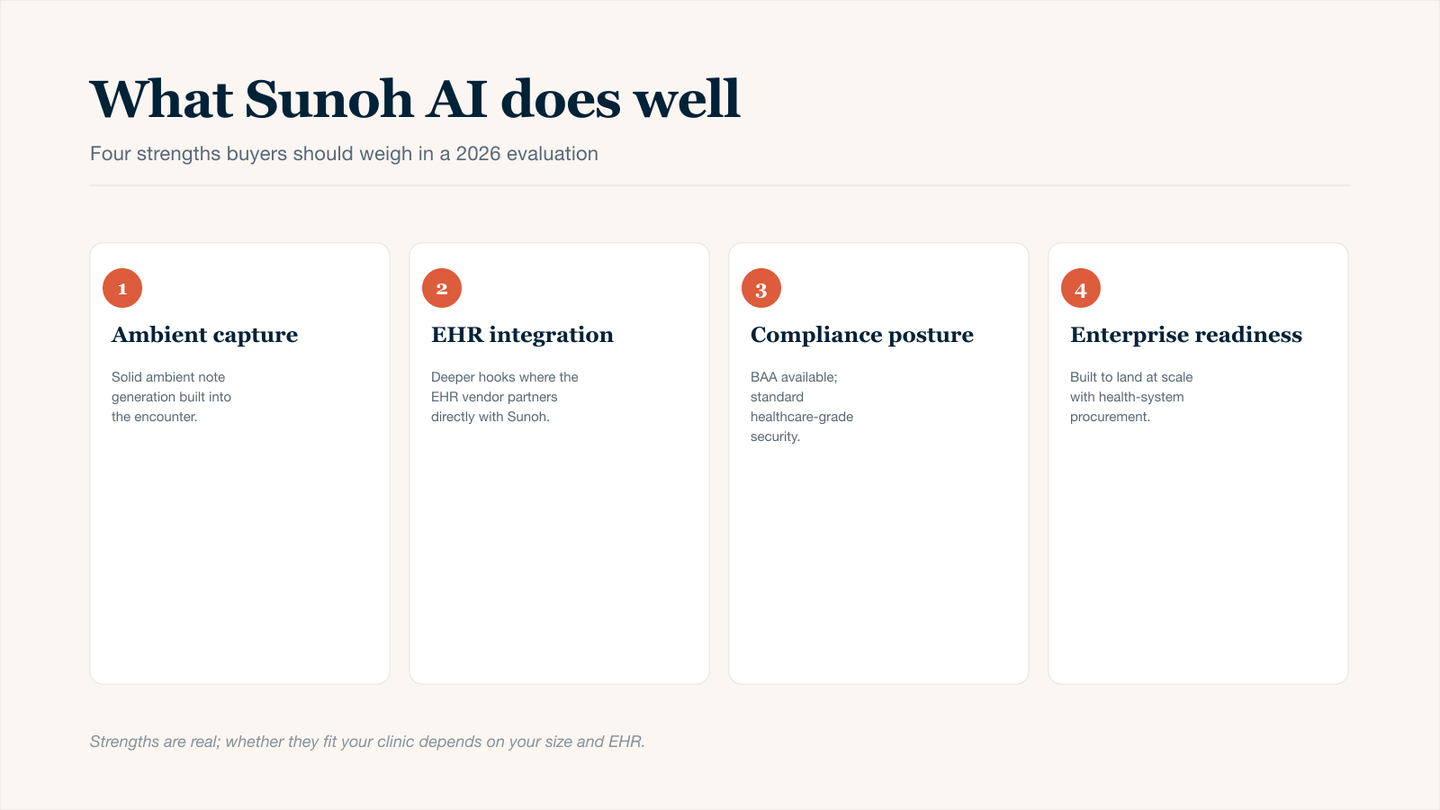
Four Sunoh AI strengths to weigh before evaluating alternatives.
What’s new (2024–2026)
- Mobile everywhere. Sunoh launched and updated iOS/Android/iPad apps so any EHR user can run ambient capture without special microphones.
- In‑workflow order help. Smartphone and iPad workflows now pre‑fill orders (meds, labs, imaging, referrals) from the encounter.
- Posted price (May 2026): Sunoh's pricing page advertises $149/user/month as a limited-time rate (originally $199/month). The older $1.25/visit usage-pricing language seen in 2024 marketing no longer appears on Sunoh's site — treat per-visit references in older third-party write-ups with caution.
- Multilingual push. eClinicalWorks highlights Spanish capture performance and multi‑party visit handling.
How Sunoh works (quick tour)
- Listen: Ambiently captures the encounter on phone, iPad, or desktop sidecar.
- Structure: Generates a dialogue flow and draft SOAP note.
- Assist: Surfaces orders and follow‑ups for review.
- Finalize: You edit once and import into the EHR (embedded in eClinicalWorks; copy/paste or interface elsewhere).
Integrations & deployment
- Deep eClinicalWorks workflow. Sunoh is “fully integrated” with eClinicalWorks and eClinicalTouch/eClinicalMobile, including import to the Progress Note and order pre‑fill on mobile.
- EHR‑agnostic beyond eCW. Sunoh markets an agnostic integration approach, connects to “your existing EHR,” and imports structured notes. (Depth varies by site.)
- Telehealth pairing. Sunoh is promoted alongside healow TeleVisits for remote encounters.
Security, privacy & data handling
- HIPAA & BAA. Sunoh states it signs BAAs and follows HIPAA administrative/physical/technical safeguards; posts emphasize industry‑standard encryption.
- Access controls. The mobile apps support two‑factor authentication; the vendor references role‑based controls in marketing content. (Confirm specifics in your MSA.)
- Practical tip. Ask for data‑flow diagrams (audio, transcripts, retention), subcontractors, and how model training treats PHI before go‑live.
Pricing & contracts
- Public list price: $149 per user per month (limited‑time) on Sunoh’s pricing page.
- Older pricing claims: A 2024 Sunoh blog post mentioned per-visit pricing from $1.25/visit, but this framing has been removed from Sunoh's current pricing page. Some third-party reviews still echo the old language — verify any per-visit quote directly with Sunoh sales.
- Market listings: SoftwareAdvice shows starting at $149/month.
Bottom line: Sunoh’s posted price is attractive compared to enterprise scribes. If you’re price‑sensitive, validate what’s included (e.g., transcription minutes, storage, support, EHR connectors) before committing.
Performance & clinician signals
- User reviews: 2025 Capterra reviews cluster around 4/5 with praise for ease and some notes on limitations - good for small clinics to evaluate.
- Case references: eClinicalWorks highlights a primary‑care practice achieving ~50% time savings after adopting Sunoh + eCW.
- Claims on site: “Save 2+ hours daily,” “notes in seconds,” and “trusted by 80,000+ providers.” Treat as vendor claims; verify locally during a pilot.
Strengths, limitations & best fit
Where Sunoh shines:
- In‑visit order assist and eClinicalWorks write‑back streamline clicks.
- Multilingual documentation (e.g., Spanish) and multi‑party handling benefit diverse populations.
Where to look closely:
- Non‑eCW depth can vary (Sunoh is EHR‑agnostic, but workflows differ by site/config).
- Security proof points (e.g., SOC 2/HITRUST) aren’t publicly highlighted; get the security packet.
- Pricing language spans per‑user and older per‑visit claims; nail down the contract.
Conclusion
Sunoh AI delivers a practical, mobile‑first ambient scribe with in‑workflow order help and posted pricing that’s attractive for independent clinicians and eClinicalWorks sites. For non‑eCW environments, run a quick pilot to validate note import, order handling, and edit burden in your build and request the security packet (BAA, encryption, retention, and any third‑party processors).
Criterion | Sunoh |
|---|---|
EHR breadth beyond eCW | ? |
Security attestations (e.g., SOC 2) | ? |
Multilingual capture | |
Mobile coverage | |
Latency at peak | ? |
Custom Templates | v (template customization for SOAP, DAP, and specialty-specific notes per Sunoh's pricing page) |
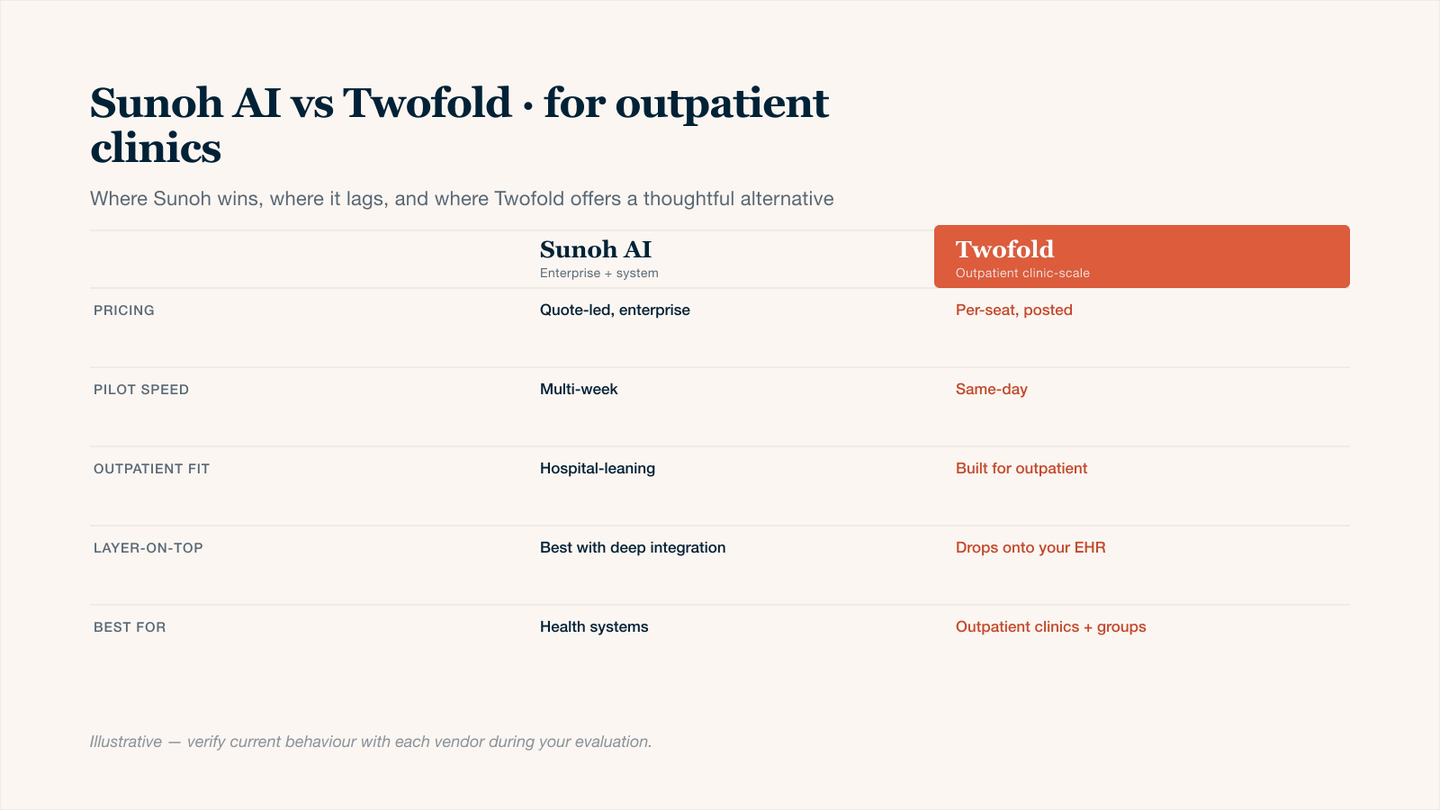
Sunoh AI vs Twofold — where each one fits, side by side.
A thoughtful alternative: Twofold Health AI Scribe
If your priority is the lowest total cost with transparent, unlimited pricing and near‑zero setup, consider Twofold Health:
- Pricing: $49/month (annual) or $69 month‑to‑month, unlimited notes on paid plans.
- Workflow: Fast drafts with copy‑to‑any‑EHR, template control, and a UI built for outpatient speed.
- Privacy: BAA at signup; HIPAA/HITECH posture; recordings not stored.
For many clinicians, Twofold’s mix of price clarity + speed + portability provides the quickest time‑to‑value, especially if you don’t need embedded eClinicalWorks order flows on day one.
Summary
Sunoh AI is a mobile-first, EHR-agnostic ambient scribe that shines for eClinicalWorks users: it captures visits on iOS/Android/iPad, drafts structured SOAP notes, and can pre‑fill orders to speed sign‑off. Posted pricing (currently $149/user/month) and quick setup make it appealing to solo and SMB clinics, while multilingual capture broadens coverage. The trade‑offs are variable depth outside eCW and the need to confirm security attestations and pricing details. If you want the lowest ongoing cost with simple copy‑to‑any‑EHR, Twofold Health AI Scribe remains a strong, transparent alternative. See also our best AI medical scribes for 2026.