


Quick verdict (who wins where)
For most solo and small‑practice clinicians I've talked to in 2026, Twofold is the better default — particularly in mental health, where Twofold's note‑format depth and SMB‑friendly pricing are hardest for Heidi to match. Heidi remains a strong choice when a perpetual free tier matters to you, when you want a broader assistant‑style product beyond pure documentation, or when you're already inside a workflow that benefits from Heidi's wider compliance positioning.
Both tools are HIPAA‑aligned, both sign BAAs, and both produce competent AI‑drafted notes from session audio. The differences that actually drive the decision are price, specialty fit, and how much product you want beyond pure documentation.
Heidi | Twofold | |
|---|---|---|
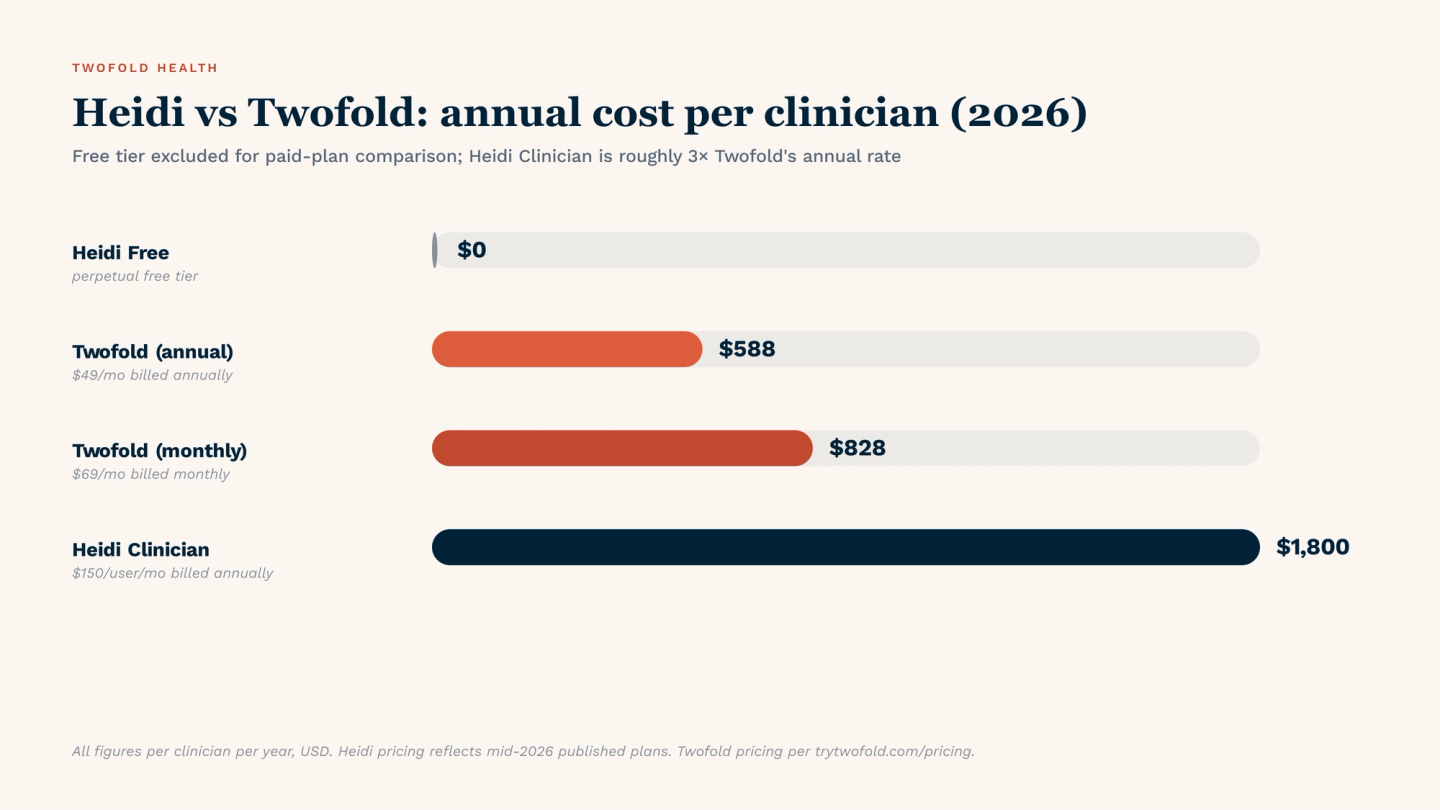
Paid plan | Clinician $150/user/mo annual | Personal $49/mo annual ($69/mo monthly) |
Free tier | Perpetual free plan | 7-day trial only |
BAA | Yes, with SOC 2 Type 2 + ISO 27001 | Yes, standard on all paid plans |
Audio retention | Per Heidi's stated data policy | Audio deleted after note drafted |
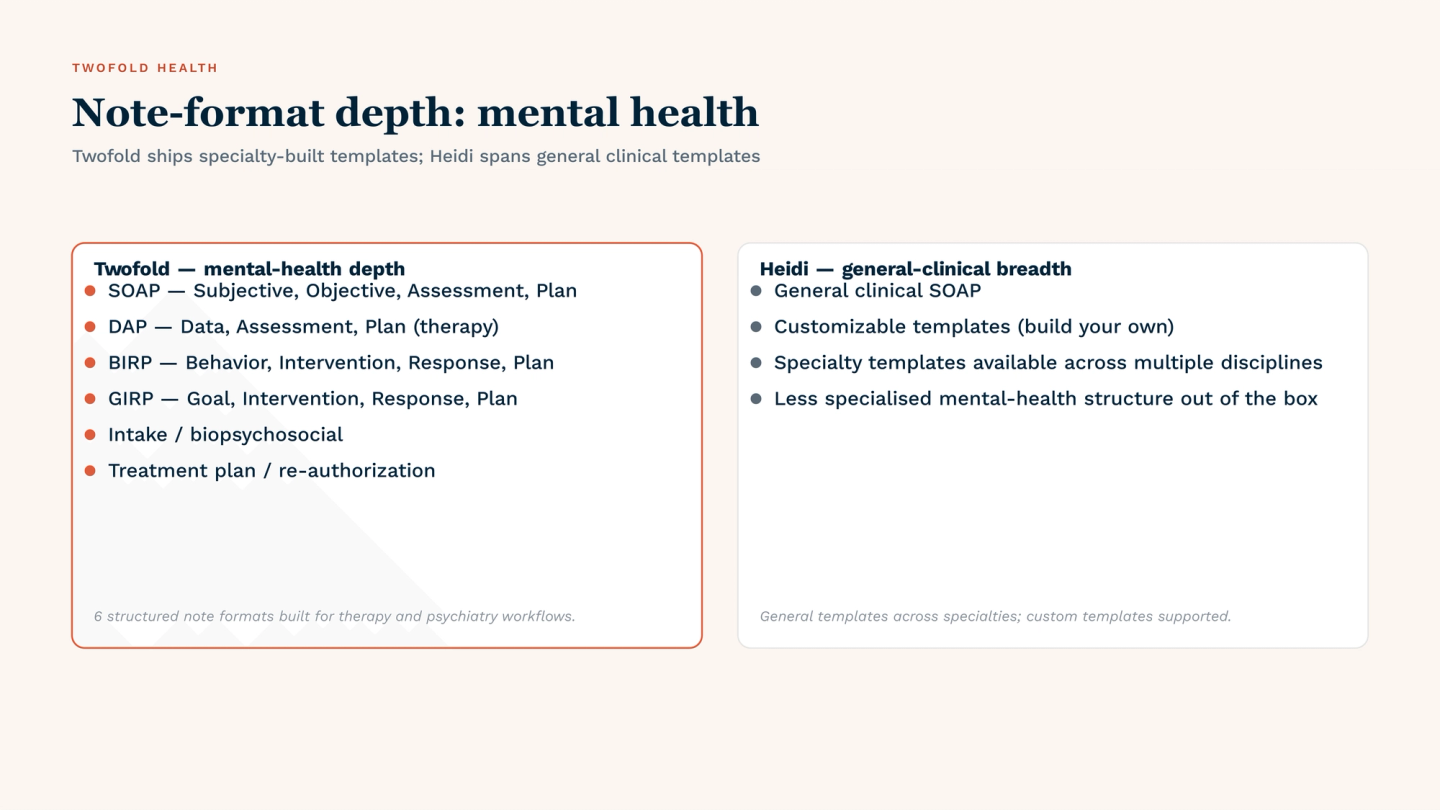
Mental-health templates | General clinical templates | DAP, BIRP, GIRP, intake (specialty-built) |
Setup time | Same-day for free tier; longer for full workflow | Same-day, self-serve |
Best for | Multi-specialty clinicians, free-tier evaluators | Solo / small mental-health practice |
Twofold Overview
Twofold Health is a self‑serve AI scribe built for solo clinicians, small practices, and specialty groups — with particular depth in mental health documentation. It captures session audio (or accepts post‑session dictation), produces structured drafts in SOAP, DAP, BIRP, GIRP, intake, and treatment‑plan formats, and is designed to paste cleanly into whatever EHR you already use.
Pricing is public and SMB‑friendly: $69/month monthly, $49/month billed annually. The trial is 7 days, no credit card. BAAs are signed as standard for paid accounts, audio is deleted after the note is drafted, and the product is positioned as a drafting tool that complements rather than replaces your EHR.
Heidi Overview
Heidi Health is an AI documentation platform with broader assistant‑style ambitions — clinical evidence search, treatment‑decision support, follow‑up tools alongside the core note generation. The product targets a wide range of specialties with global compliance positioning (SOC 2 Type 2, ISO 27001, HIPAA, GDPR).
The pricing structure as of 2026 spans a perpetual free tier, an Evidence Plus tier for clinicians wanting research integration, a Clinician plan at $150/user/month billed annually for the full clinical workflow, and a Scribe (Enterprise) tier for organizations.
Pros & cons at a glance
Twofold pros
- Transparent, SMB-friendly pricing ($49/mo annual).
- Strong mental-health specialty depth (SOAP, DAP, BIRP, GIRP, intake, treatment plans).
- EHR-agnostic paste-in workflow that doesn't require integration projects.
- BAA included on all paid plans, audio purged after drafting.
- Same-day setup — no procurement cycle, no IT involvement.
Twofold cons
- No perpetual free tier — only a 7-day trial.
Heidi pros
- Real perpetual free tier — useful for low-volume clinicians or pilot evaluation.
- Broader product surface (evidence search, assistant workflows) beyond pure note generation.
- Strong global compliance posture (SOC 2 Type 2, ISO 27001, HIPAA, GDPR).
Heidi cons
- Clinician plan at $150/user/month billed annually — significantly above SMB market norms.
- Broader assistant scope can feel like more product than a focused note-taker needs.
- Less mental-health template depth than specialty-focused alternatives.
Pricing (2026)
Twofold's Personal plan lists at $69/month monthly or $49/month billed annually. There's no per‑user multiplier for individuals — one price, one workflow. Group plans are available for practices at a per‑user rate that comes down with volume.
Heidi's structure spans four tiers: a perpetual Free plan, an Evidence Plus tier, a Clinician plan at $150/user/month billed annually, and a Scribe (Enterprise) tier with quote‑based pricing. The free tier is genuinely useful for low‑volume clinicians or pilot use; the gap between Free and Clinician is significant, which makes the choice partly a question of whether the assistant‑style features above the free tier are worth roughly 3x Twofold's rate to you.
On price alone, Twofold wins for any clinician who needs paid‑tier documentation features but doesn't need Heidi's broader assistant surface.
Security, compliance & privacy
Both products are HIPAA‑aligned with signed BAAs. Heidi additionally highlights SOC 2 Type 2 and ISO 27001 certifications, which matter most for procurement‑heavy contexts (employer‑mandated reviews, multi‑clinician practice audits). Twofold's posture is HIPAA + BAA with audio purged after the draft is produced — a tighter retention story for solo clinicians who don't want session recordings sitting on a vendor server.
For an individual clinician picking between the two, both are credible. For a practice with a compliance officer or an institutional review, Heidi's published certifications make the security review shorter; Twofold's data‑handling defaults (audio purged) make the BAA conversation shorter.
Accuracy & reliability (what to expect)
In 2026, both Twofold and Heidi produce competent first drafts from session audio. The differences clinicians report tend to come down to template fit and editing time rather than raw transcription accuracy. Twofold's specialty templates (DAP, BIRP, GIRP, intake) typically need less reshaping for mental‑health workflows because the structure is closer to what the clinician would have written manually.
Heidi's broader scope can produce drafts that include more contextual content than a tight clinical note needs, which clinicians describe as either a feature (more to work with) or a downside (more to delete) depending on their style.
Support & onboarding
Twofold is built around self‑serve onboarding — sign up, choose a template, record a session, paste into your EHR. Most clinicians are productive within an hour. Support is responsive but not enterprise‑style; you're not getting an account manager because you don't need one at this price point.
Heidi's onboarding spans a wider product surface, which means a longer ramp if you're using more than the core note‑taker. The free tier serves as its own onboarding — you can spend a week exploring before committing to a paid plan. Enterprise tiers come with more formal onboarding support.
Typical users
Twofold's typical user is a solo therapist, a small mental‑health practice, or a specialty group outside an enterprise hospital system. They want fast, transparent, EHR‑agnostic documentation and don't want a sales conversation to get started.
Heidi's typical user is broader — primary care clinicians, multi‑specialty groups, clinicians who want evidence search alongside notes, and organizations that value Heidi's wider compliance certifications for institutional review.
Two concrete scenarios that come up often when clinicians weigh the two:
- A solo therapist running 22-25 weekly sessions across in-person and telehealth. Wants DAP or BIRP notes that don't need heavy reshaping, $49/mo on annual billing fits the budget cleanly, and no assistant-style features are required. Twofold is the obvious pick.
- A primary-care PCP doing 18-22 visits per day who wants documentation plus contextual evidence search for unfamiliar conditions. Heidi's assistant scope is what they actually want; the $150/user/mo Clinician plan pays for both the documentation surface and the evidence search.
Why Twofold is the better choice across price, value, accuracy, customizability, and support
Across the dimensions most clinicians weight when picking between Heidi and Twofold, Twofold leads in five of them:
- Price — $49/month annual is roughly a third of Heidi's Clinician plan. For documentation-only use, the price gap is hard to justify.
- Value at the documentation use case — Twofold's specialty templates and EHR-agnostic paste-in workflow deliver more documentation-specific value per dollar than Heidi's broader assistant surface.
- Accuracy for specialty workflows — mental-health note formats (DAP, BIRP, GIRP) and structured templates make Twofold's drafts closer to clinician intent out of the box.
- Customizability — Twofold's template system was built around the user customizing the structure for their style, not around a global assistant model.
- Support fit — Twofold's responsive self-serve model is calibrated for solo and small-practice clinicians; you don't pay for an account manager you don't need.
Heidi is the better choice when documentation isn't the only thing you want — when evidence search, decision support, and broader assistant capabilities matter, or when a perpetual free tier is a hard requirement.
Conclusion
If your decision is between Heidi and Twofold and your primary need is fast, accurate, well‑structured clinical documentation — particularly in mental health — Twofold is the better default in 2026. The price advantage is significant, the specialty depth is real, and the workflow fits how most solo and small‑practice clinicians actually work.
If you want the broader assistant surface, value the perpetual free tier, or are inside an organization that benefits from Heidi's wider compliance certifications, Heidi remains a credible alternative. For everyone else — which is most clinicians evaluating AI scribes in 2026 — Twofold is the cleaner, more focused, more affordable choice. See also our Heidi Health alternatives.
Thinking of Switching?
If you're weighing a change, these step‑by‑step guides help you switch cleanly — without losing notes, templates, or paying for a renewal you won't use: