


Quick verdict
If your top priority is therapy specific session reflection (therapeutic alliance feedback, session analytics, and visual symptom trends) and you are comfortable working within monthly note limits, Mentalyc is compelling.
If you want the best blend of speed, compliance readiness, flexibility, and cost per note with unlimited volume, strong templates, treatment plans, and progress tracking across phone and desktop, Twofold Health is the better choice for most clinicians and most practices.
Category | Mentalyc | Twofold Health |
|---|---|---|
Best for | Therapy centered note taking plus session analytics | Therapists and clinicians who want an end to end AI scribe and assistant that scales |
Note limits | 40 to 330 notes and transcripts per month depending on plan | Unlimited notes on the personal plan |
Apps | Web based | Web+iOS+Android Apps |
Treatment plans | AI Treatment Planner on paid tiers | Treatment plans included in the personal plan |
Capture options | Record the full session or speak a quick summary; copy finished note into any EHR | Record, upload, dictate, or type; positioned to “capture any EHR or online call” |
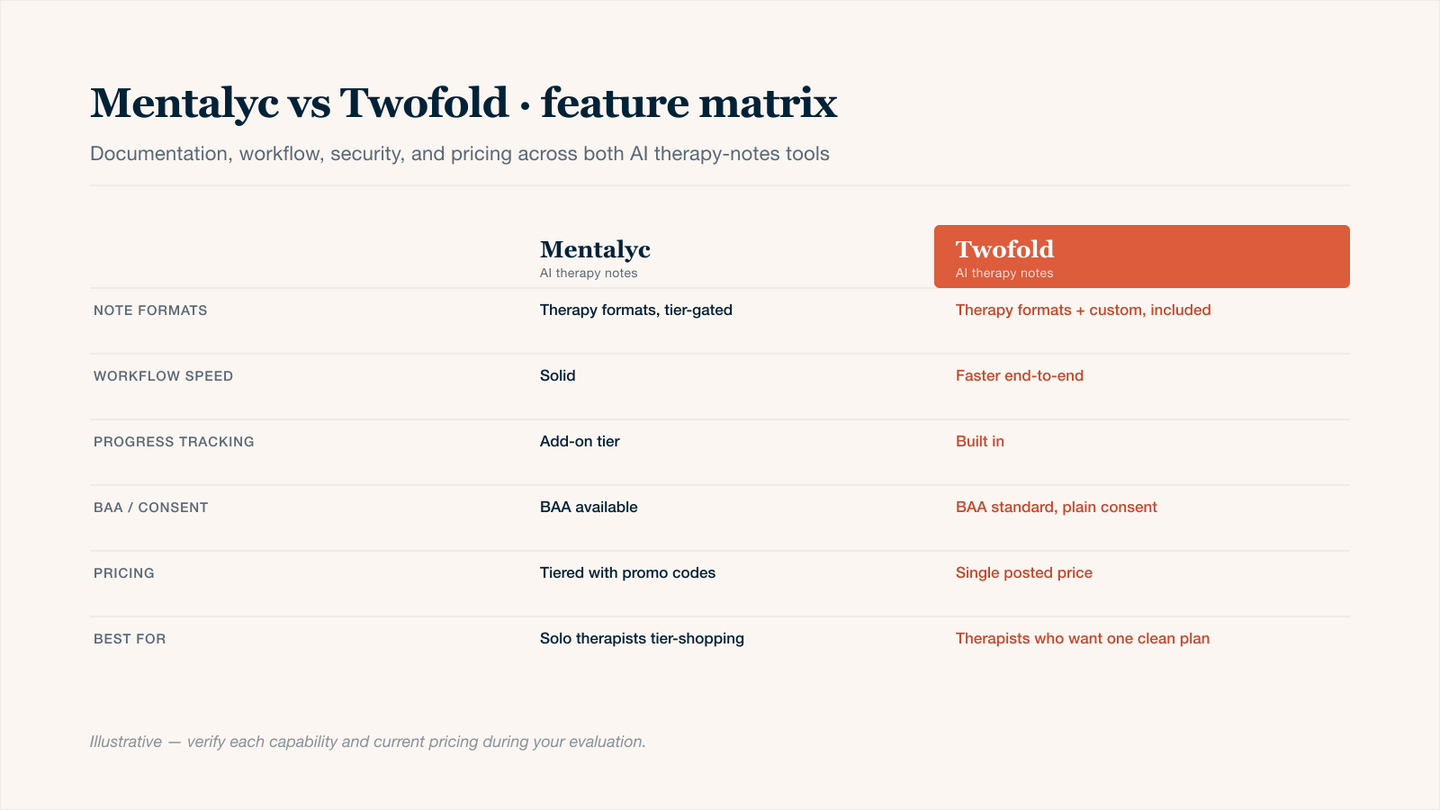
Mentalyc vs Twofold — six dimensions therapists actually weigh.
Mentalyc overview
Mentalyc positions itself as an AI scribe for mental health clinicians with an emphasis on therapy session analysis rather than pure documentation output. In addition to standard progress notes, it highlights features like:
- Alliance Genie for therapist reflection and alliance focused insights (marketed as supervision style feedback).
- AI Progress Tracker to identify symptoms, themes, and goal related moments, then visualize trends over time.
- Session analytics and client summaries listed across plans.
Mentalyc's pricing model is volume‑based. Higher tiers add child, couple, and family workflows, additional modalities (including EMDR, play, psychiatry), supervision notes, and more (per the public Mentalyc pricing page). As of May 2026, Mentalyc also publishes a Team plan at $49.99–$59.99 per seat with unlimited notes for multi‑clinician practices — a path the article didn't surface at first verification.
Twofold Health overview
Twofold Health positions itself as a broader AI medical scribe plus clinician assistant layer that works for therapists and for other outpatient specialties. Its core value proposition is reducing documentation time while keeping workflows simple:
- Unlimited notes on the personal plan, plus custom templates, treatment plans, and progress tracking.
- Works on phone or desktop, which matters if you switch between in person sessions, telehealth, and between session documentation.
- BAA at signup and ready to use consent resources, aiming to reduce rollout friction for compliant practices.
Twofold also leans into “trust signals” on the homepage, including a 4.8 out of 5 rating callout and explicit HIPAA compliant messaging.
Documentation quality and note formats
Both platforms support common therapy documentation formats. Mentalyc highlights broad template availability on higher tiers, including BIRP, GIRP, PIE, and SIRP. Twofold highlights SOAP, BIRP, DAP and progress notes, plus the ability to apply custom instructions so the output matches your voice and payer expectations.
Where Twofold tends to win for day to day charting is repeatable consistency at scale: unlimited notes, custom templates, and a workflow designed to quickly copy final notes into any EHR without complex setup.
Workflow and speed
Mentalyc is attractive if you want to do more than produce a note. It explicitly promotes a workflow where you bring sessions in for progress tracking and deeper insights.
Twofold tends to be a better fit if your priority is getting charts done fast with minimal operational overhead. Its HIPAA focused page emphasizes “record or summarize,” one click to EHR, and audit friendly notes.
Progress tracking and clinical insights
This is the area where Mentalyc is most differentiated. It markets longitudinal trend charts and alliance related reflection tools that are explicitly designed for therapist skill development and client engagement.
Twofold still covers the basics and beyond for most practices by including client progress tracking and treatment plans inside the core plan, without forcing you into higher note capped tiers.
If your clinical workflow depends heavily on insight features, Mentalyc may feel more “therapy native.” If you want a balanced system that improves documentation, planning, and tracking while staying simple and scalable, Twofold is typically the better long term platform.
Security, HIPAA, BAA, and consent
Both vendors publicly emphasize HIPAA alignment.
- Mentalyc’s security page states that recordings are not stored and it publishes a BAA that is accepted online during registration.
- Twofold states it provides a BAA at signup, offers patient consent templates, and encrypts data in transit and at rest with clear access controls.
In practice, the difference for many teams is operational simplicity. Twofold’s workflow is very explicit about making compliance rollout easy (BAA at signup plus consent templates), which matters if you are onboarding multiple clinicians or rolling out across a group.
Pricing and total cost of ownership
Mentalyc’s tiers are attractive at the low end, especially if you have modest volume. The trade off is that higher usage pushes you up the tier ladder, and even the top tier still has a monthly cap (330 notes and transcripts on Super).
Twofold’s personal plan is straightforward: $69 monthly or $49 monthly billed annually, includes unlimited notes, custom templates, treatment plans, progress tracking, and mobile plus desktop apps.
For many private practices, “value per completed note” is the deciding factor. On that metric, unlimited notes plus full feature access is one of the most practical reasons Twofold tends to win.
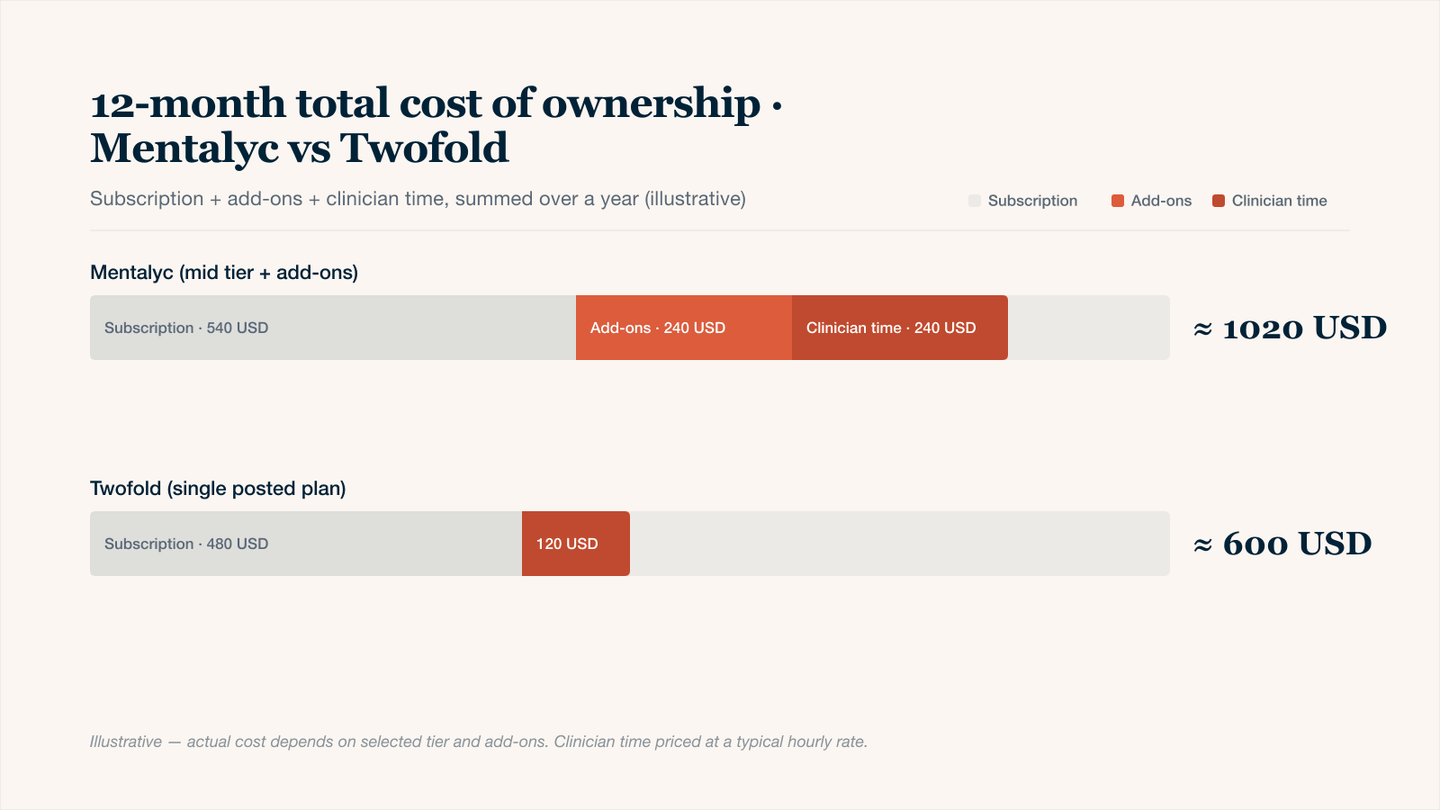
Mentalyc vs Twofold 12-month TCO — subscription, add-ons, and clinician time.
Summary
Mentalyc and Twofold Health are both credible options for clinicians searching for “AI therapy notes,” “AI progress note generator,” or a “HIPAA compliant AI scribe.” Mentalyc’s advantage is its therapy specific analytics and reflection tools, especially for clinicians who value structured feedback on alliance and longitudinal symptom trends.
Twofold Health is the better overall choice for most practices because it delivers the strongest combination of documentation speed, predictable pricing, unlimited volume, cross device workflows, and compliance ready rollout features like BAA at signup and consent templates. If you want a platform that can start in a solo practice and still fit when you grow into a group, Twofold is the safer bet.
Note: The information provided in this article is based on data available as of May 2026. Features and pricing are subject to change. Please consult the respective company websites for the most current information.
Disclaimer: This article is for informational purposes only and does not constitute legal or medical advice. Always consult professional guidelines and regulatory bodies for specific compliance requirements. See also our Mentalyc alternatives.