



This article provides a comprehensive comparison highlighting their features, pros and cons, pricing, reviews, and more. While both solutions offer innovative features, they may not fully meet all expectations. This analysis aims to help you make an informed decision by examining where these platforms excel and where they might fall short. See also our best Freed AI alternatives.
Freed Overview
Freed AI positions itself as an advanced AI scribe designed to assist clinicians, physicians, and other medical professionals in generating efficient medical notes. It offers near real‑time transcription during patient visits, aiming to reduce the time‑consuming nature of manual note‑taking. Freed AI claims to adapt to each user's unique writing style, ensuring personalized documentation.
Key Points
- Near Real-time Transcription: Captures conversations as they happen, allowing medical professionals to focus on the patient.
- Adaptive Learning: Attempts to emulate your writing style with every edit.
- Custom Note Formats: Specialty-specific templates included from Starter ($39/mo); Premier ($104/mo annual) adds the Instant Template Builder for custom note structures. The older "SOAP only" positioning is no longer accurate.
- Mobile Access: Accessible on desktop, mobile app available.
- Integrations: Not mentioned.
- Security: HIPAA and SOC II compliant.
Considerations: Users have reported that the adaptive learning may require significant time to fully align with their writing style. Additionally, real‑time transcription can sometimes lag, affecting the flow of patient consultations.
Heidi Overview
Heidi is an AI medical scribe platform offering AI‑powered medical note generation with customizable templates. It includes dictation capabilities and team collaboration features. Heidi aims to streamline administrative tasks, allowing medical professionals to focus more on patient care.
Key Points
- AI Note Generation: Offers customizable templates.
- Dictation: Provides dictation capabilities for medical note-taking.
- Custom Templates: Ability to create, store, and reuse templates.
- 'Ask Heidi' Feature: Generate documents using free-text AI prompts.
- Unlimited Free Tier: Access to unlimited consults and dictation in the free version.
- Security: Compliant with HIPAA, GDPR, and other standards.
Considerations: Advanced features like EHR integration are only available in higher‑priced plans, which may not be feasible for all practices.
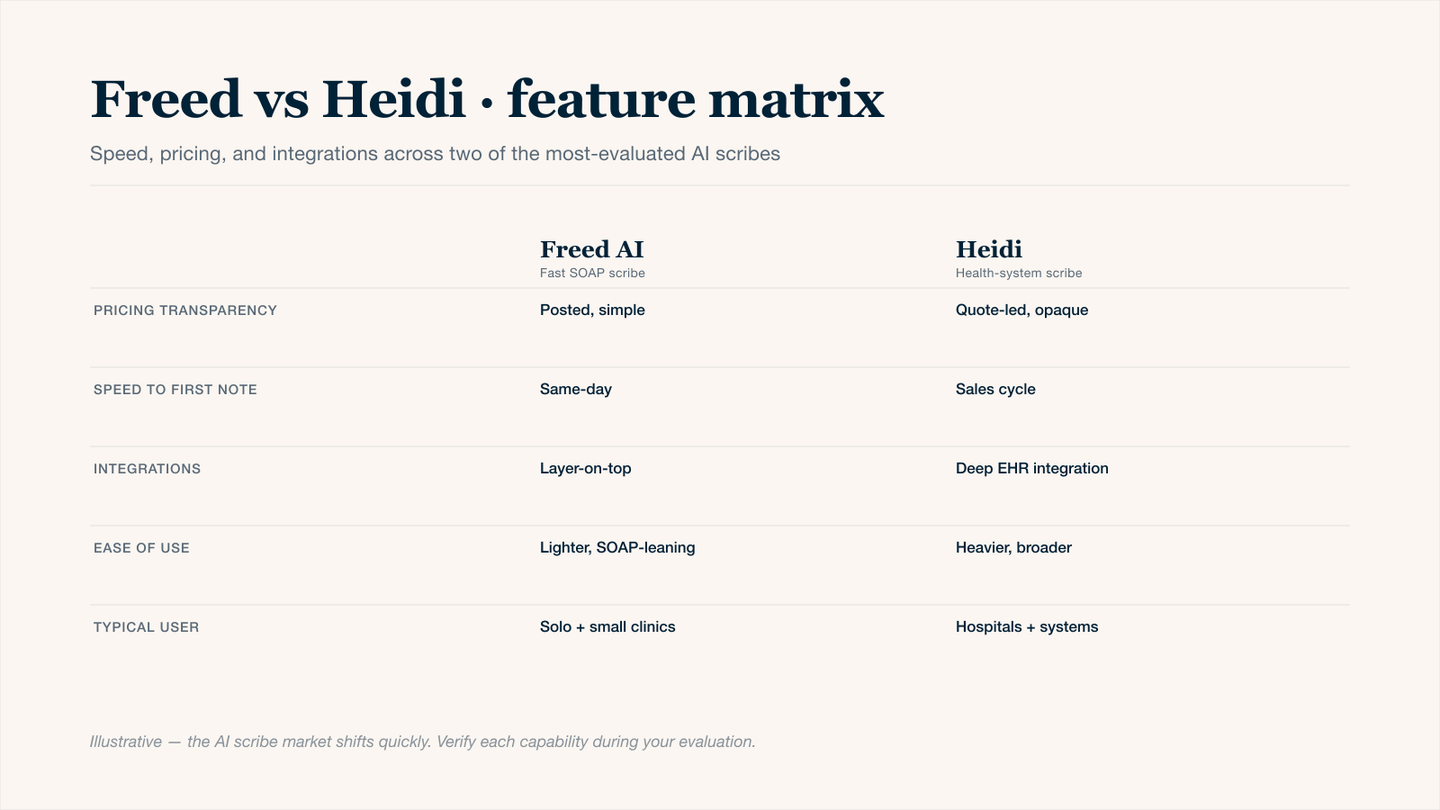
Freed vs Heidi — five dimensions medical teams actually evaluate.
Freed vs Heidi: Pros & Cons
Aspect | Freed AI | Heidi |
|---|---|---|
Pros | Simple to use and get started, attempts to adapt to individual writing styles. | Unlimited free tier (very basic features), advanced features like 'Ask Heidi', supports team collaboration |
Cons | EHR push only on Premier tier ($104/mo annual or $119/mo monthly); Starter is capped at 40 notes/month; no permanent free tier (7-day trial only) | New US Clinician tier at $150/user/mo sits at the higher end of the market; BAA gated to Practice/Enterprise; some advanced features (EHR integration, SSO) require Practice tier and above |
Freed Vs Heidi: Key Differences for Medical Professionals
Top AI Scribe Features
Feature | Freed AI | Heidi |
|---|---|---|
AI Note Generation | ||
Dictation | ||
Note Style Settings | Attempts to adapt to individual styles, but the process can be slow. | Allows customization through templates, after setup. |
Custom Note Format | Specialty templates from Starter; Premier adds the Instant Template Builder | |
Dedicated Mobile | ||
Fine-Tuned Model to Emulate Writing Style | Claims to learn over time, but effectiveness varies among users. | Based on our trial, relies on templates rather than adaptive learning, which may not capture personal writing nuances. |
Real-Time In-Consult Written Additions | ||
Unlimited Free Tier | No permanent free tier — 7-day free trial on every paid plan (Starter/Core/Premier) | Yes — Heidi Free is unlimited transcription with standard templates and 10 actions/month (US tier list post-Feb 2026 rebrand) |
Free-Text AI Prompt to Generate Any Document | Not available, limiting flexibility in document creation. | Yes, 'Ask Heidi' feature allows for more dynamic document generation. |
Create, Store, and Reuse Custom Templates | ||
Performance and Reliability | Unknown. | Unknown. |
Security and Privacy | Compliant with SOC2 and HIPAA standards. | Compliant with SOC2 and HIPAA standards. |
EHR Workflow Fit | Best for copy-paste workflows | Flexible formatting |
Onboarding Time | Quick to start | Longer setup due to templates |
Last verified May 2026
Pricing
Freed AI:
- 7-day Free Trial: Every Freed paid plan starts with a 7-day free trial (no credit card). The older "10 free notes" framing is obsolete — Freed restructured in 2026 to use a trial-and-tier model rather than a permanent free tier.
- Freed Plans (2026): Starter $39/mo (capped at 40 notes/mo), Core $79/mo (unlimited notes, monthly only), Premier $104/mo annual or $119/mo monthly (adds EHR push + ICD-10 coding). The old single $99/mo solo plan was retired in the 2026 restructure.
- Freed Groups: Custom pricing through sales; includes organization-wide BAA and centralised billing. The smaller-group tier (formerly $84/mo for 2–9 clinicians) was folded into Groups in the 2026 restructure.
Heidi:
- Free Tier: Unlimited consults and dictation, but with restricted features.
- Heidi Paid Plans (2026, US): Evidence Plus $40/user/mo (free Scribe + paid Evidence sources); Clinician $150/user/mo (the closest current equivalent to the legacy Pro plan); Practice (new version, custom-quoted); Enterprise (custom). The legacy Pro plan was renamed Scribe Plus and is now restricted to new UK/EU subscribers only.
- Heidi Practice Plan (2026 successor to Together): the new US Practice tier is custom-quoted via sales. The legacy Together plan was renamed Scribe Team and is now restricted to new UK/EU subscribers — US new subs see the new Practice tier instead.
Customer Support
- Freed AI: Offers clinician-centered support, but response times can vary.
- Heidi: Basic support in the free version; priority support in paid plans.
Accuracy
- Freed AI: Accuracy in transcription and note generation can be inconsistent, requiring manual corrections.
- Heidi: Aims for accurate transcription, but in our trial, needed user adjustments at times.
Automation
- Freed AI: Automates some processes but may not significantly reduce workload due to accuracy issues.
- Heidi: Automates documentation tasks after setup and customization.
Integrations
- Freed AI: Not mentioned.
- Heidi: Supports EHR integrations only in higher-priced plans, making it less accessible.
Ease of Use
- Freed AI: Interface more intuitive than Heidi's; learning curve can be less steep.
- Heidi: Requires time to customize and understand features; not immediately user-friendly.
Typical User Groups
- Freed AI: Suited for professionals willing to invest time for the AI to adapt to their style.
- Heidi: Better for larger teams that can allocate resources for setup and customization.
Ratings & Reviews
- Freed AI: Mixed reviews; users appreciate the concept but criticize performance inconsistencies.
- Heidi: Mixed reviews; positive sentiment.
Freed vs Heidi: Industry-Specific Use Cases
Freed
- Mental Health Therapists: May find adaptive learning beneficial, but could be hindered by initial inaccuracies. Freed does not offer templates common in the industry, such as BIRP, GIRP, DAP, and so on.
- Clinics & Healthcare Teams: Integration capabilities are useful but limited by compatibility issues.
Heidi
- Healthcare Teams: Collaboration features are advantageous but require substantial investment.
- Medical Practices: Custom templates offer flexibility but demand time for setup.
- Clinicians: Dictation features are helpful but may not offset the need for manual adjustments.
Freed vs Heidi vs Twofold: Why Twofold Might Be the Better Choice for You
While both Freed AI and Heidi offer innovative features in the realm of medical scribe technology, they may not fully meet the needs of all professionals due to performance issues, high costs, and complexity. Users have reported challenges with accuracy, user interface, and the need for extensive customization, which can hinder the seamless adoption of these platforms.
Twofold Health AI Scribe presents a compelling alternative that addresses these shortcomings:
- User-Friendly Interface: Designed with simplicity in mind, Twofold reduces the learning curve typically associated with new software. This allows medical professionals to integrate the medical scribe seamlessly into their daily routines without significant disruption.
- Reliable Performance: Twofold offers consistent accuracy in transcription and medical note generation, minimizing errors and the need for manual corrections. This reliability ensures that professionals can trust the software to produce quality documentation every time.
- Cost-Effective Solutions: With competitive pricing and a valuable free trial, Twofold makes advanced AI scribe technology accessible to practices of all sizes. This affordability does not compromise on features, providing excellent value for money.
- Advanced Automation: Twofold includes intelligent features that automate repetitive tasks, reducing the manual workload for clinicians. This automation leads to more efficient workflows and allows professionals to focus more on patient care rather than on documentation.
- Seamless Integration: Recognizing the importance of interoperability, Twofold offers seamless integration with a wide range of Electronic Health Record (EHR) systems and other healthcare software. This compatibility ensures that data flows smoothly between platforms, enhancing overall efficiency and reducing the potential for errors.
- Dedicated Support: Twofold provides responsive customer service to address user concerns promptly. This support includes onboarding assistance and ongoing technical help, ensuring that any issues are resolved quickly and do not impede daily operations.
By considering Twofold, medical professionals may find a more balanced medical scribe solution that addresses the shortcomings of both Freed AI and Heidi. The combination of user‑friendly design, reliable performance, cost‑effectiveness, advanced automation, and seamless integration makes Twofold a strong contender for practices seeking to enhance their documentation processes without the drawbacks encountered with other platforms.
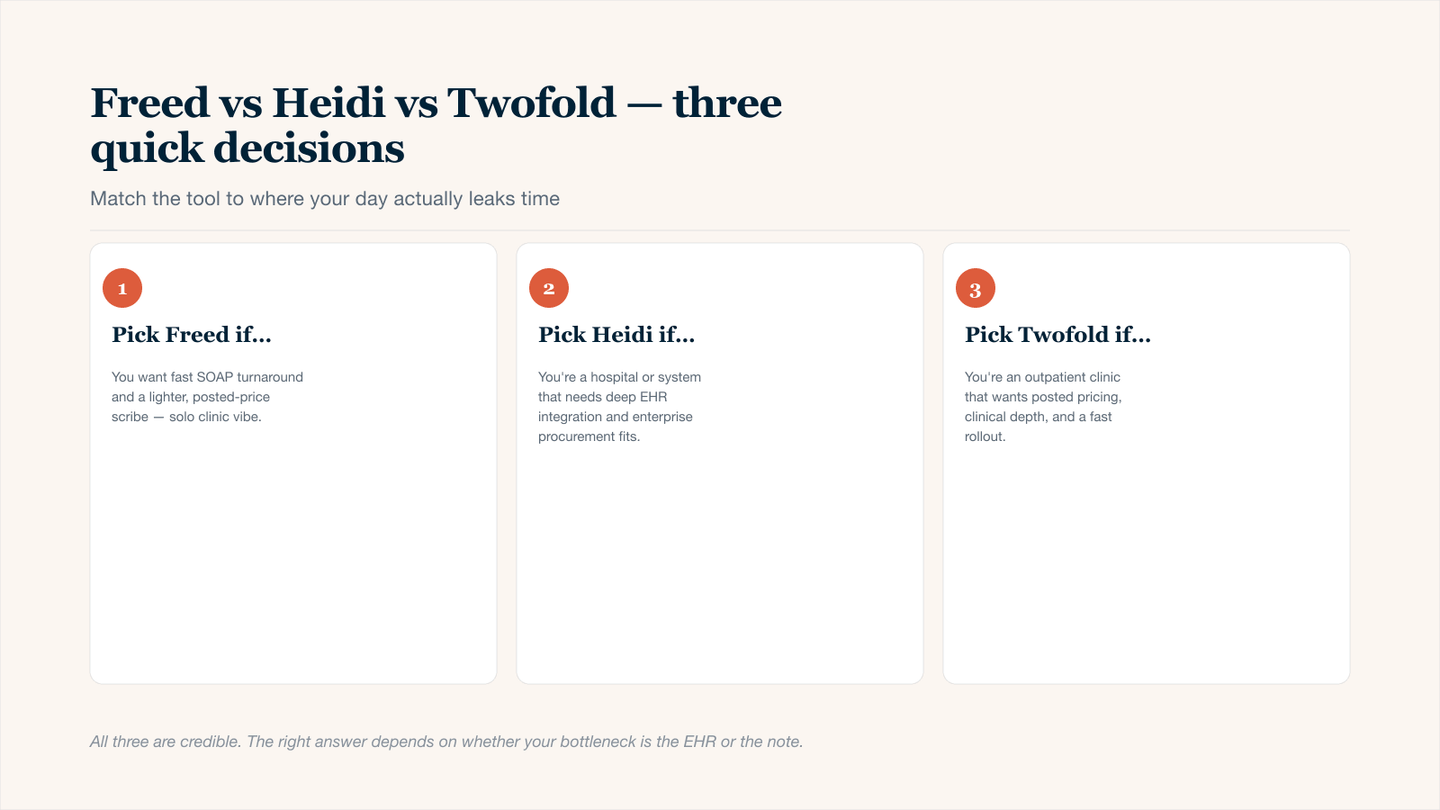
Freed vs Heidi vs Twofold — three decisions based on where your day actually leaks time.
Conclusion
Selecting the right AI medical scribe software is crucial for enhancing productivity and improving patient care. While Freed AI and Heidi offer several innovative features, they come with limitations that may not align with the expectations of all users. Performance inconsistencies, high pricing, and complexity are common concerns. Twofold Health AI Scribe emerges as a strong alternative, potentially offering a more reliable and cost‑effective solution. It addresses many of the issues found in Freed AI and Heidi, making it worth considering for professionals seeking an efficient and user‑friendly AI medical scribe.
Note: The information provided in this article is based on data available as of May 2026. Features and pricing are subject to change. Please consult the respective company websites for the most current information.
Disclaimer: This article is for informational purposes only and does not constitute legal or medical advice. Always consult professional guidelines and regulatory bodies for specific compliance requirements.
Thinking of Switching?
If you're weighing a change, these step‑by‑step guides help you switch cleanly — without losing notes, templates, or paying for a renewal you won't use: