



What is Suki AI?
Suki AI is a clinical assistant that captures the clinician‑patient conversation and generates a draft note. Beyond documentation, it supports voice‑enabled editing, problem‑based charting, clinical reasoning, and assisted revenue‑cycle management — and Suki publicly markets coverage across 100+ specialties and the four leading EHRs.
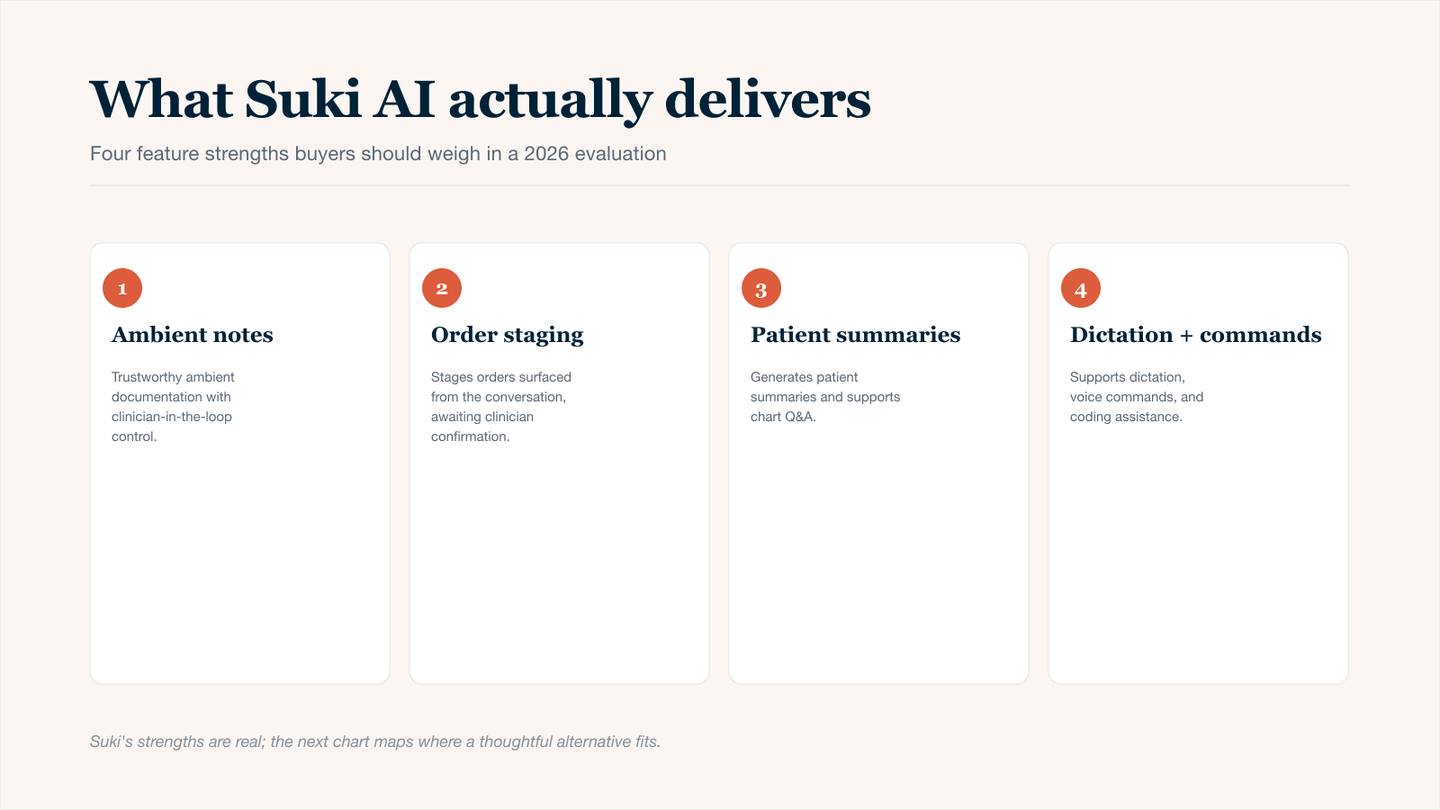
Four Suki AI feature strengths buyers consistently mention.
What’s new in 2024–2026 (at a glance)
- Patient Summarization & Clinical Q&A (Google Cloud): Suki added concise chart summaries and natural-language questions for clinicians, built on Vertex AI.
- Ambient Order Staging: Speak the plan; Suki structures, codes, and stages prescription orders for your approval in the EHR.
- Embedded with the four leading EHRs: Suki now publicly markets deep, real-time integrations with Epic, Oracle Health, athenahealth, and MEDITECH — billed on its homepage as "the most embedded ambient AI solution on the market." The MEDITECH Expanse path was a 2024-2025 first; the multi-EHR posture is the May 2026 message.
Funding note: Suki raised $70M (Series D) in October 2024 to expand these capabilities.
Feature Deep-Dive (what you actually use)
Ambient notes you can trust (but still control)
Suki drafts a structured note from the conversation that you can accept, reject, or edit before it touches the chart. The company emphasizes “clinician‑reviewed before EHR write‑back” and design choices to minimize hallucinations.
Order staging from the conversation
During the plan, clinicians can say medication names, sig, quantity, and refills; Suki stages those orders so they’re ready for review/sign‑off ‑ reducing clicks after the visit.
Patient summaries & chart Q&A
Ask for the last A1c, recent imaging, or medication gaps; Suki surfaces chart facts and a short patient summary to reduce cognitive load.
Dictation + commands, coding help
Traditional speech‑to‑text, smart commands, and assistance with ICD‑10/HCC coding are built into the same assistant.
Integrations & Deployment
- EHR connectivity: Suki highlights broad connectivity and has specific announcements for MEDITECH Expanse (documentation APIs), and athenahealth’s “choose-your-player” Ambient Notes (GA), allowing practices to run Suki within a standard UI.
- Footprint growth: Strategic partnerships have expanded distribution, including telehealth channels.
- Availability & support: Suki markets enterprise-grade rollout leadership and 24/7/365 availability.
Security, Privacy & Compliance
Suki’s trust materials cite HIPAA and SOC 2 Type II with encryption and access controls documented in its Trust Center. (As a reminder, HIPAA covers PHI handling; SOC 2 focuses on broader security controls.) Always review BAAs and data‑flow diagrams in your own contracting.
Pricing & Commercial Approach
Suki primarily sells via an enterprise motion (demo → contract). Public trade coverage has reported a list price around $399 per clinician per month, with discounting for resource‑constrained sites. Your terms will vary by EHR, scope, and support.
Where Suki Fits Best
Great fit: organizations that value embedded workflows and chart‑aware assistance, especially those standardizing on MEDITECH Expanse or adopting athenahealth Ambient Notes. Order staging and chart Q&A can reduce after‑visit clicks for high‑volume primary care and IM.
Potential friction: smaller clinics that want a “copy‑to‑EHR and go” setup with posted, low, individual pricing may find the enterprise contracting and governance heavier than needed. (See the alternative below.)
Conclusion
Suki AI pushes past “ambient scribe” into a fuller clinical assistant ‑combining real‑time capture, coding help, chart Q&A, and order staging. For teams that can leverage its integrations and governance model, the workflow depth is compelling. For clinicians prioritizing speed, simplicity, and transparent pricing, a lighter solution can deliver faster day‑one value.
Concern | Suki | Note |
|---|---|---|
Price transparency for small clinics | Enterprise quotes | |
Budget friendliness | Higher total cost | |
EHR integration depth | Epic/Oracle/athena/MEDITECH | |
A/P edit burden variability | ? | Specialty-dependent |
Data security posture | ? | HIPAA/SOC 2 |
Multilingual encounters | Broad language support | |
UI/layout customization | Config varies by org/EHR | |
Procurement/IT lift | Contracting + EHR build | |
Mobile and Device Access | Availible on iOS and Android mobile apps, in addition to desktop/web access. | |
Scalibility | Suitable for small clinics through large hospital networks. |
Last verified May 2026
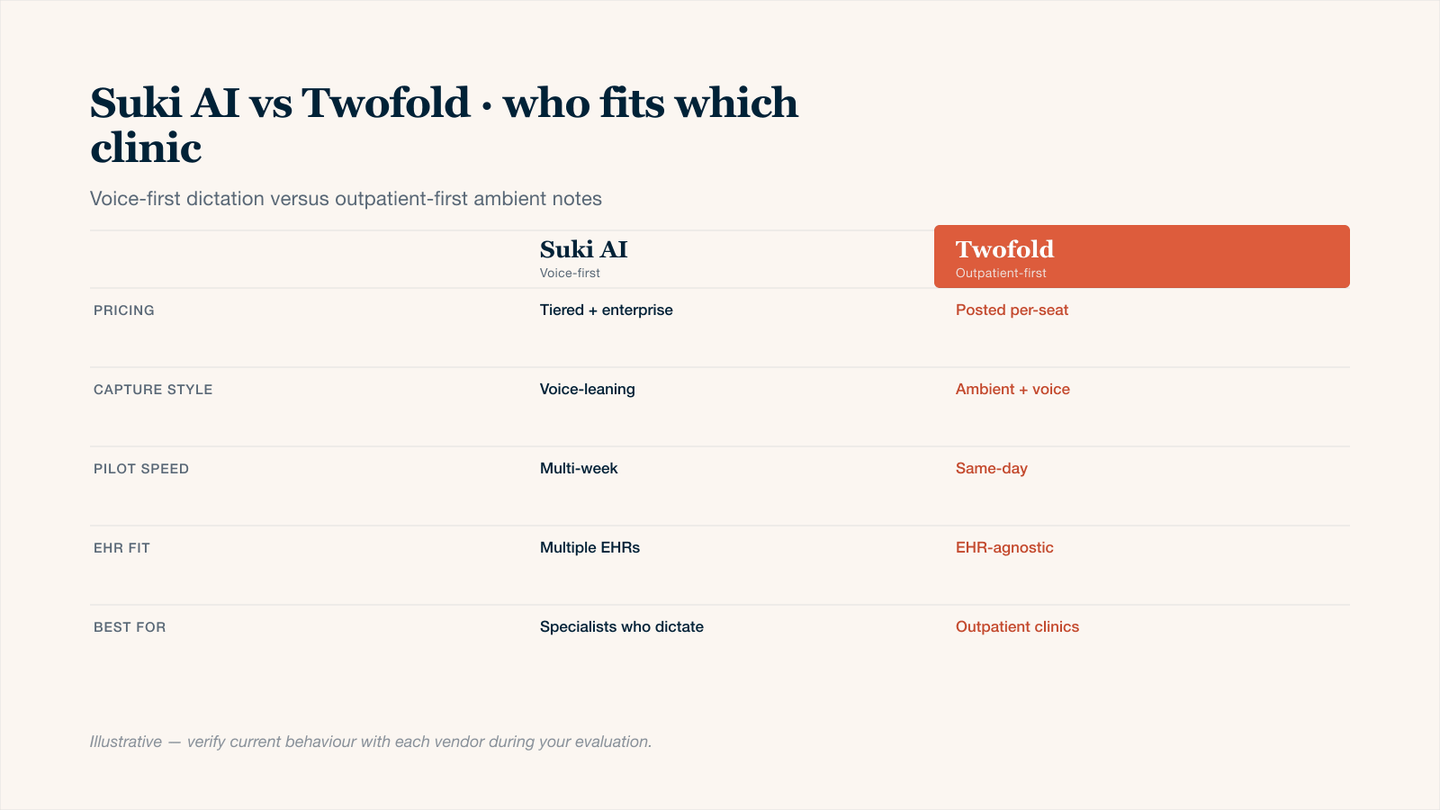
Suki AI vs Twofold — voice-first dictation versus outpatient-first ambient notes.
A thoughtful alternative: Twofold Health AI Scribe
If your priority is fast, accurate drafts with minimal friction and clear, individual pricing, Twofold Health AI Scribe is worth a look. It’s designed for small and medium‑sized practices that want simple export to the EHR, customizable templates, and transparent monthly plans without enterprise procurement. As of May 2026, Twofold also ships treatment plans, progress tracking, an AI assistant that answers progress questions across past notes, and 24/7 human support on every paid plan — features Suki's enterprise contract doesn't include at any tier.
Summary
Suki AI is a mature clinical assistant that blends ambient notes with chart‑aware tools and order staging, supported by expanding EHR pathways (e.g., MEDITECH APIs, athena Ambient Notes). It suits groups that can benefit from deeper, governed workflows. Clinicians seeking lightweight rollout and predictable individual pricing may lean toward a simpler AI scribe such as Twofold Health‑ the “right” choice depends on your mix of workflow depth vs. speed of adoption.
Note: The information provided in this article is based on data available as of May 2026. Features and pricing are subject to change. Please consult the respective company websites for the most current information.
Disclaimer: This article is for informational purposes only and does not constitute legal or medical advice. Always consult professional guidelines and regulatory bodies for specific compliance requirements. See also our best AI medical scribes for 2026.