



Mental health marketing carries unique ethical weight. Unlike selling products, you are inviting vulnerable people into a clinical relationship. This article provides an ethics‑first framework grounded in APA and ACA advertising rules. You will learn practical strategies that attract ideal clients without exploiting vulnerability.
What Makes Mental Health Marketing Different?
- Vulnerability of the Audience: Prospective clients are often in distress; marketing must avoid exploiting that vulnerability.
- Regulatory Oversight: Licensing boards and professional associations (APA, ACA, NASW) enforce advertising standards.
- Trust as Currency: Ethical marketing builds long-term credibility; unethical tactics may yield short-term gains but damage reputation.
- Key Principle: Marketing should inform, not persuade. It educates the public about available services rather than pressuring individuals into care.

The Ethical Foundation: APA and ACA Advertising Rules
Understanding your professional obligations is the first step. Below is a summary of key advertising principles.
Principle | APA Ethics Code | ACA Code of Ethics |
|---|---|---|
Accuracy | Claims must not be false, deceptive, or misleading. | Advertising must be accurate and not misleading. |
Testimonials | Do not solicit testimonials from current clients or others vulnerable to undue influence (Standard 5.05). | Do not solicit testimonials from current or former clients, or anyone vulnerable to undue influence (C.3.b). |
Scope of Practice | Represent competence only within the boundaries of training. | Advertise only within areas of competence. |
Confidentiality | Protect client identity in all marketing materials. | Maintain confidentiality in all public communications. |
Best Practice: Review your licensing board's specific advertising guidelines before launching any campaign.
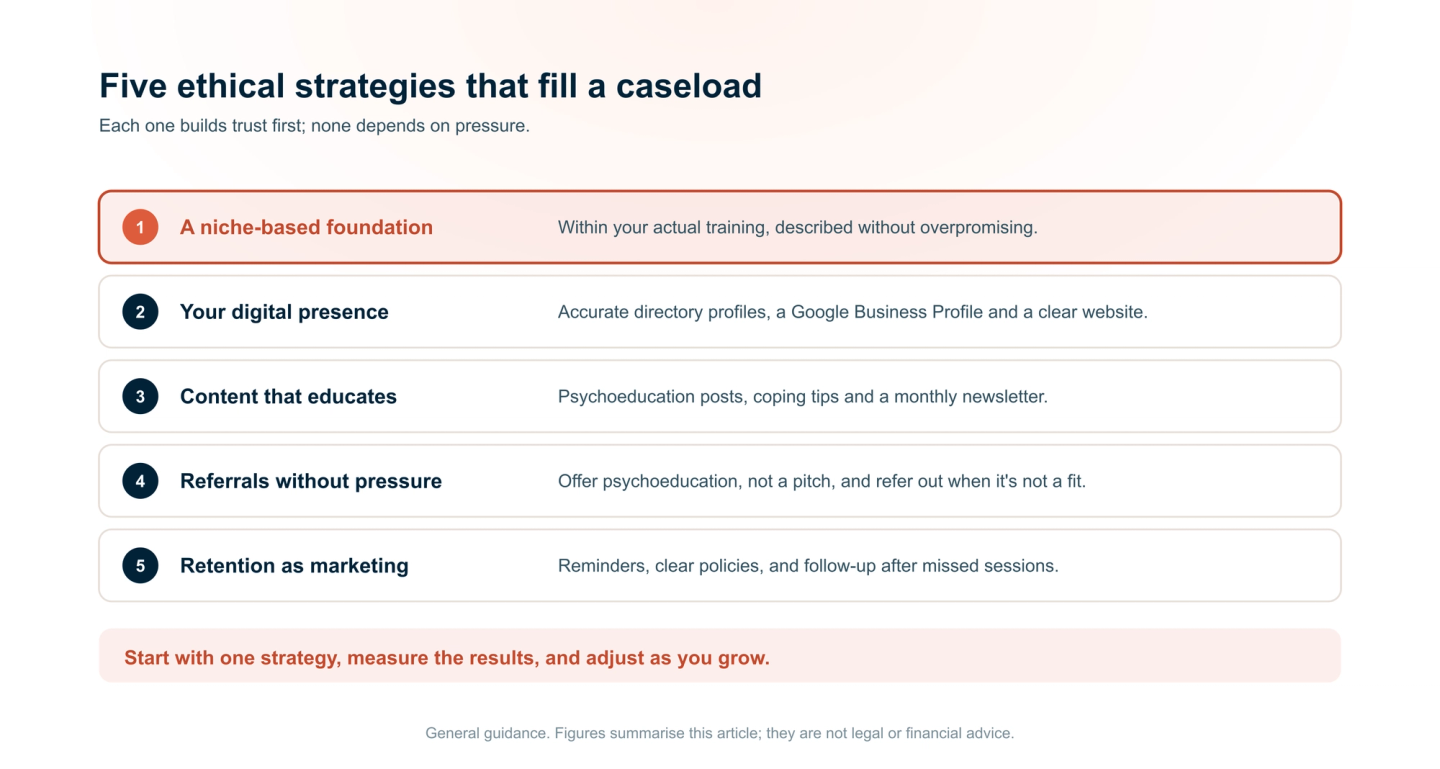
Ethical Strategy 1: Build a Niche-Based Foundation
Why It Works: A clear niche signals competence and helps ideal clients self‑identify.
How to Do It Ethically:
- Choose a niche within your actual training and experience.
- Avoid claiming expertise you do not possess.
- Use language that describes your approach, not guaranteed outcomes.
Example: "I specialize in helping adults navigate grief and loss using evidence-based approaches"
rather than "I guarantee you will feel better in 6 sessions."
Marketing Checklist
- Does this niche reflect my genuine competence?
- Can I describe my approach without overpromising?
- Does my marketing language avoid pathologizing or stigmatizing clients?
Ethical Strategy 2: Optimize Your Digital Presence
- Psychology Today & Directories: Complete profiles accurately. Use your niche keywords.
- Google Business Profile: Essential for local SEO. Keep it complete and accurate, but don't ask clients for reviews — asking for a review is soliciting a testimonial.
Website Essentials:
- Clear statement of services and fees.
- Informed consent and privacy policy.
- Accessibility features (alt text, readable fonts).
Ethical SEO vs. Unethical SEO
Ethical | Unethical |
|---|---|
Keyword-rich educational blog posts | Misleading clickbait headlines |
Accurate meta descriptions | Promises of cures or guaranteed outcomes |
Local citations with correct info | Fake reviews or inflated credentials |
Ethical Strategy 3: Content Marketing That Educates
- Psychoeducation Blogs: Write about topics within your niche.
- Social Media: Share mental health tips, coping strategies, and resource links. Avoid client stories, even de-identified, without explicit consent.
- Newsletter: A monthly email with practical tips keeps you top-of-mind with referral sources and past inquiries.
Ethical Strategy 4: Referral Networking Without Pressure
- Warm Referrals: Connect with physicians, schools, and community organizations. Offer to provide psychoeducation, not to "pitch" your practice.
- Reciprocity: Refer out when a client is not a good fit. This builds trust and strengthens your network.
- Documentation: Keep records of referral relationships and communications.
Ethical Strategy 5: Retention as Marketing
Why It Matters: Retaining clients reduces the need for constant new marketing. Satisfied clients will refer others.
Strategies:
- Automated appointment reminders to reduce no-shows.
- Clear cancellation policies.
- Consistent follow-up after missed sessions.
- Soliciting feedback (not testimonials) to improve services.
Red Flags: What to Avoid in Mental Health Marketing
- Guaranteed Outcomes: Never promise specific results.
- Client Testimonials: Avoid using current or former client testimonials.
- Before/After Narratives: Even de-identified, these can breach confidentiality.
- High-Pressure Sales: Avoid countdown timers, limited-time offers, or urgency tactics.
- Misrepresentation: Do not inflate credentials, experience, or scope of practice.
Conclusion
Ethical mental health marketing is both possible and necessary. By grounding your strategies in APA and ACA advertising rules, prioritizing education over persuasion, and building trust through transparency, you can fill your caseload without compromising your values. Marketing is not the opposite of ethics; it is an extension of your commitment to making care accessible. Start with one ethical strategy, measure your results, and adjust as you grow.