



Medical advertising operates under unique constraints that most industries never face. Strict regulations govern what you can claim, who you can target, and how you can track results. This guide helps clarify confusion by comparing advertising channels for medical practices, including real cost benchmarks by specialty and the compliance rules that govern healthcare marketing.
Advertising vs. Marketing: What's the Difference?
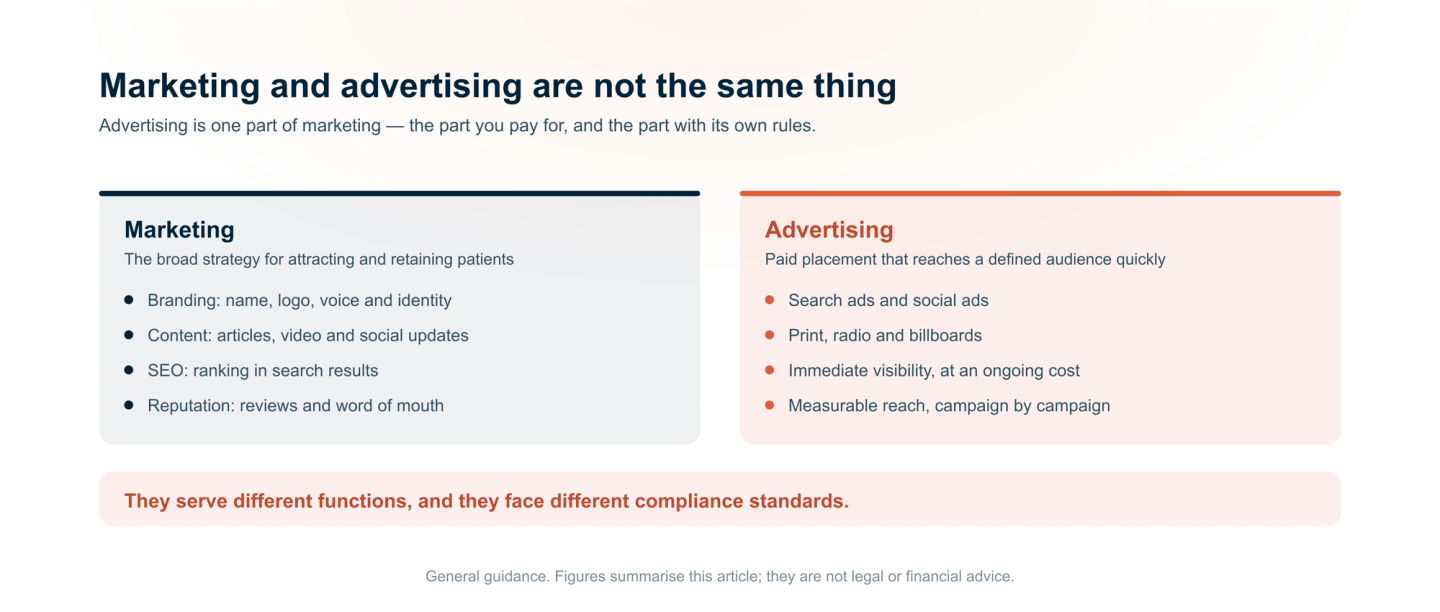
Before diving into channels and CPCs, it is essential to understand the distinction between marketing and advertising. While often used interchangeably, they serve different functions and face different compliance standards.
Marketing
Marketing is the broad strategy for attracting and retaining patients. It includes every checkpoint where potential patients interact with your practice.
- Branding: Your practice name, logo, voice, and visual identity.
- Content: Blog posts, educational videos, social media updates.
- SEO: Optimizing your website to rank in search results.
- Reputation: Online reviews, testimonials, and word-of-mouth.
Advertising
Advertising is a subdivision of marketing; it is paid placements designed to reach a defined audience quickly.
- Examples: Google Search Ads, Facebook/Instagram Ads, print ads, radio spots, billboards
- Characteristics: Immediate visibility, ongoing cost, measurable reach.
The Compliance Landscape: Rules You Must Know
Medical advertising is governed by a framework of regulations. Unlike other industries, healthcare marketers must navigate HIPAA marketing rules and medical board rules. Understanding these before launching a campaign prevents violations and protects your practice's reputation.
HIPAA and Ad Targeting
The Health Insurance Portability and Accountability Act (HIPAA) protects patient health information. When applied to advertising, it creates strict limits on how you can target audiences.
What Is Prohibited
- No use of Protected Health Information (PHI) in ad targeting, meaning you cannot upload patient lists to platforms like Facebook or Google.
- No sharing patient data with ad platforms: Even encrypted or hashed lists may violate HIPAA if derived from patient records.
Safe Targeting Practices
- Geographic Targeting: Target by city, zip code, or radius around your practice.
- Demographic Targeting: Age, gender, language (if not tied to health status).
- Interest-based Targeting: General wellness interests, not condition-specific.
- Contextual Targeting: Place ads on health-related content sites without tracking individuals.
FTC and Medical Board Rules
Beyond HIPAA and platform policies, medical advertising must comply with FTC guidelines and state medical board regulations.
FTC Guidelines
- No Misleading Claims: Avoid "best," "guaranteed," or unsubstantiated superlatives.
- Testimonials: Must be truthful, not misleading, and disclose typical results.
- Substantiation: All claims must be backed by evidence.
- Disclosure: Material connections (e.g., paid endorsements) must be disclosed.
State Medical Board Rules
- Varies by State: Some states restrict advertising of specific procedures or testimonials.
- Professional Conduct: Advertising must not be false, deceptive, or misleading.
- Specialty Claims: Must be board-certified in the specialty advertised.
- Best Practice: Have all ad copy reviewed by legal counsel or compliance staff.
Special Considerations for Behavioral Health
Addiction and mental health advertising faces additional regulations.
- Confidentiality: Avoid any implication that you know a viewer's health status.
- Crisis Language: Include appropriate disclaimers and crisis resources where required.

Advertising Channels Compared (by Specialty)
The table below outlines key channels with realistic costs by specialty for medical practices.
Specialty | Best Channels | Average CPC |
|---|---|---|
Primary Care | Google Search, Directories | $3–$8 |
Cardiology | Google Search, Referrals | $5–$15 |
Physical Therapy | Google Search, Local SEO | $5–$12 |
Psychiatry | Psychology Today, Google Search | $3–$8 |
Dentistry | Google Search, Facebook | $7–$18 |
Therapy/Counselling | Psychology Today, Directories | $3–$8 |
Key Takeaway: High‑competition specialties face higher CPCs and require larger budgets. Always prioritize compliance over reach.
Conclusion
Advertising your medical practice does not have to come at the cost of compliance. By understanding the rules governing HIPAA and FTC guidelines, you can promote your services ethically and effectively. The key is choosing the right channels for your specialty, budgeting realistically, and tracking results.