


Social media can be tricky for healthcare providers. On one hand, it is a very helpful tool for patient engagement, community building, and practice growth. On the other hand, the risk of violating the Health Insurance Portability and Accountability Act (HIPAA) can sway providers away from social media marketing entirely. This playbook provides the rules and three ready‑to‑use templates you need to market your practice safely and effectively without compromising patient privacy.
Understanding the HIPAA Privacy Rule
Before you can create a safe strategy, you must understand the principles of the HIPAA Privacy Rule. Essentially, HIPAA prohibits the sharing of "Protected Health Information" (PHI) without explicit patient consent.
What is PHI?
PHI is any information that can be used to identify a patient and relates to their physical or mental health condition. This includes:
- Names
- Dates (birth, admission, discharge)
- Contact information (address, phone number, email)
- Medical record numbers.
- Images or any other identifying characteristics.
The Safe Distinction: Education vs. Testimonials
The simplest way to stay compliant is to distinguish between two types of content:
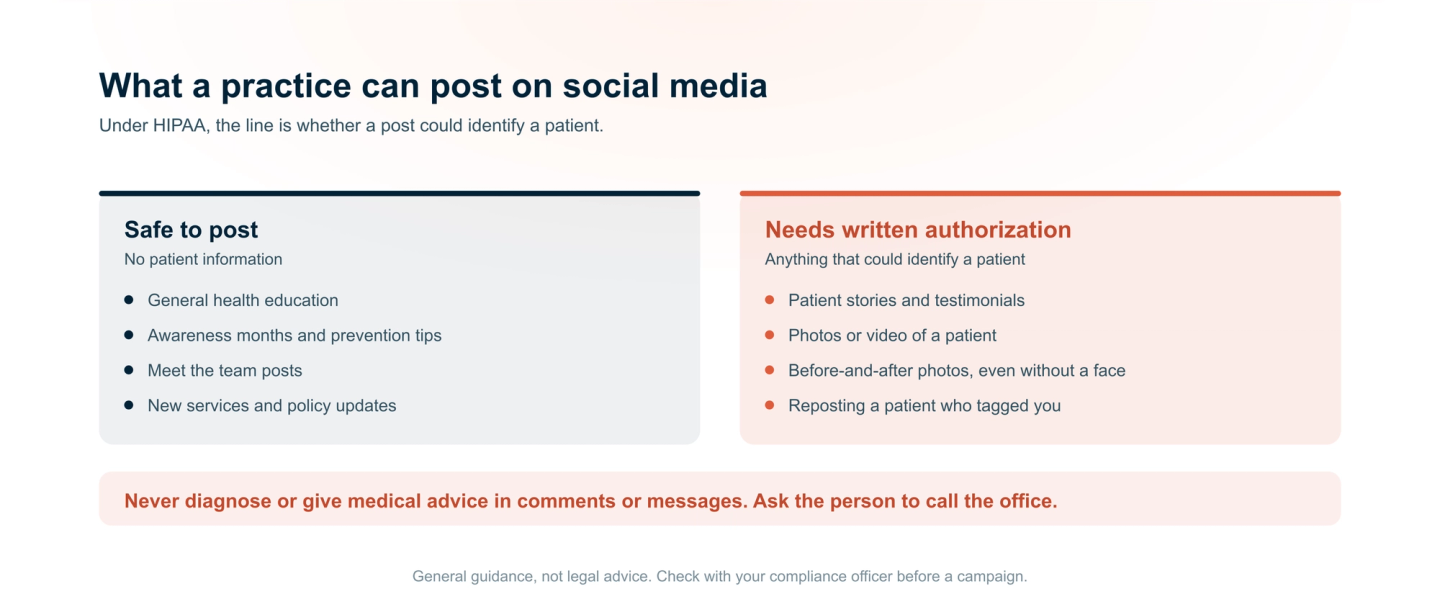
- Patient Education (Safe): Content that provides general health information and does not reference a specific patient is always safe. Examples include posts about flu prevention, healthy eating tips, or explaining a new procedure in general terms.
- Patient Testimonials (Risky): Sharing a patient's story, photo, or experience, even if you think it's anonymous, is very risky. Even a before-and-after photo without a face can be considered identifiable if other details (like a unique tattoo or a rare skin condition) are present.
3 Non-Negotiable Rules For HIPAA-Safe Content
Adhering to these three rules will create a strong foundation for your social media policy and protect your practice.
- Get Written Authorization: Never post a patient's story, photo, or video without a signed, specific HIPAA authorization form. The authorization must clearly state what information will be shared and on which platforms.
- No Identifiable Faces or Features: If you want to showcase a procedure or facility, use high-quality stock photos or crop images to remove any identifiable features. Focus on the technology, the team, or the general environment rather than a specific patient.
- Avoid the "Diagnosis" in the Comments: never provide specific medical advice in response to a comment or direct message.
- Answering a question like "Is this rash something to worry about?" with a diagnosis creates liability, and a reply that confirms the person is your patient can breach HIPAA. Instead, respond with general information: "We recommend consulting with a physician for proper evaluation. You can call our office to schedule an appointment."
The Playbook: Copy-and-Paste Templates for Your Practice
Here are three simple templates you can adapt to your practice's voice. They are designed to be engaging, informative, and HIPAA‑compliant.
Template 1: The "Health Awareness" Post (Facebook/Instagram)
Strategy: Educational content is always HIPAA‑safe. This post positions your practice as a trusted community resource.
Template:
Did you know that [insert health statistic]? This month is [Health Awareness Month]. At [Practice Name], we encourage you to prioritize your [Health Area] health. Regular check-ups are key to early detection. Schedule your appointment today. #HealthAwareness #[Specialty]Care #Prevention
Template 2: The "Meet the Team" Post (LinkedIn, Instagram)
Strategy: Humanize your practice by introducing your providers. This builds trust without revealing any patient information.
Template:
Meet Dr. [Name]. With over [number] years of experience in [Specialty], Dr. [Name] is passionate about helping patients achieve [Goal, e.g., heart health]. In their free time, they enjoy [Hobbies]. Book your consultation today to meet our dedicated team. #MeetTheTeam #[Specialty]Care #OurPractice
Template 3: The Policy Update Post (All Platforms)
Strategy: Inform patients about new services or policies while setting clear communication boundaries.
Template:
Important Update: We are now offering [New Service/Treatment]. This is a safe and effective way to manage [Condition]. Contact our front desk to see if this option is right for you. Please note: For your privacy and safety, we cannot diagnose or offer medical advice via social media comments or direct messages. Please call our office for all medical inquiries.
Conclusion
Staying within HIPAA on social media mostly takes common sense and caution. By focusing on general education, obtaining explicit written consent, and never offering individualized medical advice online, you can safely use social media to grow your practice and engage your community.