


Med spa growth depends on more than beautiful results. It requires a strategic blend of recurring revenue, compelling social proof, and strict legal compliance. Memberships stabilize income and improve patient lifetime value, while Instagram drives discovery and trust. This guide simply explains the membership‑model math, ethical Instagram tactics, and FTC compliance rules every med spa must follow.
The Financial Breakdown: Mastering the Membership Model
Transactional med spa revenue is unpredictable. A patient comes in for Botox, disappears for six months, then returns for filler. Memberships convert that sporadic behavior into predictable monthly revenue, higher lifetime value, and stronger patient retention.
The Revenue Math: Transactional vs. Membership
Metric | Transactional Patient | Membership Patient |
|---|---|---|
Average spend per visit | $250-$500 | Included in dues/ monthly credit |
Visits per year | 1-2 | 12 |
Retention rate | Low | High |
Annual Revenue | $500-$800 | $1,800 to $5,200 |
The contrast is clear: a membership patient can generate five to six times the annual revenue of a transactional patient, even before retail attachments. That predictability lets you forecast staffing, inventory, and marketing spend with confidence.
Designing Tiers That Patients Actually Use
Effective memberships work as access programs rather than discounts. Consider these structures:
- Entry Tier: One service per month (e.g., chemical peel or express facial) plus a 10% retail discount.
- Premium Tier: Higher-value treatments (e.g., laser or injectables), exclusive events, and guest passes.
Instagram Marketing: Visual Proof vs. Privacy
Instagram is where aesthetic patients discover providers, evaluate results, and decide whom to trust. It is also where med spas expose themselves to the greatest legal risk. Before/after photos are powerful marketing assets, but they are also protected health information when paired with identifying details.
The Consent Checklist
Before any patient image reaches your feed, confirm the following:
- Separate written authorization signed by the patient. A verbal "yes" is not enough.
- Specific language naming Instagram, your website, and paid ads as permitted channels.
- Explicit right to revoke consent at any time, with a defined opt-out process.
- No identifying details in the caption (no names, locations, or dates of birth).
- No misleading editing that alters the actual result or implies unrealistic outcomes.
Instagram Strategy That Reduces Risk
Prioritize educational reels. Explain how a treatment works rather than showcasing a single result.
- Feature Provider Authority: Introduce your injectors and nurses to build trust without patient images.
- Use Stories for Engagement: Polls, Q&As, and behind-the-scenes content drive DMs without publishing patient results.
- Archive Strategically: If a patient revokes consent, you must be able to remove the content from all channels, including saved Highlights.
Compliance: FTC Rules and Photo Consent
Compliance is the foundation of a sustainable practice. The Federal Trade Commission (FTC) regulates advertising for health and wellness services, and med spas are included. Every claim you make, whether in a caption, a testimonial, or a before/after photo, must be truthful, non‑misleading, and substantiated by scientific evidence.
The FTC Truth-in-Advertising Standard
- Substantiation: If you claim a treatment is "pain-free," "permanent," or "risk-free," you must have reliable evidence to support it.
- Typical Results: Testimonials and before/after photos must reflect what an average patient can expect, not an exceptional outlier.
- Disclosure: If a post is sponsored or a patient was compensated, that relationship must always be clearly disclosed.
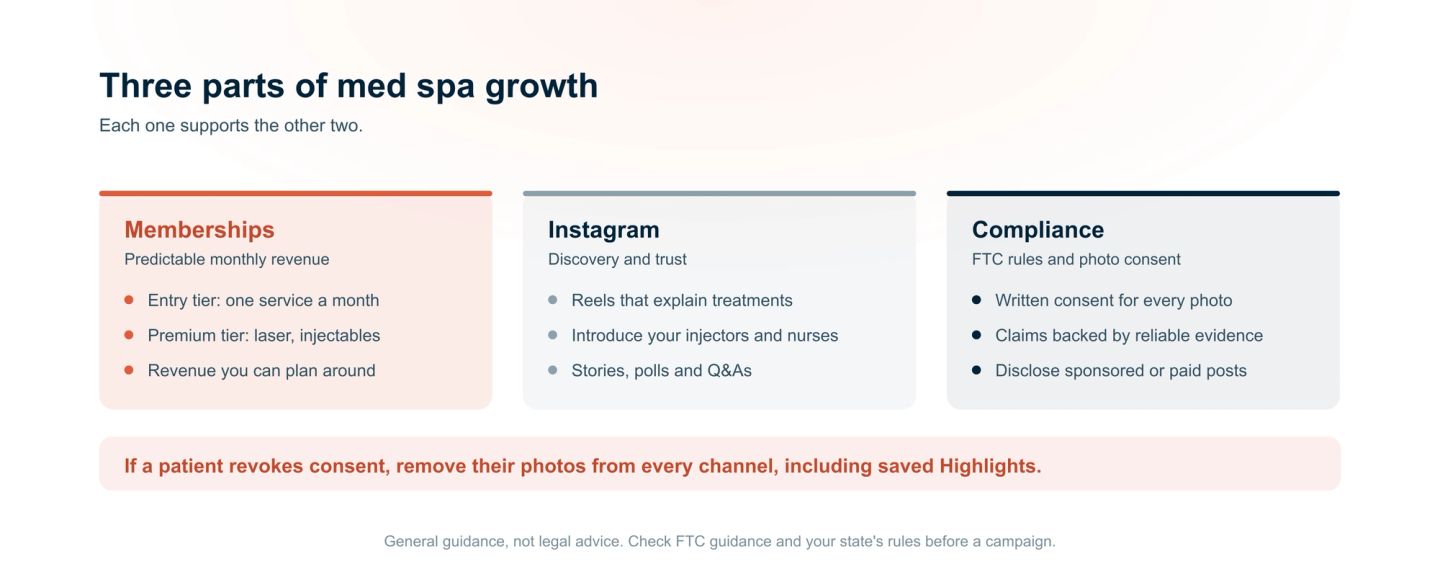
Memberships, Instagram, and compliance are not separate initiatives. They form a single growth engine. Instagram drives discovery, memberships convert that attention into predictable revenue, and compliance protects the entire operation from fines, lawsuits, and reputational damage.
Conclusion
Sustainable med spa growth rests on three pillars: memberships that stabilize revenue, Instagram strategies that build trust without violating privacy, and compliance with FTC and HIPAA rules that protect your practice. Together, these elements form a strong marketing engine. Prioritize documented consent, substantiated claims, and recurring revenue, and your practice will grow without unnecessary legal exposure.