


As healthcare transitions toward value‑based reimbursement, coding accuracy has never been more critical. Meanwhile, clinician burnout from excessive documentation fuels errors that cost practices millions annually. Artificial intelligence promises relief by automating clinical note creation and code suggestion. Yet, compliance officers remain apprehensive. Does AI's efficiency come at the cost of increased upcoding risk? This article examines how AI clinical note tools can improve coding precision while maintaining compliance standards and outlines the essential guidelines practices must implement to harness AI's benefits.
The Current State of Coding Inaccuracy
Coding errors remain surprisingly common across healthcare settings, and most are unintentional. Understanding the scope and root cause is the first step toward meaningful improvement.
Human Error
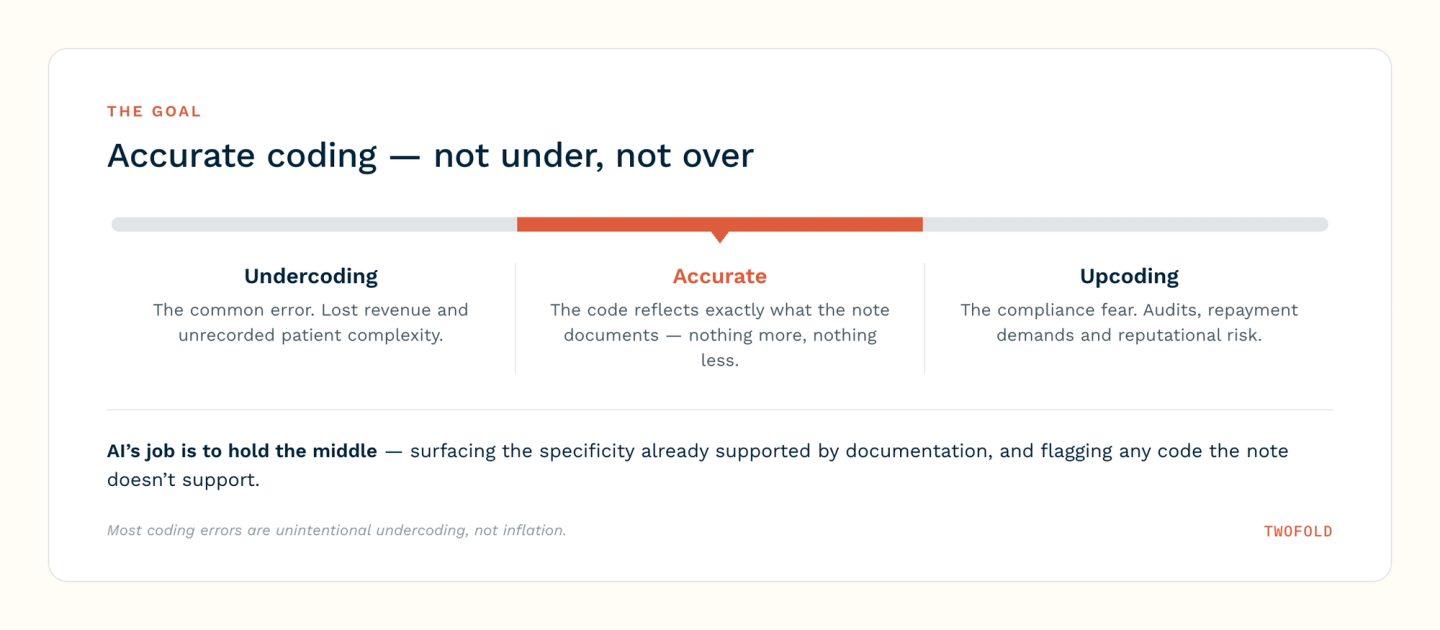
- The majority of these errors are undercoding (missing diagnoses, omitted modifiers, or failure to capture the full clinical picture) rather than intentional inflation.
- Coders can only code what is documented. When clinical notes lack detail, the default is a lower, safer code, resulting in lost revenue.
- These omissions are rarely due to coder incompetence; they stem from incomplete or rushed physician documentation.
The Cost of Inaccuracy
The financial and regulatory consequences of coding errors extend far beyond a single denied claim.
- Delayed payments disrupt cash flow and create billing backlogs that compound over time.
- Inconsistent documentation, where diagnoses, treatments, and plans don't align, triggers payer audits.
- Even unintentional errors can invite RAC (Recovery Audit Contractor) reviews.
- Defending against an audit is costly, time-consuming, and can result in repayment demands, fines, or reputational damage.
- In value-based care models, inaccurate coding distorts risk adjustment scores, affecting reimbursement.
How AI Improves Coding Accuracy
Artificial intelligence addresses the root causes of coding errors without altering the physician's workflow.
The Mechanism: Natural Language Processing (NLP)
- AI uses Natural Language Processing to interpret the clinical narrative, not just scan for keywords.
- It identifies relationships between symptoms, diagnoses, exams, and treatments to build a complete clinical picture.
- The technology converts unstructured physician dictation into structured, codable data without requiring physicians to change their documentation habits.
Suggesting Specificity
AI actively guides physicians toward more precise documentation by prompting for missing details.
- It flags omissions such as:
- Laterality (e.g., left vs. right knee).
- Chronicity (acute vs. chronic condition).
- Severity (mild, moderate, severe).
- Etiology (underlying cause or associated complications).
- These prompts appear as non-intrusive reminders, allowing physicians to add specificity in seconds.
- Capturing these details ensures the final code accurately reflects patient complexity, reducing both undercoding and overcoding.
Real-Time Guidance
Timing is critical. AI provides coding insights during documentation.
- It evaluates the documentation against Medical Decision Making (MDM) criteria and suggests appropriate Evaluation & Management (E/M) levels.
- If documentation supports a higher level of service, AI flags it so the physician can add supporting detail.
How to Use AI to Avoid Upcoding
AI is a compliance tool, not a risk, when implemented with the right safeguards.
The "Medical Necessity" Check
- AI serves as a real-time alert tool, flagging discrepancies before submission.
- AI compares proposed codes against documented detail and flags mismatches.
- This prevents unintentional upcoding and improves documentation awareness.
Human-in-the-Loop
- AI recommendations must be reviewed and verified by a qualified coder or clinician.
- Human oversight ensures clinical judgment applies to every case.
- This model transforms AI from a risk into a quality control mechanism.
Practical Guidelines for Implementation
Thoughtful governance ensures AI enhances accuracy without introducing new risks.
Set Specificity Rules
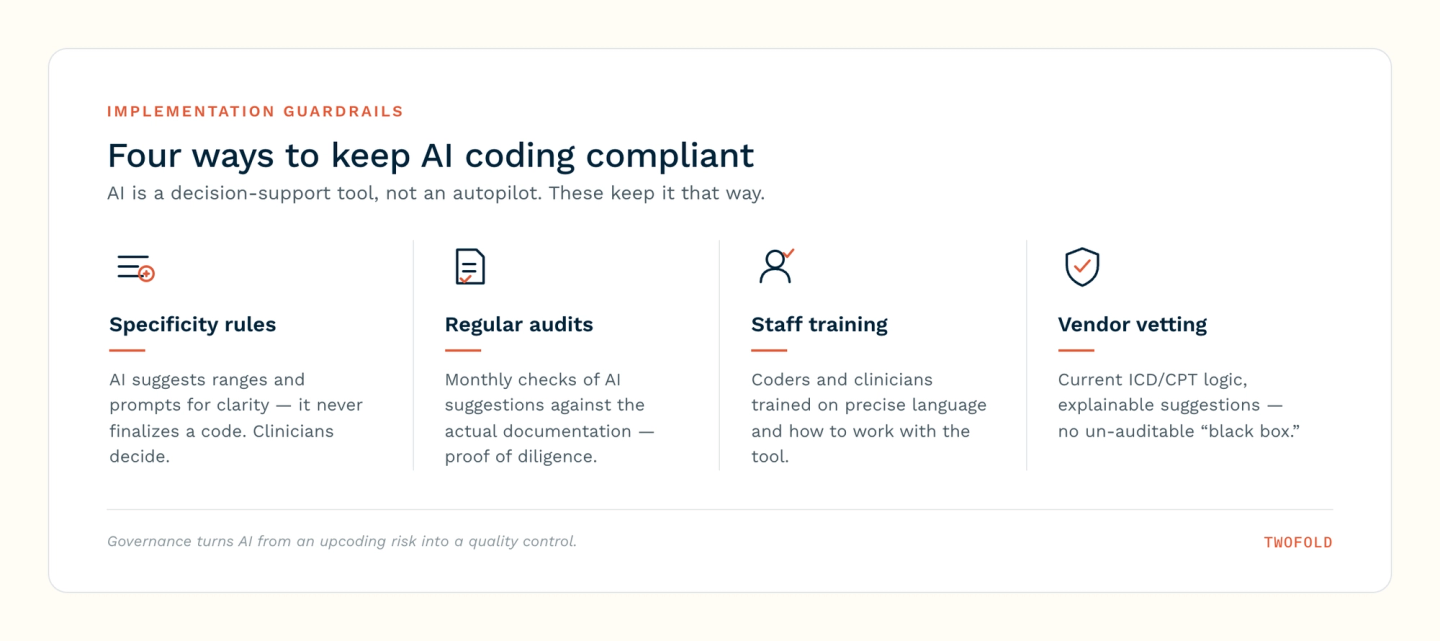
- AI should assist, not automate, final coding decisions.
- AI should only suggest ranges or prompt for clarification. This preserves clinical judgment and maintains accountability.
Regular AI Audits
- AI systems require ongoing oversight to remain accurate.
- Conduct monthly audits of AI suggestions against actual documentation.
- Regular audits demonstrate compliance diligence to regulators.
Staff Training
- Clinicians and coders must understand how to interact with AI effectively.
- Train staff on precise language.
- Provide ongoing education as guidelines and AI systems evolve.
- Informed staff use the tool more effectively and avoid unintended errors.
Vendor Vetting
- Ensure the vendor uses the latest ICD and CPT guidelines.
- Demand explainability; avoid "black box" systems that cannot be audited.
- Verify the vendor's process for updating coding logic as regulations change.
- Request references and inquire about audit experiences with the tool.
Conclusion
AI can improve coding accuracy without increasing upcoding risk, but only with intentional implementation. The technology reflects what clinicians document and flags inconsistencies. Success depends on clear governance: human oversight, transparent vendor partnerships, and ongoing education. When practices treat AI as a decision‑support tool, they can unlock its full potential. The result is fewer denials, seamless audit processes, and documentation that truly reflects patient complexity.