


We work on medical transcription and documentation every day at Twofold, and the most common — and most expensive — early mistake we see is treating clinical audio like any other audio. General speech‑to‑text is genuinely excellent technology. It's just trained for a different job, and it fails in precisely the places clinical documentation can least afford.
This guide explains where the two diverge, why it matters for patient safety and billing, and — most importantly — how to measure accuracy honestly for your own use case instead of trusting a vendor's demo reel.
The core difference: vocabulary and context
A general STT model is optimized for the language people use in everyday audio — meetings, videos, voice notes. A medical model is trained on clinical speech: drug names, dosages, anatomy, lab values, and the dense abbreviations clinicians actually say. That training does two things. It expands the vocabulary the model can recognize, and it gives the model the context to resolve clinical homophones — distinguishing 'ileum' from 'ilium,' or hearing 'metoprolol' instead of a phonetic guess.
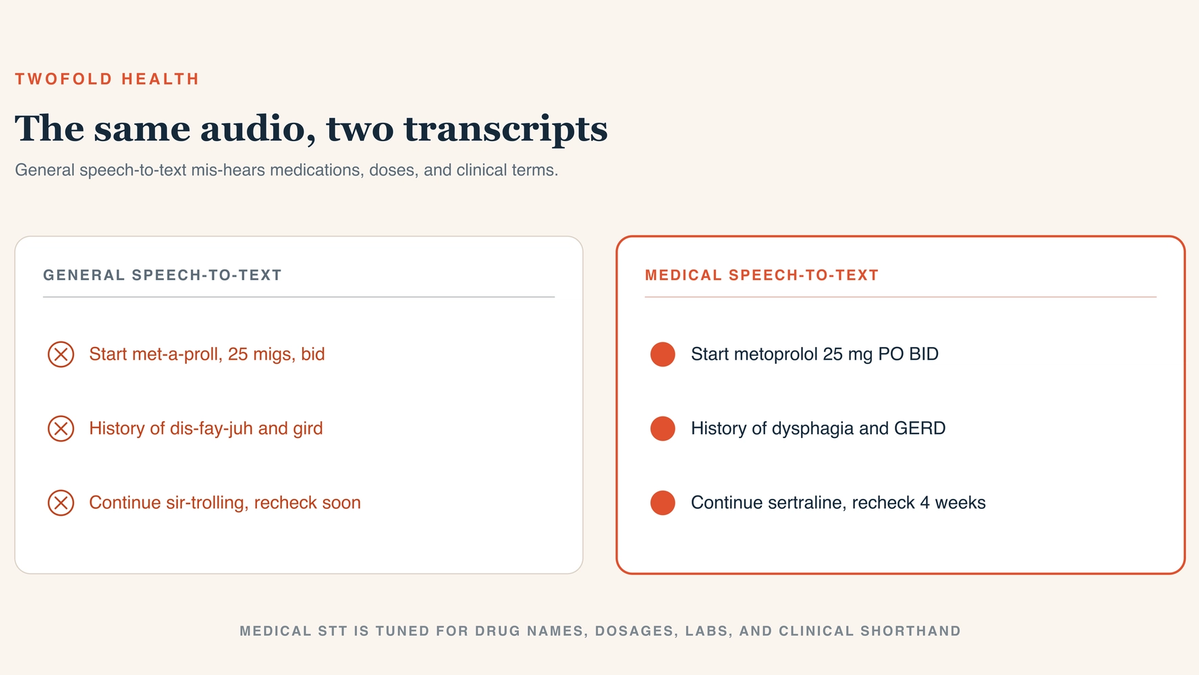
The hero illustration above makes the gap concrete: the same three sentences, transcribed by a general model and a medical model. The general model doesn't fail randomly — it fails on the medications, doses, and clinical terms that carry the most weight.
Where general STT breaks in clinical audio
Three patterns show up again and again when general models meet clinical speech:
- Medications and doses: 'metoprolol 25 mg PO BID' degrades into phonetic nonsense, and a wrong drug or dose is a safety issue.
- Clinical shorthand: abbreviations and units (PO, BID, mg, GERD) get expanded incorrectly or dropped.
- Specialty terms: uncommon anatomy and procedure names are replaced with common-language near-matches.
In a non‑clinical setting these are cosmetic errors. In a note that informs care or supports a claim, they're the difference between a usable record and a liability.
What to measure before you choose
Accuracy is only half the decision, and the published accuracy figure is the least trustworthy part. Score every vendor on the six dimensions below — and measure the first three yourself.

1. Word error rate (WER)
Measure WER on a sample of your own real encounters, not the vendor's curated benchmark. A number from someone else's audio tells you almost nothing about yours.
2. Medical-term accuracy
Track errors on drugs, doses, and labs specifically. A model can post a great overall WER while still botching the handful of words that actually matter — so weight those.
3. Real-world robustness
Test the conditions you'll actually see: accents, cross‑talk between clinician and patient, noisy rooms, and the audio compression that telehealth introduces. These degrade accuracy far more than vendors advertise.
4. PHI handling
Confirm encryption in transit and at rest, least‑privilege access controls, and audit logging across every component that touches audio or transcripts.
5. BAA coverage
Get a signed Business Associate Agreement, and confirm exactly which plans it applies to — some vendors gate the BAA to enterprise tiers.
6. Data retention
Pin down how long audio and transcripts are stored and whether your data is used to train the vendor's models. Get both in writing.
How to run your own benchmark
- Collect 20–50 representative encounters that reflect your real specialties, accents, and recording conditions.
- Create a ground-truth transcript for each — corrected by a human who knows the clinical terms.
- Run each shortlisted API and compute overall WER plus a separate error rate on medical terms.
- Re-run the same set whenever you change vendors or models, so comparisons stay honest over time.
A small, well‑chosen evaluation set is worth more than any vendor benchmark. It's also reusable: it becomes your regression test every time something in the pipeline changes.
When general STT is still the right call
Medical STT isn't always the answer. For non‑clinical audio — appointment scheduling, support lines, or a rough searchable index where the occasional misheard drug name carries no risk — a high‑quality general engine is cheaper and perfectly adequate. The mistake isn't using general STT; it's using it for the clinical note. Match the tool to the stakes of the text it produces.
Transcript, or note?
Once you've chosen medical‑grade transcription, there's one more fork. If your product stores a transcript, you're done — feed it into your own pipeline. If your product needs a finished clinical note and structured data, that's a layer on top of transcription, and our medical speech-to-text and documentation API is built to return it directly. Either way, measure on your own audio first — that single habit will save you more grief than any vendor comparison table.