


The stethoscope revolutionized diagnosis; AI clinical notes are revolutionizing documentation. Enter the Clinical Notes Operating System: a three‑stage framework where artificial intelligence transforms charting from a post‑visit setup into a proactive, intelligent workflow. Explore how integrating AI before, during, and after the visit can shift documentation into a clinical advantage.
Understanding AI Clinical Notes
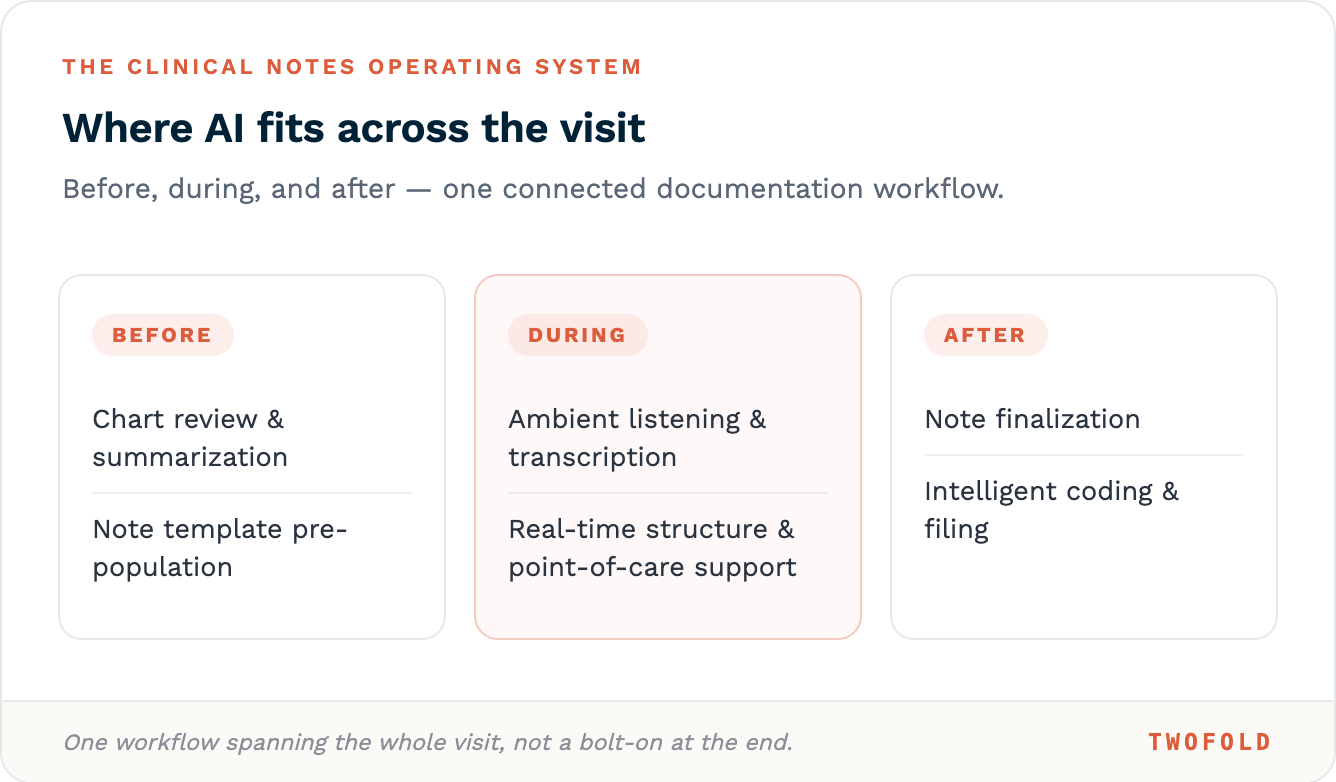
AI clinical notes are ambient, voice‑enabled, or text‑driven documentation tools that capture a patient encounter in real time, structure it into a medical note, and integrate it with the Electronic Health Record (EHR). Unlike traditional dictation or typing, AI‑powered note generation works in the background, listening, transcribing, summarizing, and even suggesting relevant diagnoses and billing codes. Therefore, the clinician stays focused on the patient.
See a 5-minute breakdown of how an AI scribe works for more in‑depth info.
Before the Visit: AI-Powered Preparation
By intelligently aggregating and analyzing EHR data, AI prepares the clinician for a focused, efficient visit.
Intelligent Chart Review and Summarization
Instead of spending 10–15 minutes combing through the chart, the clinician receives a concise, AI‑generated pre‑visit summary. The system pulls together data from past notes, lab results, imaging reports, specialist consults, and hospital discharge summaries.
Note Template Pre-Population
With the summary in hand, the AI builds a framework. The reason for the visit is filled in, the HPI template mirrors the known chronic conditions, and the medication list is pre‑reconciled where possible. The clinician walks into the room, and only the patient's story and physical exam remain to be added during the encounter.
During the Visit: AI as a Silent Partner
Once the clinician walks into the exam room with a pre‑populated note in hand, the AI becomes an invisible partner, capturing the conversation, extracting structured data, and delivering real‑time decision support, all while the clinician focuses entirely on the patient.
Ambient Listening and Real-Time Transcription
Ambient AI uses a secure microphone to capture the dialogue between the clinician and the patient. The system transcribes and analyzes the conversation, distinguishing between speakers and identifying medical terminology, social context, and emotional cues.
Structured Data Extraction and Point-of-Care Support
While capturing the conversation, the AI also pulls out data that feeds the note and decision‑making in real time.
How the AI Enriches The Note As The Visit Unfolds:
- Entity Recognition: Symptoms, medications, allergies, procedures, and social history elements are tagged with standardized codes (ICD-10, SNOMED) as they're mentioned.
- Real-time Order Link: When the clinician says, "Let's start you on lisonipril 10 mg," the AI logs it as a medication order, linking diagnosis and code, and pre-filling the medication table in the plan.
- Contextual Timeline: Duration and severity descriptions (e.g., "three weeks of worsening shortness of breath") are extracted and organized chronologically in the HPI, saving the clinician from manually arranging symptoms.
- Instant Physical Exam Capture: As the clinician speaks through findings, the AI populates the appropriate exam fields.
See more on how an AI scribe works during a visit.
After the Visit: AI-Driven Completion and Action
The moment the patient steps out, the AI tool transforms the captured data into a final, coded note and actionable insights for the care team.
Note Finalization and Intelligent Coding
Within 30 to 60 seconds of the visit's end, the clinician receives a draft of the entire SOAP note.
AI Post-Processing Checklist:
- Completeness Scan: The system checks for missing HPI elements, absent ROS review points, or a lacking link between diagnoses and orders, flagging any gaps gently.
- Coding Guidance: Based on the documented level of medical decision-making, the AI suggests the appropriate E/M code and ensures the note contains all the required bullet points to support it.
- Continuity of Care: The AI automatically pulls forward the problem list, updates chronic disease statuses, and flags any new diagnoses for addition.
- Signature-Ready: The clinician reviews the note, makes any quick edits (which the AI learns from over time), and signs.
The Integrated Benefits of a Clinical Notes OS
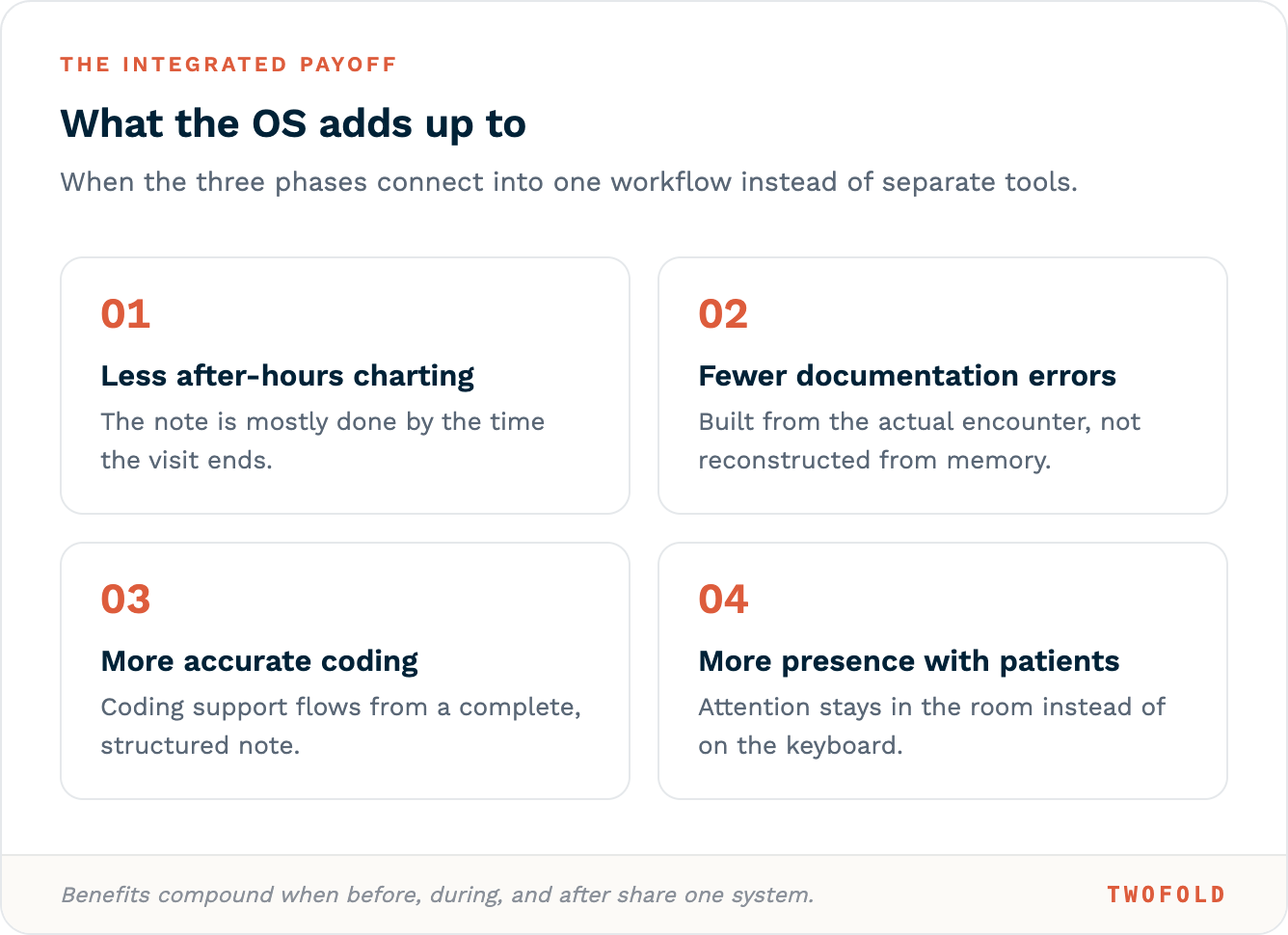
When the pre‑visit, during‑visit, and after‑visit stages work together, the AI clinical notes deliver benefits far greater than any single generic AI tool.
At a Glance:
- Pre-visit: AI summarizes the chart, surfaces care gaps, and pre-populates the note. The clinician enters the room informed and ready.
- During visit: Ambient AI captures the conversation and extracts structured data.
- Post-visit: A complete, coded draft appear in under a minute.
Conclusion
AI clinical notes redefine documentation by embedding AI before, during, and after every visit. Pre‑visit summaries and chart prep eliminate hours of review; ambient listening captures the encounter without a keyboard; and post‑visit AI instantly turns the conversation into a complete, coded note and a plain‑language patient summary. Together, these stages reclaim hours of documentation time and let clinicians focus fully on the person in front of them.