


Medical billing is the financial backbone of any practice, and often its greatest vulnerability. AI medical billing changes this equation. By automating eligibility checks, coding, claim scrubbing, and denial management, AI reduces errors, accelerates payments, and frees staff for higher‑value work. This article maps AI onto each step of the revenue cycle and provides a vendor‑neutral comparison with evaluation tips.
Understanding AI in Medical Billing
AI medical billing applies Machine Learning, Natural Language Processing (NLP), and Robotic Process Automation (RPA) to automate and optimize revenue cycle tasks.
How The Technology Powers AI Billing
- Natural Language Processing (NLP): Extracts structured data from unstructured clinical notes. It reads physician documentation and identifies diagnoses, procedures, and modifiers for accurate coding.
- Machine Learning (ML): Analyzes historical claims data to identify patterns. It predicts which claims are likely to be denied, flags high-risk accounts, and continuously improves accuracy over time.
- Robotic Process Automation (RPA): Automates repetitive tasks like claim submission, status checks, and payment posting. It works across systems without human intervention.
- Predictive Analytics: Scores claims before submission, prioritizing those with the highest denial risk for human review. It also forecasts cash flow based on payer behavior.
The Role of AI Medical Scribes
AI medical scribes capture clinical documentation during patient encounters, ensuring diagnoses and procedures are accurately recorded in real time. This documentation flows directly into the coding and billing process, reducing the gap between what happened in the exam room and what appears on the claim.
How AI Transforms Each Step of the Revenue Cycle
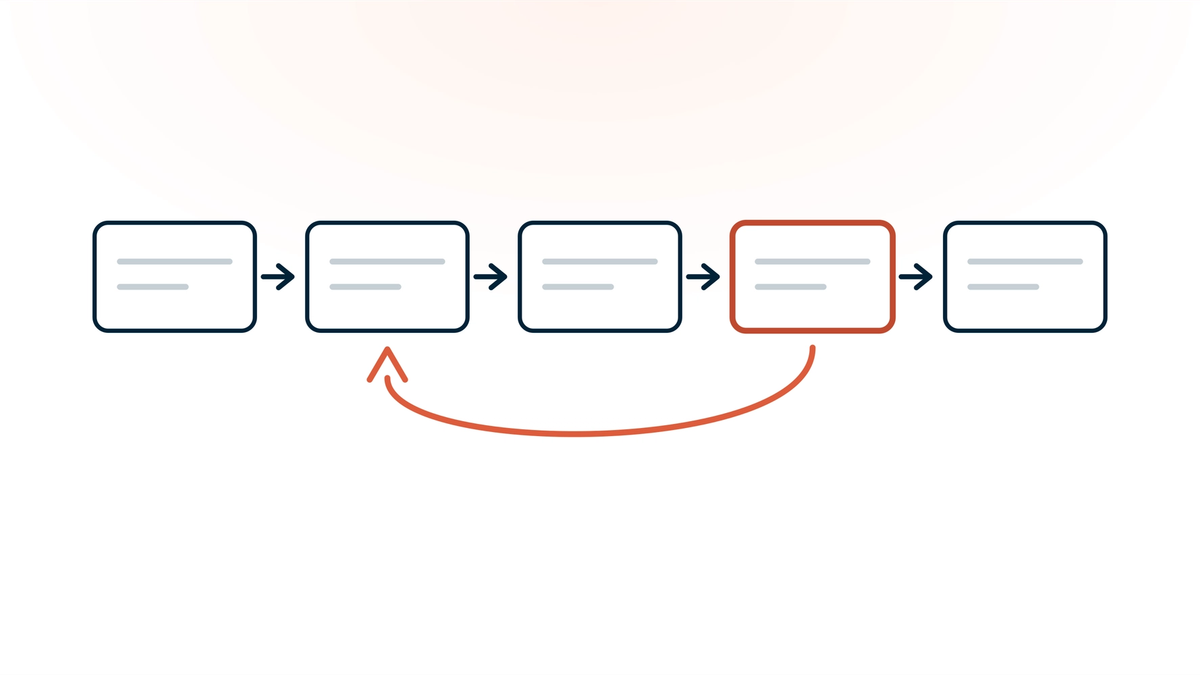
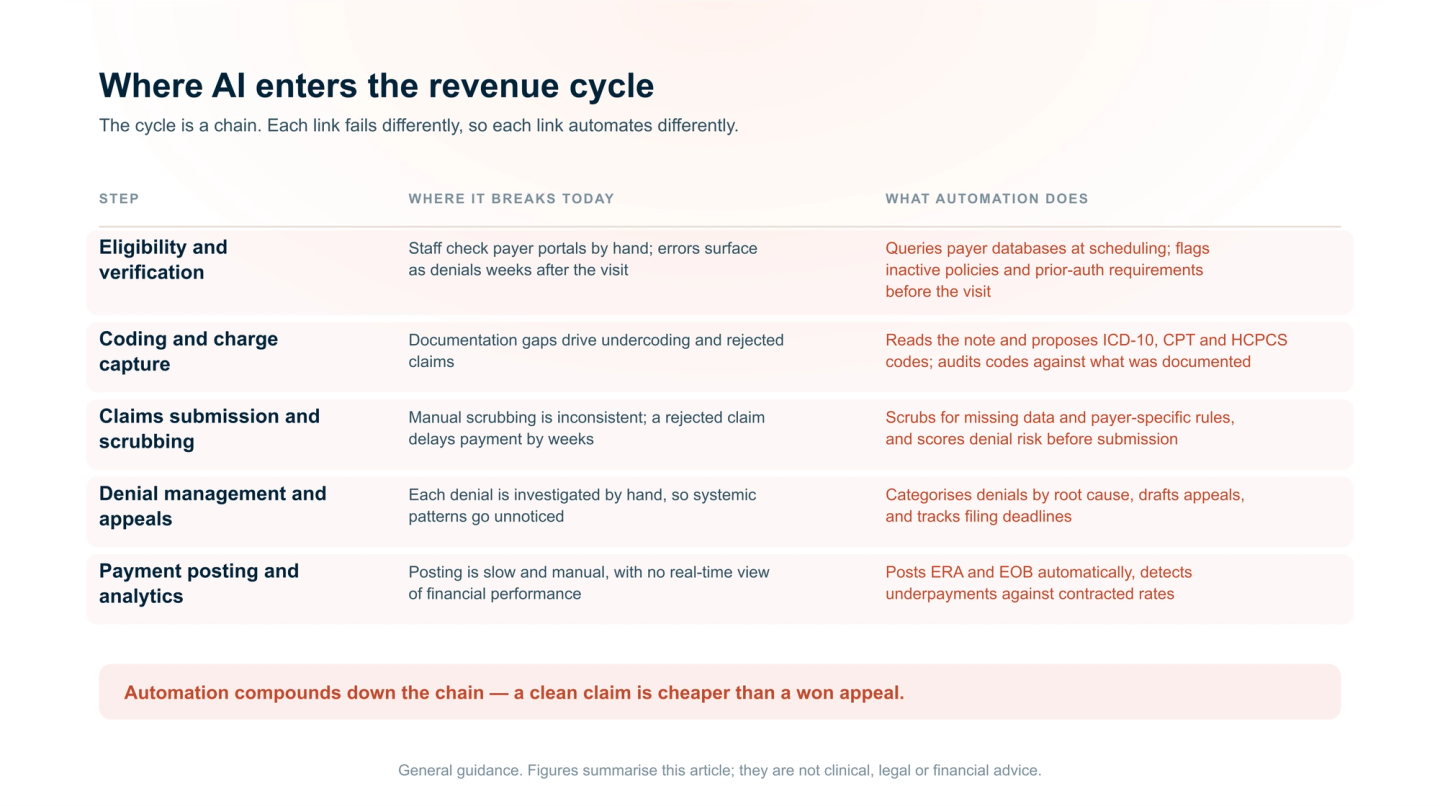
The revenue cycle is a chain. AI strengthens every step, from the moment a patient schedules to the final payment posting. Here is how automation maps onto each step.
Step 1: Patient Eligibility and Verification
The Problem: Manual eligibility checks take time. Staff navigate multiple payer portals, and errors can lead to denials weeks later.
The AI Solution:
- Real-Time Verification: AI queries payer databases instantly at scheduling or check-in.
- Benefits Breakdown: Automatically calculates patient responsibility, deductibles, and copays.
- Coverage Alerts: Flags inactive policies, prior authorization requirements, and network issues before the visit.
- Patient Communication: Sends automated reminders for outstanding balances or missing information.
- The Impact: Reduces eligibility-related denials and eliminates manual verification workload.
Step 2: Medical Coding and Charge Capture
The Problem: Coding errors account for 20-25% of claim denials. Human coders face burnout, and documentation gaps lead to undercoding or rejected claims.
The AI Solution:
- NLP-Powered Code Suggestions: AI reads clinical notes and recommends ICD-10, CPT, and HCPCS codes.
- AI Medical Scribe Integration: Documentation is captured at the point of care, ensuring accurate charge capture.
- Real-Time Audits: Flags inconsistencies between documentation and codes before submission.
- Modifier Recommendations: Suggests appropriate modifiers to maximize legitimate reimbursement.
Step 3: Claims Submission and Scrubbing
The Problem: Claims with errors are rejected or denied, delaying payment by weeks. Manual scrubbing is inconsistent and time‑consuming.
The AI Solution:
- Automated Claim Scrubbing: Identifies missing data, invalid codes, and payer-specific requirements before submission.
- Predictive Denial Scoring: Machine learning scores each claim for denial risk, prioritizing high-risk claims for human review.
- Payer-Specific Rules: AI learns each payer's quirks and adjusts claims accordingly.
Step 4: Denial Management and Appeals
The Problem: Denials require manual investigation. Appeals are time‑consuming, and teams often miss patterns.
The AI Solution:
- Root-Cause Categorization: AI classifies denials by reason: coding, eligibility, authorization, medical necessity.
- Automated Appeal Letters: Generates appeals with supporting documentation and payer-specific language.
- Pattern Recognition: Identifies systemic issues (e.g., a specific payer consistently denying a procedure) and recommends corrective action.
- Deadline Tracking: Ensures appeals are filed within payer time limits.
Step 5: Payment Posting and Analytics
The Problem: Manual payment posting is slow and error‑prone. Practices lack real‑time visibility into financial performance.
The AI Solution:
- Automated ERA/EOB Posting: Matches payments to claims and flags discrepancies instantly.
- Underpayment Detection: Identifies when payers reimburse less than contracted rates.
- Real-Time Dashboards: Tracks KPIs including days in A/R, denial rate, and net collection rate.
- Cash Flow Forecasting: Predicts future revenue based on payer behavior and historical trends.
Vendor-Neutral Tool Comparison
No single AI billing solution fits every practice. The right choice depends on your specialty, EHR, practice size, and existing workflow. This section provides a vendor‑neutral framework for evaluating options.
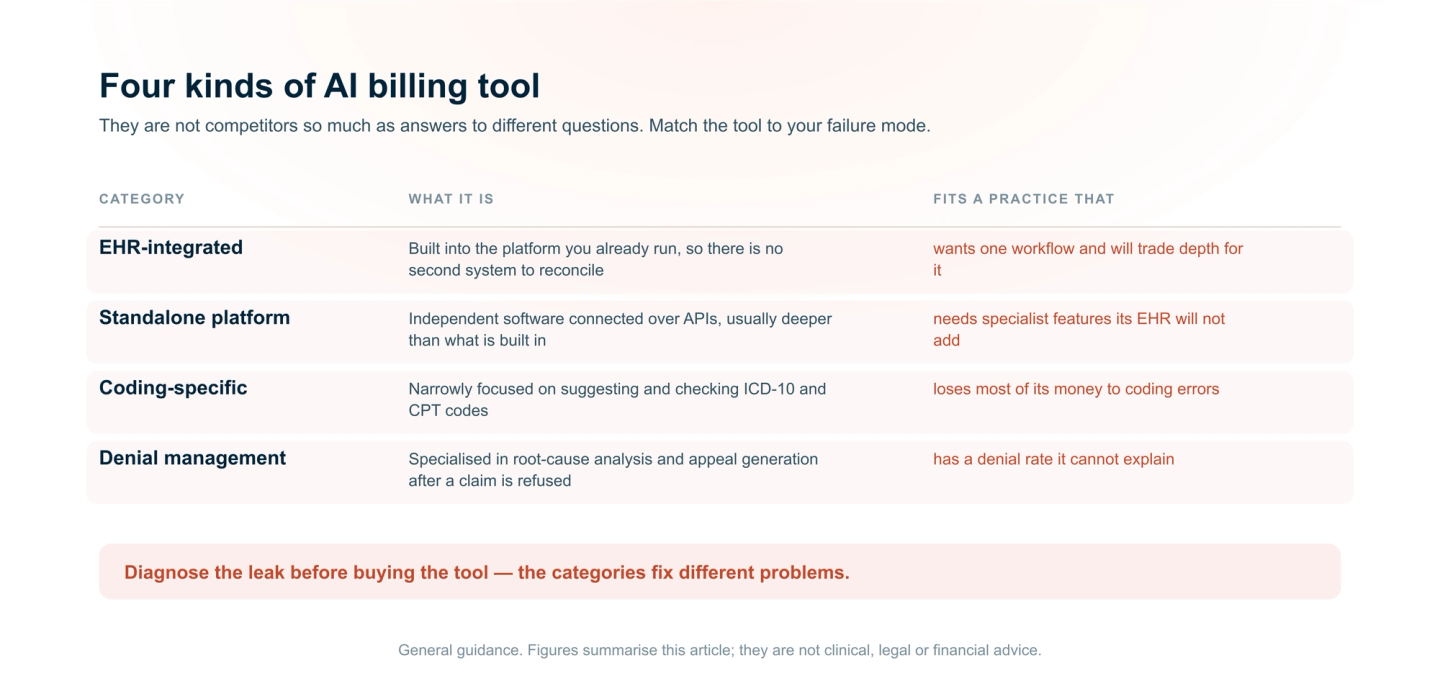
Categories of AI Billing Tools
Category | Description | Best For |
|---|---|---|
EHR-Integrated AI | Built into existing platforms (Epic, Cerner, Athenahealth). | Practices wanting seamless workflow. |
Standalone AI Billing Platforms | Independent solutions that connect via APIs. | Practices needing specialized features. |
Coding-Specific AI | Focused on ICD-10/CPT code suggestions | Practices with high coding error rates |
Denial Management AI | Specialized in appeals and root-cause analysis | Practices with high denial rates |
Key Evaluation Criteria
When comparing vendors, assess each against these specifics:
- EHR Integration: Native integration is preferred.
- Specialty Fit: Some tools excel in primary care; others in surgical, behavioral health, or radiology.
- Pricing Model: Per-claim, per-provider, or flat monthly fees. Calculate total cost of ownership.
- Implementation Time: Ranges from days (EHR-native) to months.
- Scalability: Can the tool grow with your practice without proportional cost increases?
- Compliance: BAA availability, SOC 2 certification, encryption standards.
- Support: Dedicated account management, training resources, uptime guarantees.
Conclusion
From real‑time eligibility verification to automated denial management, AI reduces errors, accelerates cash flow, and frees staff for higher‑value work. The evidence is clear: practices that adopt AI‑driven billing outperform competitors on both financial and operational metrics. With denial rates falling and clean claim rates rising, the return on investment is measurable within months. The question is not whether to implement AI billing, but how quickly you can start.