


For a solo California LMFT already on SimplePractice with about $50 to spend, we would start with Twofold if annual billing is workable: it is $49 a month billed annually, or $69 billed monthly ($19 for the first month on the monthly plan), with unlimited notes, couples and family templates, treatment plans, and copy‑and‑paste into SimplePractice. We make Twofold, so weigh our view accordingly; Upheal AI Notes is the cheaper strong alternative at $39/month flat, while SimplePractice Note Taker is $35/month on top of your SimplePractice plan and is the better pick if staying inside one system matters most. Mentalyc's under‑$50 solo plans are capped and individual‑adult only, so an LMFT doing couples or family work would need Pro at $69.99 monthly or $59.99/month annual, checked November 13, 2026.
The short version for a $50 SimplePractice budget
The $50 constraint leaves three realistic choices: Twofold on annual billing, SimplePractice Note Taker, and Upheal AI Notes. Mentalyc is worth knowing about, but its solo plan that supports couples and family sits above the budget.
- Pick Twofold if you want unlimited notes, couples and family templates, treatment plans, CPT and ICD-10 code suggestions for clinician review, a signed BAA, no stored audio, and a straightforward copy-and-paste workflow into SimplePractice. Twofold works alongside SimplePractice rather than inside it, and you can read more about that workflow in our SimplePractice scribe guide.
- Pick SimplePractice Note Taker if your first priority is staying in one system. SimplePractice's pricing page lists the add-on at $35/month on top of an active SimplePractice subscription, checked November 13, 2026.
- Pick Upheal AI Notes if you want a $39/month flat standalone tool with unlimited AI notes and a Chrome extension that can fill SimplePractice SOAP and DAP templates, based on Upheal's help article checked November 13, 2026.
- Be cautious with Mentalyc under $50 if you see couples, children, teens or families. Mentalyc's Mini and Basic plans are individual-adult only, and the first solo plan with couple, child/teen and family clients is Pro.
Cost on top of your SimplePractice subscription
The added cost ranges from $35 to $69.99 a month, depending on annual billing and whether couples and family sessions are included. Competitor prices and plan limits in this section were checked November 13, 2026, and prices change, so verify the vendor page before you switch.
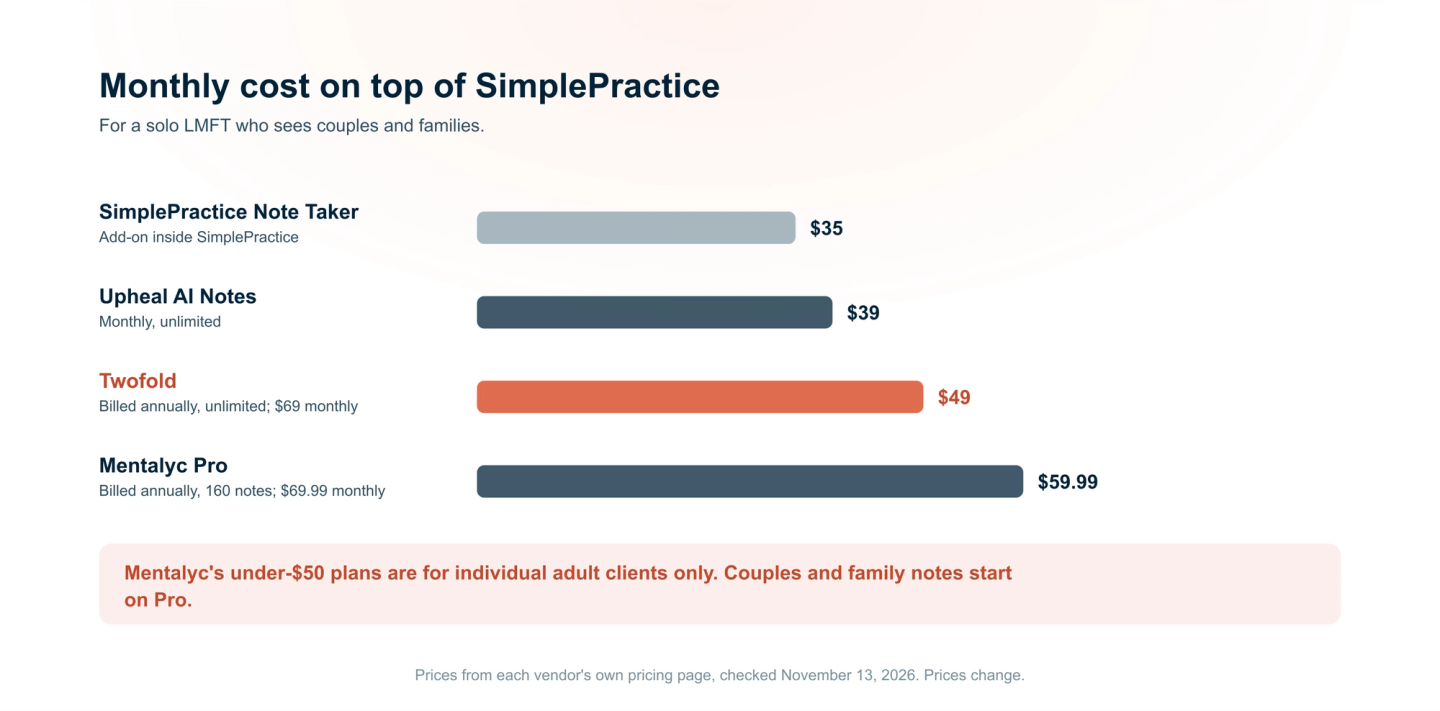
For rough note‑cap math, multiply weekly sessions by 52 and divide by 12: 15 a week is about 65 notes a month, 25 is about 108, and 35 is about 152. That matters because a 100‑note cap can feel fine in a lighter month and tight during a full caseload month with intakes, collateral contacts or make‑up sessions.
Tool and plan | Added cost | Note limit | Couples, family and plans | SimplePractice handoff |
|---|---|---|---|---|
SimplePractice Note Taker | $35/mo add-on | No cap published | Couples yes; family unclear; plans in Care Aide | Inside SimplePractice |
Twofold individual | $49/mo billed annually; $69 monthly | Unlimited | Yes; plans included | Copy and paste |
Upheal AI Notes | $39/mo flat | Unlimited | Yes; plans included | Smart Fill or paste |
Mentalyc Basic | $39.99 monthly; $29.99/mo annual | 100/mo | No; plans included | Extension, 20/mo |
Mentalyc Pro | $69.99 monthly; $59.99/mo annual | 160/mo | Yes; plans included | Extension, unlimited |
SimplePractice's pricing page does not publish a Note Taker cap, so we would not treat unlimited use as confirmed. Its Care Aide bundle includes Note Taker plus Session Sidekick, Treatment Planner Beta and Client Summaries, but SimplePractice lists that bundle at $59/month for the account owner.
If the budget is a hard $50 with no annual payment, Upheal is the clearest standalone live‑capture option in this group. If annual billing is fine, Twofold's $49 a month billed annually price fits the budget and avoids note caps, which helps when a couples note takes more editing than a routine individual follow‑up.
Why couples and family support changes the choice
For an LMFT, couples and family support is a fit issue because relational notes have more clinical risk than single‑client notes. The draft has to track more than one voice, identify who the client is, and document the relational intervention rather than turning the session into an individual progress note with extra names.
Twofold includes a couples therapy progress note template and a family therapy note template, along with custom templates if your practice uses a particular structure. It also includes intakes, biopsychosocial assessments, treatment plans, EMDR, play therapy, collateral contact summaries, and other formats in the same paid plan.
Upheal's AI Notes plan lists individuals, couples and families, so it belongs on the shortlist for this reader. Mentalyc can support couple, child/teen and family clients on Pro and above; Mentalyc's FAQ says couples and family sessions get one shared note, with quotes attributed to each person.
SimplePractice's Note Taker FAQs say it works with couple and group appointments. The FAQ does not publish the same clear family‑session statement, so if you want to stay inside SimplePractice, test it on one couples session and one family‑style clinical scenario before relying on it for that part of your practice.
California consent and BBS record-keeping checks before you record
In California, get written consent from every party before recording a confidential therapy session. California Penal Code section 632(a) prohibits recording a confidential communication without the consent of all parties, so a recorded couples or family session needs consent from everyone whose confidential communication is being captured.
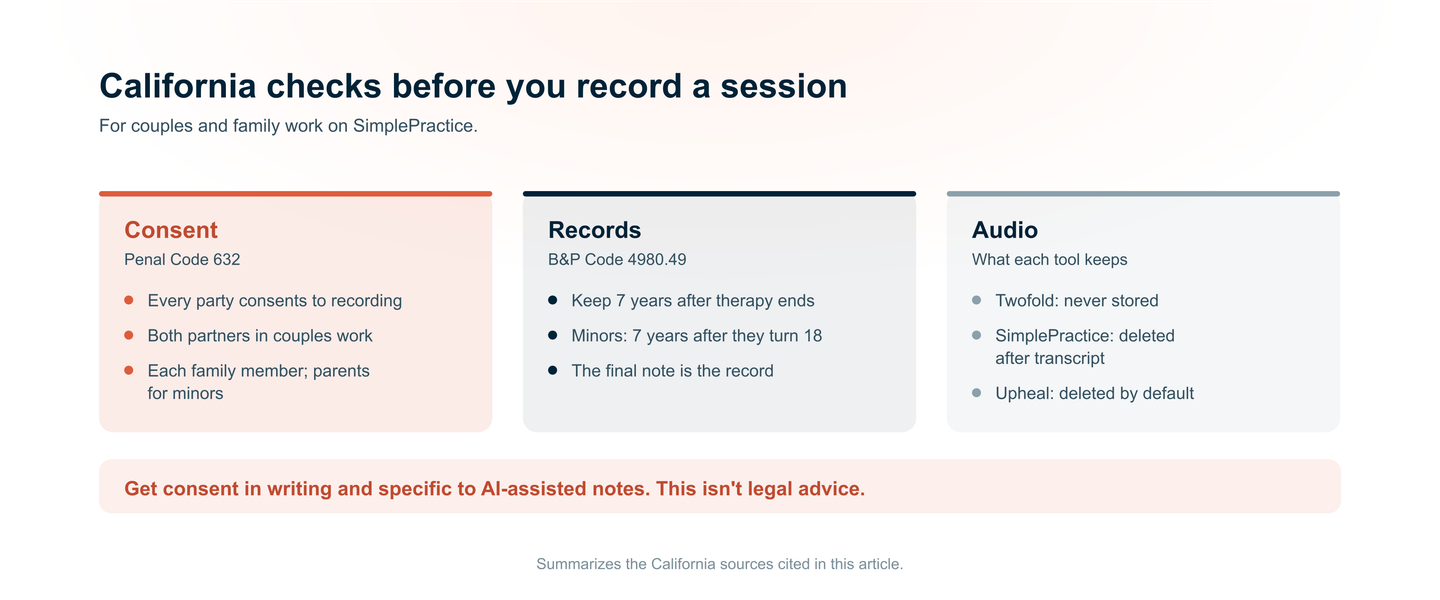
For therapy, we would make the consent specific to AI‑assisted note‑taking and recording or audio capture. For a couples session, that means both partners. For a family session, that means each adult family member, each person in the room or telehealth visit as clinically appropriate, and parents or legal representatives for minors where applicable.
The BBS retention rule for California LMFTs applies to the final health service record, even if the AI tool does not store audio. Business and Professions Code section 4980.49 says an LMFT must retain a client's or patient's health service records for at least seven years from the date therapy is terminated; for a minor, at least seven years from the date the client or patient reaches 18. Records may be written or electronic.
That means the reviewed note you keep in SimplePractice is the record to preserve. Twofold says audio is processed to create the note and never stored. SimplePractice says audio is deleted after the transcript is generated, and Upheal says audio is deleted by default once notes are generated unless kept with explicit client consent.
How the Twofold to SimplePractice workflow works
With Twofold, the SimplePractice workflow is record or dictate, review, then copy and paste. Twofold does not have a direct SimplePractice integration, so the handoff is manual, but formatting carries over and there is no integration fee.
- Before the session, confirm consent for any recording and choose the note format you want, such as couples therapy, family therapy, SOAP, DAP, BIRP or a custom template.
- During or after the session, use Twofold for an in-person or telehealth session, dictate a summary, or upload audio.
- Review the draft as the clinician. Edit clinical language, risk content, diagnosis support, participants, medical necessity and anything the model got wrong or left vague.
- Use Twofold's included tools if helpful: Ask Twofold for edits, CPT and ICD-10 suggestions for review, treatment plan drafting, or a letter or referral draft.
- Copy the finished note into the SimplePractice note field, confirm the formatting, and finalize the note according to your usual SimplePractice process.
This workflow is a little more work than an in‑EHR recorder, but it is predictable. It also keeps your scribe separate from your EHR choice if you later move from SimplePractice or add a second system.
How SimplePractice Note Taker workflow differs
SimplePractice Note Taker wins on fewer handoffs because the recorder and note are already in SimplePractice. SimplePractice's help center says telehealth sessions use a Record audio button in the SimplePractice telehealth toolbar, while in‑person sessions use the SimplePractice for Clinicians mobile app.
SimplePractice also supports dictation for client notes, and its help center says recording and dictation cannot both be used for the same session. Uploads are listed for .mp3, .m4a, txt, .md, .pdf, .docx and .rtf, which gives you several ways to draft without leaving the EHR.
The tradeoff is that you are using SimplePractice's AI rules and retention settings. SimplePractice says drafts and transcripts are available for seven days or until the note is signed and locked, whichever comes first. Its transcript retention FAQ says new Note Taker users are opted in by default to retention of de‑identified, de‑coupled transcripts for evaluating output and refining prompts, not for retraining the underlying model, so check that setting before using it with California clients.
Where Upheal and Mentalyc fit
Upheal is the under‑$50 competitor most worth testing, while Mentalyc is harder to make work at $50 if couples and family sessions are part of your week. Both have useful features, but the plan gates matter.
Upheal
Upheal AI Notes is the price leader among the live‑capture standalone tools here, at $39/month flat as of November 13, 2026. Upheal's pricing page lists unlimited AI notes via video, audio, dictation and uploads, supports individuals, couples and families, includes treatment plans, and offers a Chrome extension with Smart Fill for EHRs.
Upheal may be the better pick if you want a lower monthly price than Twofold, want live audio or video capture, and prefer Smart Fill over copy and paste. The main caution for this reader is that Upheal's SimplePractice help article describes compatibility with SOAP and DAP templates, and Upheal does not support group therapy documentation.
Mentalyc
Mentalyc is usually not the $50 answer for a solo LMFT who sees couples and families. Mentalyc's pricing page lists Mini at $19.99 monthly or $14.99/month annual with 40 notes per month, and Basic at $39.99 monthly or $29.99/month annual with 100 notes per month; both are individual‑adult only, checked November 13, 2026.
Mentalyc Pro adds couple, child/teen and family clients, custom templates, more formats, automatic CPT codes, and unlimited EHR‑extension transfers, but it is above this budget. Mentalyc Team has unlimited notes with a fair‑usage clause at $49.99 per seat per month billed annually or $59.99 per seat billed monthly, but Mentalyc says solo clinicians cannot buy Team seats.
A one-week trial plan with real sessions
A one‑week trial should use a few real sessions, with consent, and measure review time rather than draft impressiveness. Twofold offers a 7‑day free trial with no credit card; SimplePractice lists Note Taker as free for 30 days; Mentalyc offers a 14‑day Pro trial with 15 notes; Upheal says no credit card is required for trial, but its pricing page does not state the trial length.
- Day 1: Update your AI note-taking consent language and choose appropriate sessions. Include at least one individual session and, with consent from everyone, one couples or family session.
- Day 2 to Day 4: Use the workflow you would use in a normal week. Time note creation, review, editing and movement into SimplePractice.
- For every draft, check speaker attribution, client identity, risk language, interventions, client response, plan, diagnosis support and whether the note sounds like your clinical voice.
- For couples and family notes, watch for one partner's statement assigned to the other partner, a child mislabeled as the client, or a missed relational intervention.
- Day 5: Test the SimplePractice handoff. For Twofold, copy and paste the final note. For Upheal, test Smart Fill on your actual SimplePractice note type. For SimplePractice Note Taker, confirm where draft, transcript and retention controls appear.
- Day 6: Compare treatment plan support. If the AI tool drafts plans, check whether goals and progress tracking match your clinical model and payer language.
- Day 7: Choose the tool that saves enough review time without adding consent confusion, plan caps or SimplePractice friction. If two tools are close, pick the one you will use after a hard clinical day.