

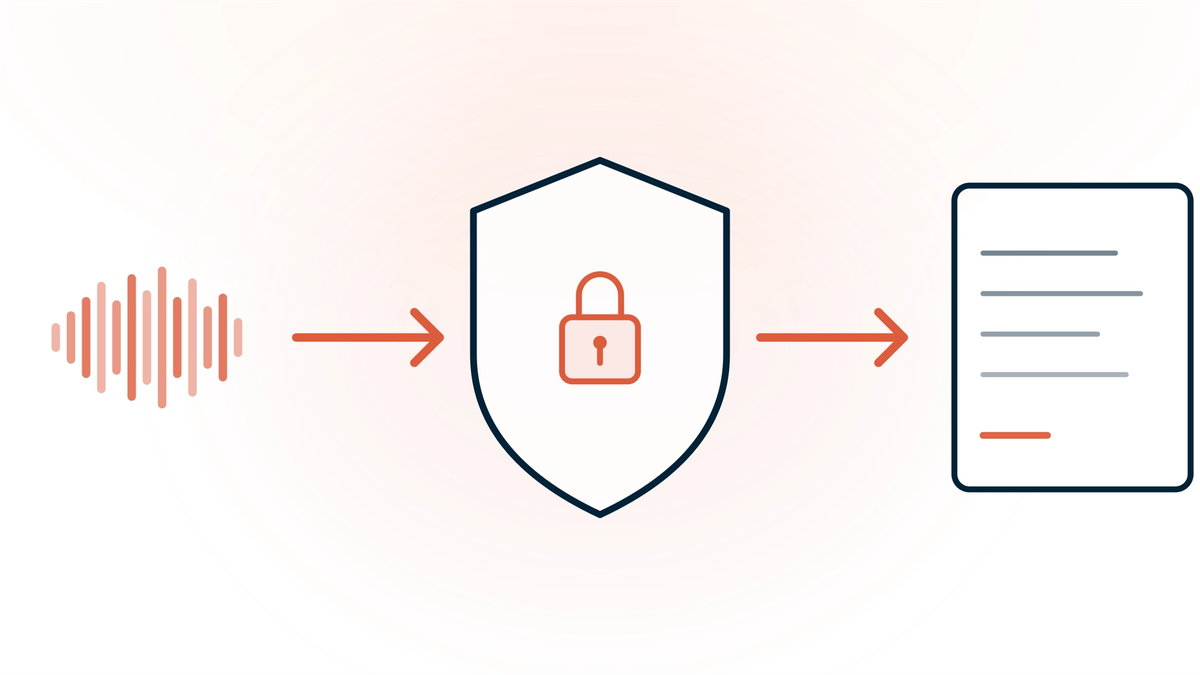
A medical transcription API is HIPAA compliant when the vendor will sign a Business Associate Agreement (BAA) and backs it with real safeguards: encryption in transit and at rest, role‑based access, audit logging, a clear data‑retention policy, and a commitment not to train models on your audio or notes. The API itself is never "HIPAA certified" — HIPAA has no certification. Compliance is a property of how the vendor handles protected health information (PHI) and the contract you sign, not a badge on a pricing page.
This guide is for developers, product leaders, and compliance reviewers evaluating a clinical speech‑to‑text or medical scribe API. It covers what actually makes a transcription API HIPAA compliant, why the BAA is non-negotiable and who has to sign it, the safeguards to require, and the exact questions to put to a vendor before any patient audio flows through their servers.
Disclosure: this guide is published by Twofold Health, which offers a HIPAA‑compliant medical speech‑to‑text API. It is general information, not legal advice — have your own counsel and compliance team review any vendor and BAA. Product details are from trytwofold.com, verified July 2026.
What Makes a Transcription API HIPAA Compliant?
When your app sends patient audio to a transcription API, that audio is PHI and the vendor becomes your business associate. HIPAA compliance for the API comes down to three things working together:
- A signed BAA — the contract that legally binds the vendor to HIPAA's rules for the PHI you send them. Without it, sending PHI to the API is itself a violation.
- Technical safeguards — encryption, access controls, and audit logging that protect the audio and text end to end.
- Administrative practices — retention limits, breach notification, and a policy against reusing your data (for example, training models on it).
The BAA Is Non-Negotiable — And Who Signs It Matters
The single most important question for any medical transcription API is: will you sign a BAA? If the answer is no, or it's gated behind an enterprise tier you can't reach, the API is a non‑starter for clinical PHI. Twofold makes a BAA available for eligible partners building on the API.
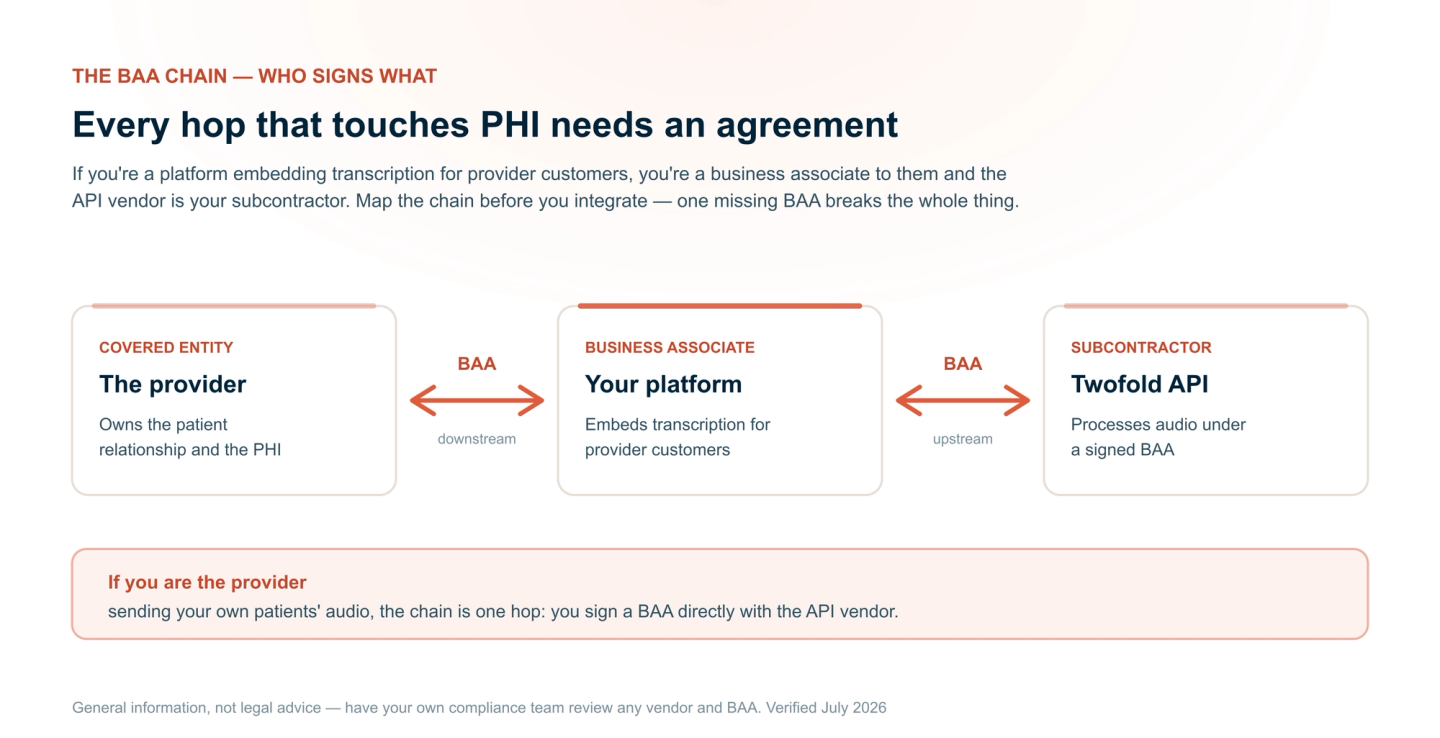
Who signs depends on your architecture. If you're a covered entity (a provider) sending your own patients' audio, you sign a BAA directly with the API vendor. If you're a software platform embedding transcription for your customers, you're typically a business associate to them and need a BAA both upstream (with the API vendor, who becomes your subcontractor) and downstream (with your provider customers). Map that chain before you integrate.
If you're rebranding the scribe as your own feature, the same chain applies — see our guide to launching a white-label AI medical scribe for how the BAA and partnership fit together.
Security Safeguards to Require
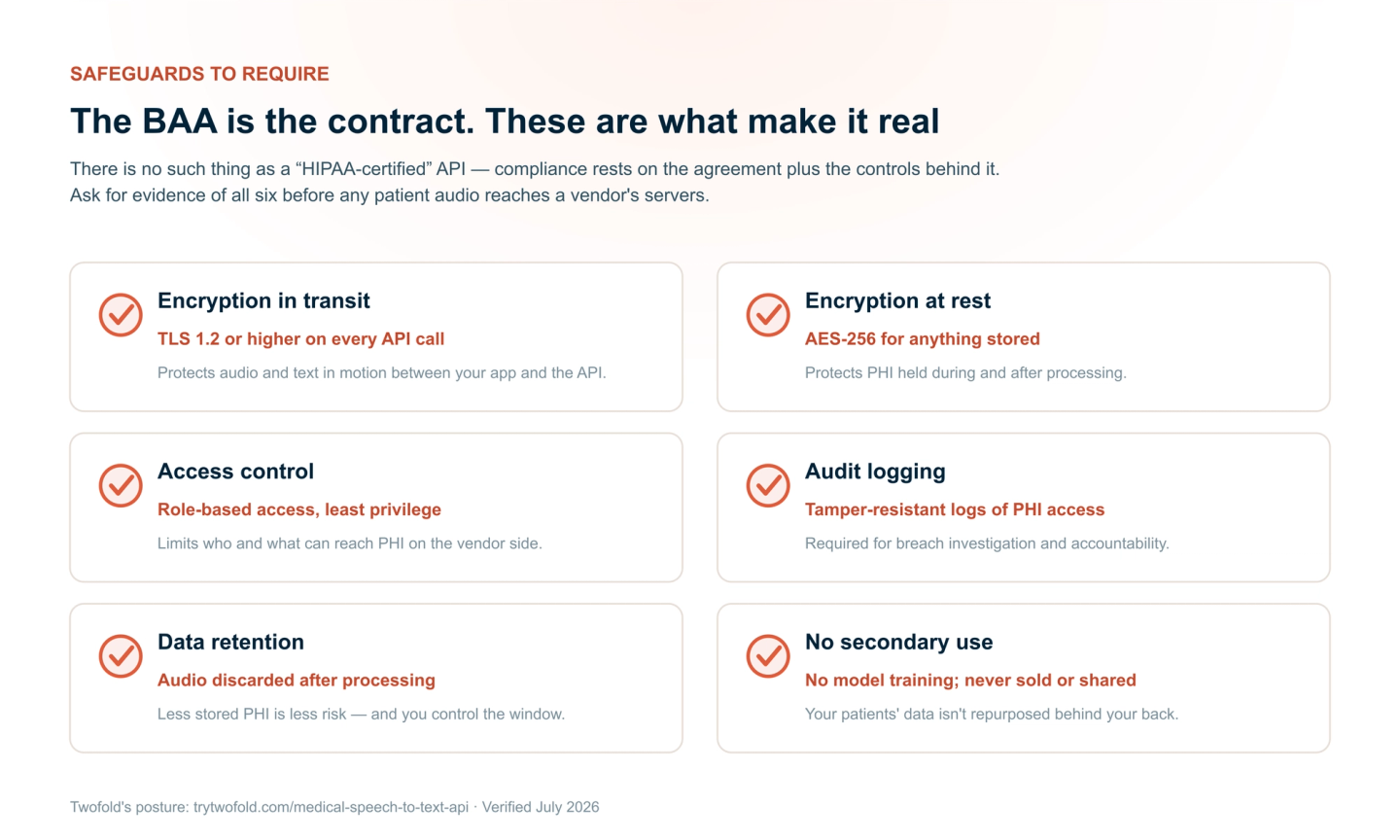
A BAA is the contract; these are the technical controls that make it real. Require evidence of each before you send PHI:
Safeguard | What to require | Why it matters |
|---|---|---|
Encryption in transit | TLS 1.2 or higher on every API call | Protects audio and text as they move between your app and the API |
Encryption at rest | AES-256 for anything stored | Protects PHI held during and after processing |
Access control | Role-based access, least privilege | Limits who and what can reach PHI on the vendor side |
Audit logging | Tamper-resistant logs of PHI access | Required for breach investigation and accountability |
Data retention | Audio discarded after processing unless you opt in | Less stored PHI is less risk; you control the window |
No secondary use | No training on your audio or notes; never sold or shared | Your patients' data isn't repurposed behind your back |
Questions to Ask Before You Integrate
Put these to any vendor — and to your own compliance reviewer — before the first patient recording is sent:
Why Generic Speech-to-Text APIs Fall Short
General‑purpose speech‑to‑text APIs built for podcasts and call centers create two problems for healthcare. First, compliance: some won't sign a BAA at all, or bury it behind terms that don't fit clinical use. Second, accuracy: they mangle drug names, dosages, and lab values because they were never tuned on clinical speech — a documentation risk on top of a compliance one. We cover the accuracy gap in depth in medical vs. general speech-to-text.
A medical‑first API closes both gaps: it's built to handle PHI under a BAA, and it recognizes clinical language — then, in Twofold's case, returns finished notes and structured encounter data, not just a transcript.
Bottom Line
A medical transcription API is HIPAA compliant when the vendor signs a BAA and backs it with encryption, access controls, audit logging, sane retention, and a no‑training commitment — verified, not assumed. Map your BAA chain, require the safeguards above, and ask the hard questions before any PHI moves. See Twofold's medical speech-to-text API or book a call with our product team to walk your security reviewer through the specifics.