


The adoption of AI scribes has been revolutionizing clinical documentation and significantly reducing clinician burnout. However, implementing this technology across multiple locations introduces a dangerous variable: inconsistency. A single site's overlooked vulnerability can compromise the entire healthcare enterprise. To successfully scale, healthcare organizations must shift to a unified playbook. This guide provides the essential framework for standardizing vendor vetting, training protocols, and continuous audits to ensure HIPAA-compliant AI notes across every practice in your network.
1. The HIPAA Foundation: What Makes an AI Note Tool Compliant?
Any AI vendor handling Protected Health Information (PHI) must sign a Business Associate Agreement (BAA) with your practice. This legally binding contract shifts responsibility for data protection to the vendor and makes them accountable under HIPAA.
The Five Pillars of HIPAA-Compliant AI Notes
For an AI note‑taking tool to be truly HIPAA‑compliant across a multi‑location practice, it must demonstrate the following:
Compliance Pillar | What it Means | Why it Matters for Multi-Location Practices |
|---|---|---|
End-to-End Encryption | AES-256 encryption at rest and TLS 1.3 in transit | Protects data as it moves between locations and devices |
Zero Audio Retention | Immediate deletion of recordings after transcription | Eliminates the largest security vulnerability |
Automatic PHI Redaction | Removing addresses, and identifiers from transcripts | Ensures consistency across all sites regardless of provider diligence |
Role-Based Access Control | Granular permissions so staff see only what they need to | Prevents cross-location data exposure |
Audit Trails | Logs showing who accessed what data and when | Enables root-cause analysis across distributed sites |
The Data Training Risk
One of the most overlooked HIPAA risks is how vendors use your data. Many consumer‑grade AI tools use customer data to "train" their models. In a healthcare context, this is a serious HIPAA violation; patient details could technically "leak" into the AI's future responses for other users.
See more information on free vs. paid AI note tools.
2. The Multi-Location Challenge: Why Scale Changes Everything
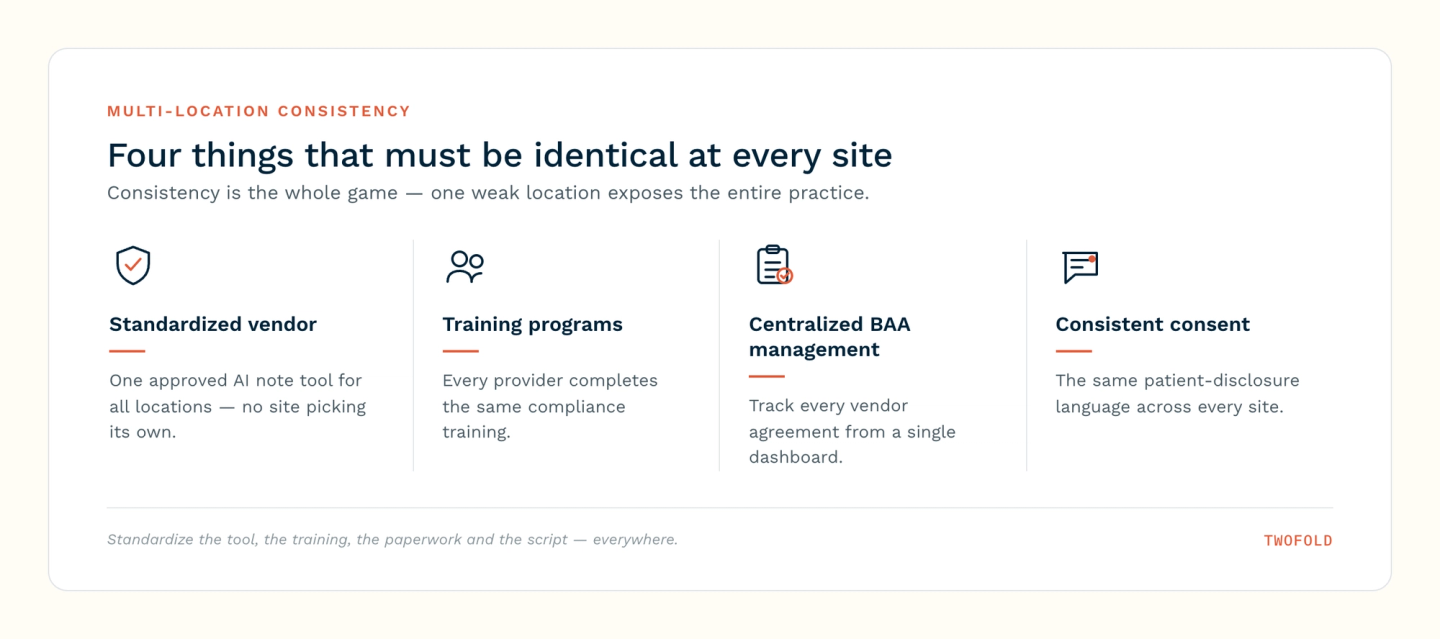
When rolling out AI notes across multiple locations, consistency is very important. Different sites cannot interpret compliance requirements differently.
Key Considerations For Multi-Location Consistency:
- Standardized Vendor Selection: One approved AI note tool for all locations.
- Training Programs: Every provider completes the same compliance training.
- Centralized BAA Management: Track all vendor agreements from a single dashboard.
- Consistent Patient Consent Protocols: The same disclosure language across every site
Data Residency and Cross-Border Compliance
For practices operating across state lines, data residency becomes a critical concern. Compliance extends beyond server location to include ETL pipelines, AI APIs, cloud regions, logging systems, and cross‑border data transfers.
Different states may have additional privacy requirements beyond HIPAA, and while HIPAA-compliant AI tools typically meet state requirements automatically, practices must verify compliance for each specific location.
The Human-in-the-Loop Mandate
In 2026, an error generated by an AI is now viewed as a "failure of supervision". For multi‑location practices, this means:
- Every AI-generated note must be reviewed, edited, and finalized by a licensed provider.
- Automation bias, the tendency to trust AI suggestions even when they contradict clinical judgment, must be actively counteracted.
3. The Compliance Checklist: Vetting AI Notes for Multi-Location Deployment
Before setting up any AI note‑taking tool across your practice locations, complete this due diligence checklist:
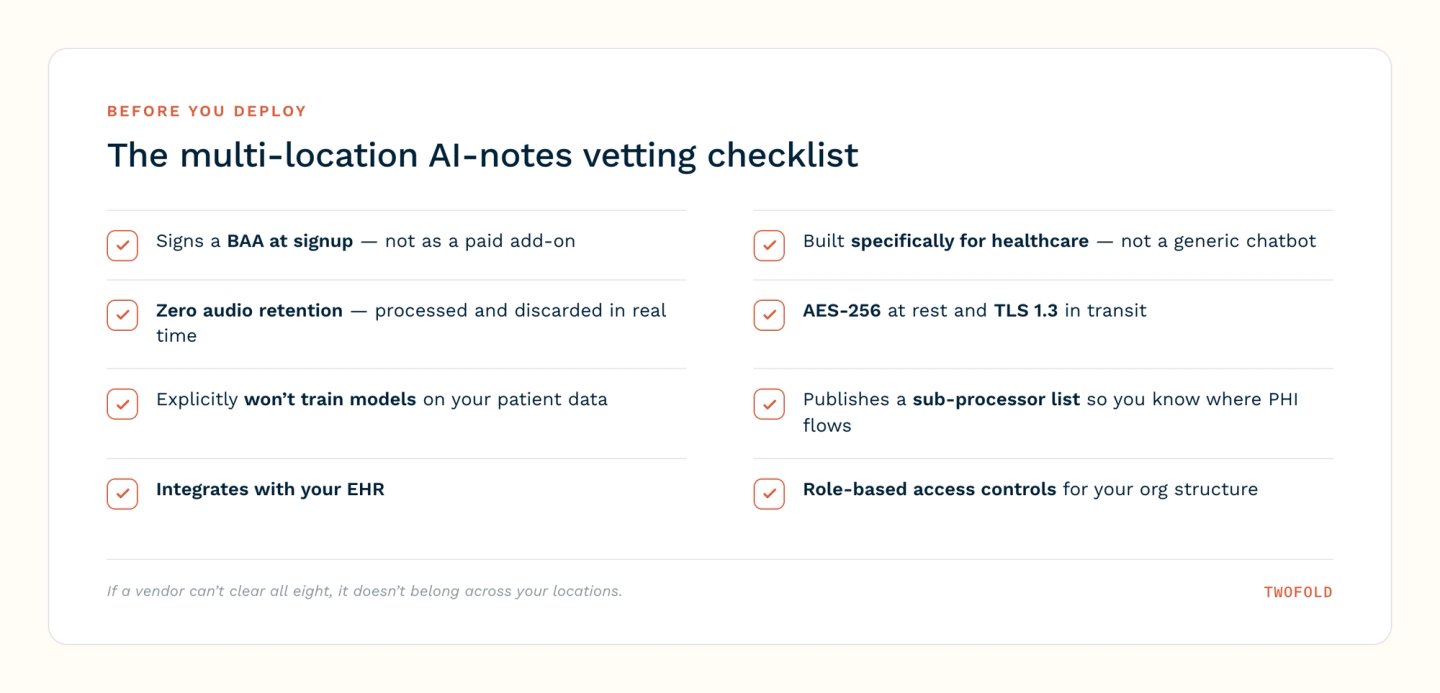
- Does the vendor sign a BAA at signup, not as an "add-on"?
- Is the tool built specifically for healthcare (not a generic AI like standard ChatGPT)?
- Does the vendor practice zero-audio-retention, processing in real-time, and discarding immediately?
- Is data encrypted with AES-256 (at rest) and TLS 1.3 (in transit)?
- Does the vendor explicitly prohibit using your data for model training?
- Is there a published sub-processor list so you know where PHI flows?
- Does the tool integrate with your EHR?
- Does the platform support role-based access controls appropriate for your organizational structure?
Ongoing Operational Compliance
Once set up, multi‑location practices must maintain:
- Vendor Contract Management: Track all BAAs, renewal dates, and compliance certifications.
- Regular Security Audits: These must be conducted at the enterprise level, not site-by-site.
- Incident Response Protocols: Standardized procedures for any data breach, regardless of where it occurs.
- Provider Attestation Logs: Document that every AI-generated note was reviewed by a licensed clinician.
- Version Control Tracking: Maintain an "AI Compliance Log" tracking which model version generated each note.
Conclusion
For multi‑location practices, HIPAA-compliant AI notes aren't just about avoiding fines; they're about building patient trust, reducing clinician burnout, and creating operational efficiency at scale. Practices that build strong compliance frameworks now, with centralized vendor management, standardized training, and consistent implementation across all locations, will be positioned to leverage AI's full potential while maintaining the trust and security that patients deserve.