


AI clinical notes are changing the daily workflow of medical documentation. But do they benefit residents and senior attendings equally? For residents, charting often means extra hours of after‑hours work, a major cause of burnout. For attendings, it's about recovering lost time and streamlining workflow. However, while attendings gain efficiency and reclaim more time for patient care, residents risk losing the critical thinking that is essential for developing diagnostic reasoning. This raises an important question: who benefits more from AI clinical notes? Discover the impact on both attendings and residents, and which group ultimately gains the greatest advantage.
Understanding AI Clinical Notes: A Brief Overview
AI clinical notes are ambient, voice‑enabled, or text‑driven documentation tools that capture patient encounters in real time, structure them into medical notes (typically SOAP format), and integrate with the Electronic Health Record (EHR).
- How They Work: Ambient AI scribes passively listen to clinician-patient conversations and generate structured notes without requiring the clinician to dictate, press buttons, or interact with software during the visit.
- The Adoption Landscape: While AI scribes are gaining traction across healthcare settings, their implementation in graduate medical education has only just begun. A 2024 study conducted at Stanford Health Care found that ambient AI transcription systems based on advanced language models reduced documentation burden and physician burnout and improved usability.
The Resident Physician's Perspective: Benefits and Challenges
Time Savings and Documentation Efficiency
A 2026 pilot study of family medicine residents found that documentation time per patient decreased by more than 3 minutes per patient after implementing ambient AI software, representing a significant gain for time‑constrained trainees. By automating the History of Presenting Illness, Review of Systems, and Assessment and Plan, residents can reclaim hours of their day, eliminating the need to take work home.
Additionally, a 2025 study comparing ChatGPT‑4o to resident physicians' documentation efficiency found that the AI matched the documentation quality of resident physicians, while substantially reducing the time required to document medical histories.
The Educational Dilemma: Learning vs. Efficiency
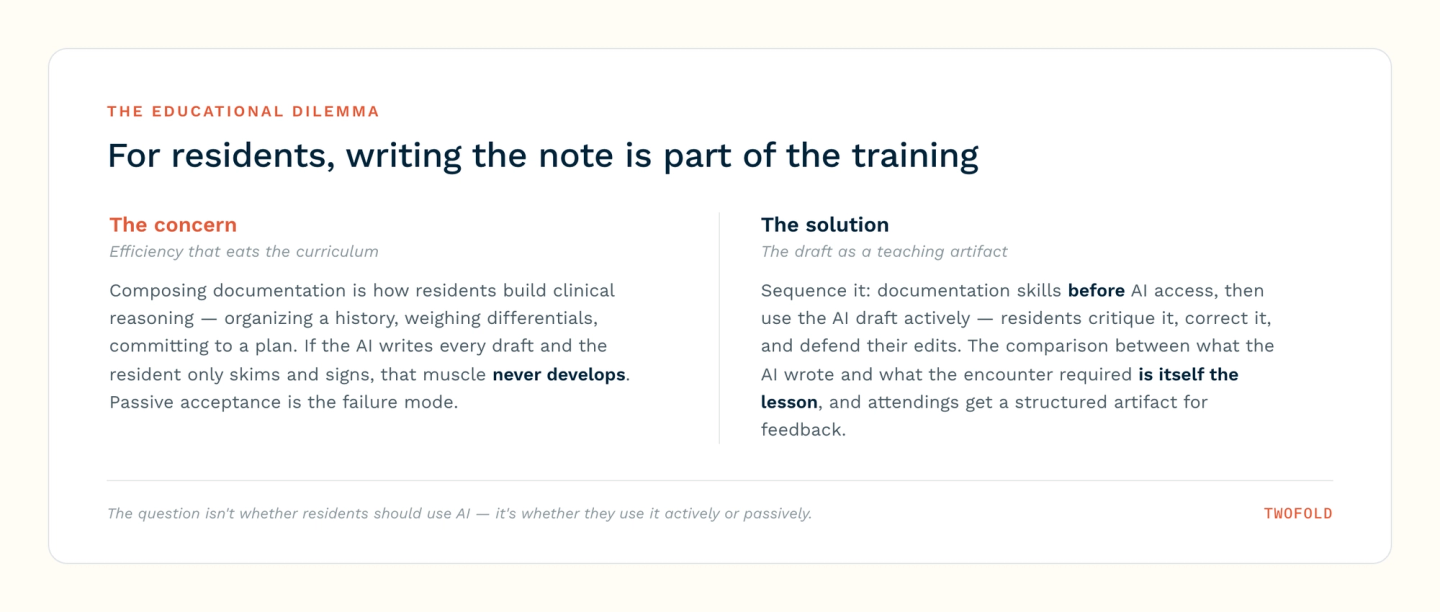
Clinical documentation is the foundation of physician training and clinical reasoning. For residents, writing notes is a reminder to justify decisions appropriately and prioritize information to form logical notes.
- The Concern: When AI handles note-writing and case summarization, residents miss repeated opportunities to synthesize complex histories. Many clinical AI note tools are optimized for efficiency, meaning shorter notes and fewer clicks.
- The Solution: Educators must guide learners to use AI as a framework for clinical reasoning, not as a substitute for it. Best practices include establishing documentation skills, AI training protocols, review of AI clinical notes, and creating feedback opportunities.
The Attending Physician's Perspective: Benefits and Considerations
Burnout Reduction
Ambient AI scribes are associated with reduced clinician burnout, lower cognitive task load, and significant time savings in documentation, particularly in after‑hours EHR work. A 2025 randomized trial found that using AI for clinical documentation decreased work exhaustion and interpersonal disengagement.
Supervisory Responsibilities
For attendings in academic settings, AI notes introduce new supervisory considerations. When residents are involved, attendings must review, edit, and sign off on AI‑generated notes. This represents both a new opportunity and a challenge.
On one hand, AI‑generated drafts provide a structured starting point for teaching and feedback. On the other hand, attendings must ensure they remain actively engaged with the patient's story rather than passively accepting AI‑generated content.
As a Professor of Emergency Medicine reflected, "We take great pride in preparing our residents for real-world practice. Our goal is to help them grow into confident, skilled attending physicians — and integrating tools like AI scribes is an essential part of that journey."‑ Aman Parikh, UC Davis Health, 2026.
This emphasizes that attending to oversight remains essential; the AI is an assistant, not a replacement.
Comparison: Residents vs. Attendings Using AI Clinical Notes
Aspect | Resident Physicians | Attending Physicians |
|---|---|---|
Primary Benefit | Educational framework and time savings | Efficiency and workflow optimization |
Burnout Impact | Significant improvement | Reduced burnout, but professional fulfillment is lacking |
Risk | Loss of clinical reasoning development | The patient relationship will be affected if overly reliant |
Supervisory Need | Requires structured training and oversight | Independent use, but quality review is still needed |
Who Benefits More from AI Clinical Notes
- For Efficiency And Time Savings: Attendings may see more immediate, measurable gains.
- For Educational Value: Residents arguably benefit more only if AI is implemented thoughtfully.
Both physicians benefit significantly, but in different ways. Attendings gain efficiency; residents gain a learning framework.
The greater long‑term impact may be on residents, as clinical AI documentation tools will shape how the next generation of physicians learns to think, synthesize, and document.
Practical Recommendations for Implementation
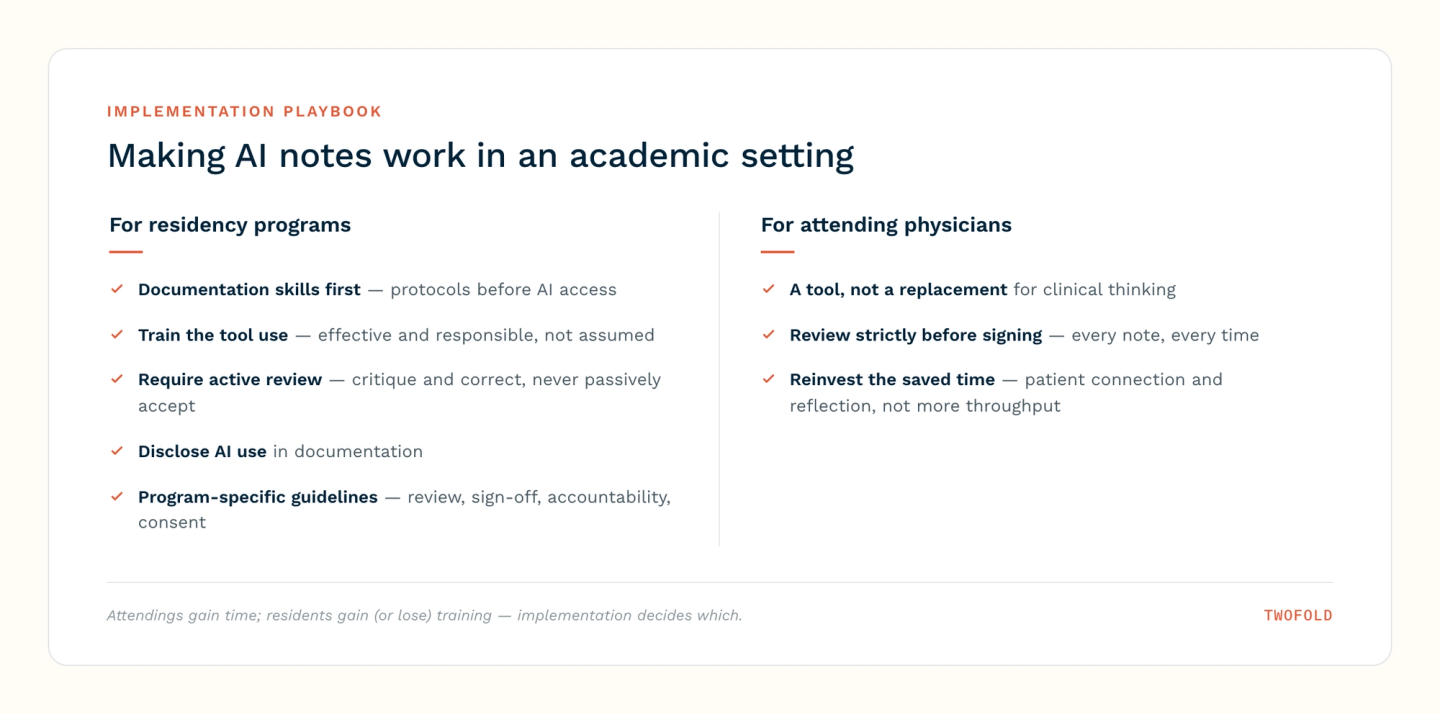
For Residency Programs
- Implement documentation skills protocols before introducing AI clinical note tools.
- Provide AI training on how to use the tool effectively and responsibly.
- Emphasize and require review of AI-generated notes rather than passive acceptance.
- Emphasize disclosure of AI use in documentation.
- Develop program-specific guidelines addressing resident review, note sign-off, accountability, patient consent, and scope of use
For Attending Physicians
- Use AI as a tool, not a replacement for clinical thinking.
- Review all AI-generated notes strictly before signing.
- Use the time saved for patient connection and reflection.
Conclusion
AI clinical notes are transforming medical documentation for both resident and attending physicians. Residents benefit from reduced documentation burden, improved well‑being, and an educational framework, but risk losing the clinical reasoning process if too reliant on AI. Attendings benefit from reclaimed time, reduced burnout, and improved efficiency, but must be wary of passively accepting AI‑generated notes. AI clinical note implementation is therefore best utilized when prioritizing patient connection, clinical reasoning, and professional fulfillment for both residents and attendings.