
Emergency physicians are drowning in documentation, spending more time clicking than caring for critical patients. Enter the AI medical scribe, an ambient listening tool that promises to automate charting, restore eye contact, and bring back patient connection. But in the chaotic ER, speed without safety can be dangerous. While these scribes offer a path to faster care, they introduce new risks: hallucinations, data bias, and potential liability. Explore how to embrace the speed without sacrificing safety with AI.
How AI Scribes Operate in the ER
Unlike traditional dictation, which merely records audio, ambient AI acts as a silent, intelligent observer. It sits in the corner of the consultation room (or runs securely on a smartphone or tablet), filtering out the chaotic background noise of the ER (beeping monitors, intercom pages, and the rustle of privacy curtains) to focus exclusively on the provider‑patient dialogue.
From Conversation to Charting
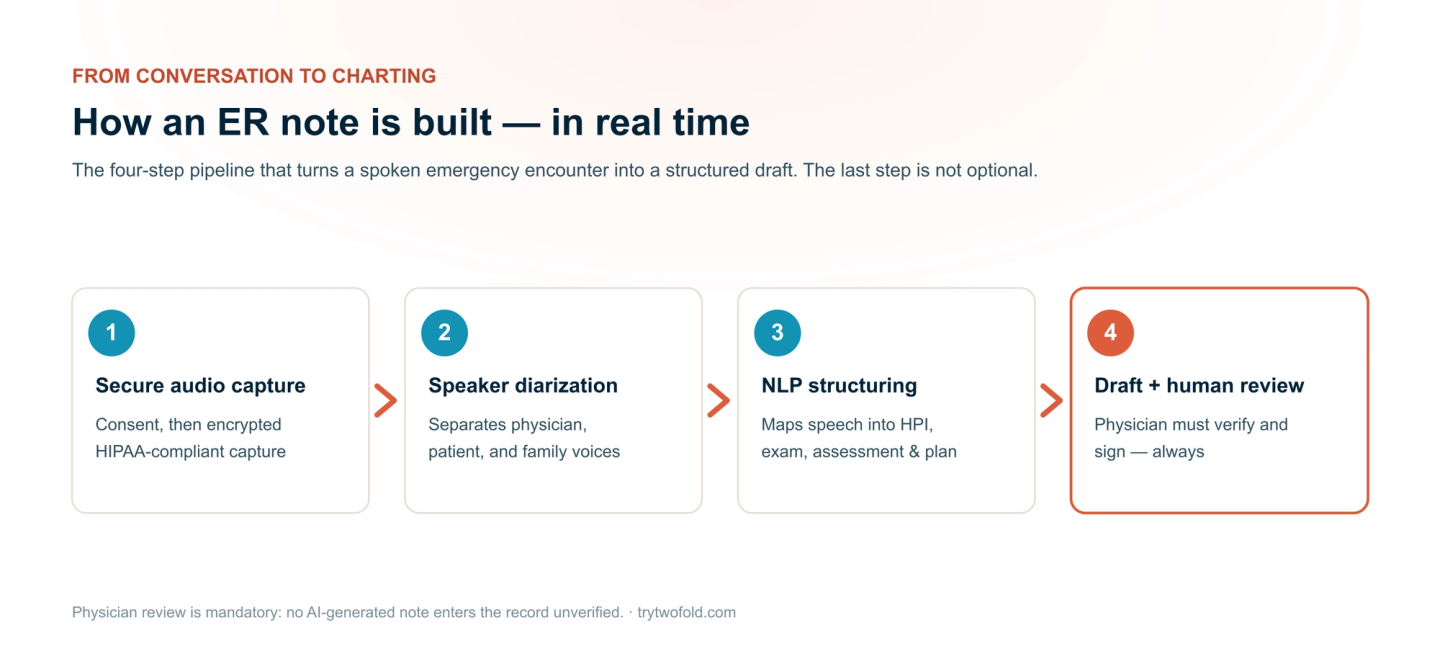
The transition from spoken word to structured EHR data happens in real‑time, following a four‑step pipeline designed specifically for the high‑acuity environment of emergency medicine.
The Step-by-Step Process:
- Secure Audio Capture: The physician initiates the session with the patient's consent. The device captures the conversation using encrypted, HIPAA-compliant audio processing.
- Speaker Diarization: The AI distinguishes who is speaking, separating the physician's questions from the patient's responses, and even filtering out a family member's interjections. This prevents the patient's complaints from being incorrectly attributed to the physician's exam findings.
- Natural Language Processing (NLP) and Structuring: The AI translates conversational language into standardized clinical terminology. It automatically parses this data into the proper sections: HPI (History of Presenting Illness), ROS (Review of Systems), and the Physical Exam.
- Draft Generation and Human Review: The AI populates the EHR with a comprehensive, formatted draft, including a preliminary Assessment and Plan (A&P). The emergency physician must review, edit, verify, and digitally sign it, retaining complete ownership of the final record.
The "Faster Care" Promise
When executed flawlessly, this workflow transforms the ER dynamic. With an AI medical scribe, that time shrinks to under 2 minutes for the initial draft. But the speed benefits extend far beyond administrative efficiency:
Reducing Cognitive Load
The ER requires split‑second, high‑stakes decisions. Every second spent toggling between EHR screens is a second of "cognitive offloading", distraction from the patient in front of you. By automating documentation, the AI preserves the physician's working memory for diagnostic reasoning, differentials, and interpretation of lab results.
Accelerated Triage
In busy Level 1 trauma centers, even cutting 5 minutes off per patient chart can significantly reduce wait times, decompress overcrowded waiting rooms, and allow beds to turn over faster.
Better Bedside Manner
Perhaps the most human benefit is the restoration of eye contact. Without a screen and keyboard serving as a barrier, the physician can face the patient directly, observe nonverbal cues, and actively listen to the patient.
The Risks in the High-Stakes ER Environment
In the emergency room, haste can carry devastating consequences. While an AI medical scribe can draft a chart in seconds, it lacks the contextual intelligence, emotional intuition, and physiological pattern recognition of a clinician. Introducing ambient AI into this chaotic environment introduces three distinct categories of risk that healthcare systems must pay attention to.
The Danger of "Hallucinations" and Inaccurate Data
In the world of generative AI, a "hallucination" refers to the model confidently generating information that is factually incorrect or entirely fabricated. In an ER setting, this is a patient safety risk waiting to happen.
Furthermore, AI struggles with atypical speech patterns. Patients with dysarthria (slurred speech from a stroke), heavy regional accents, or those who are intubated and using a communication board often produce audio that the algorithm cannot parse.
Algorithmic Bias and Diagnostic Disparities
Most large language models (LLMs) and NLP systems are predominantly trained on standard English‑language datasets that overrepresent geographically Western populations. This training gap creates a systemic bias that directly impacts the quality of care for minority populations in the ER.
For more in-depth information, see our research article on biased AI in healthcare.
Privacy and Security Concerns
The ER is a public space. Introducing a listening AI microphone amplifies these privacy vulnerabilities.
Data Breaches
AI temporarily stores and processes audio data. This audio is transmitted to third‑party cloud servers for processing, creating multiple points of potential interception. A vulnerability in the vendor's API, a compromised employee credential, or a ransomware attack on the cloud provider could expose thousands of hours of intimate ER conversations.
Consent
In the emergency department, obtaining consent is often more challenging due to the unpredictable nature of the clinical environment. A patient arriving in cardiac arrest, actively seizing, or altered from intoxication cannot provide meaningful consent. Obtaining consent from a panicked family member in the trauma bay is often impractical and can potentially add to their stress.
Furthermore, the AI may inadvertently record nearby patients, bystanders, or EMS handoff reports, capturing data from individuals who never agreed to be monitored. This creates a significant gray area regarding HIPAA compliance and institutional liability, forcing hospitals to choose between implementing AI broadly and developing complex, case‑by‑case consent workflows that slow down emergency care.
Best Practices for Implementation
The solution lies in intentional, governed integration. For emergency departments ready to embrace this technology, success hinges on protocols that prioritize patient safety, data integrity, and clinician accountability.
Implementation Best Practices
- Physician Oversight is Non-Negotiable: No AI-generated note should ever enter a patient's record without direct, active physician review.
- Training and Continuous Auditing: Demand that vendors train their models specifically on emergency medicine datasets, including trauma resuscitations, stroke alerts, and psychiatric emergencies.
- Post-implementation, conduct randomized audits comparing AI-generated notes against actual audio recordings for accuracy.
- Track error categories (omission, hallucination, misattribution) and feed these insights back into the model's fine-tuning loop.
- Streamlined Consent Protocols: Develop a standardized consent script. For example: "We use a secure AI tool that listens and takes notes for me. It's confidential, and you can opt out at any time."
- Automated Clinical Red Flag Systems: Configure the AI to automatically detect and escalate high-risk keywords. When detected, the AI should either pause drafting and prompt physician confirmation or refuse to auto-populate sensitive fields, ensuring the machine never minimizes a critical safety issue.
See more on how AI can catch risk language you might miss.
Conclusion
AI medical scribes are not a replacement for clinical judgment; instead, they are a tool to augment it. In the ER, where seconds save lives, the speed they offer is undeniably valuable. The future of emergency medicine will rely heavily on ambient AI, but success depends on a "human‑first" approach: clinician oversight, continuous auditing, and accountability. Faster care is achievable, but only when we prioritize safety over convenience and verification.