



AI clinical note scribes have become increasingly adopted in clinical settings. Yet their integration raises a critical question: how can healthcare organizations ensure transparency and accountability when machine‑generated text enters the medical record? Digital watermarking, a technique that embeds detectable markers within AI‑generated content, offers a potential solution. This article examines watermarking's promise and its technical challenges in medical contexts.
What is a Digital Watermark for AI Text?
A digital watermark for AI-generated text is an invisible, machine‑readable marker embedded directly into the content during its creation. Think of it as a digital fingerprint, imperceptible to the human eye (or ear) but easily detectable by specialized software. Its purpose is to establish provenance: to verify that a piece of text was generated by an AI system and, in some cases, by what specific model.
The Medical Context: A Domain-Specific Challenge
While the concept is straightforward, its application in medicine is uniquely challenging. A 2025 study found that current watermarking methods may compromise medical factuality.
The problem lies in how watermarks work. They often adjust "low‑entropy" tokens, which are words that are highly predictable in a given context. In medical text, these low‑entropy tokens are typically medical terminology and jargon, such as disease names or drug dosages. Altering the probability of these words to embed a watermark can change their meaning, leading to inaccuracies and even hallucinations.
This finding highlights that generic watermarking solutions are not sufficient for healthcare. The technology must be domain‑aware to protect the integrity of medical content.
Watermarking AI Clinical Notes
As AI clinical note scribes rapidly move to enterprise implementation across health systems, the need for provenance mechanisms has become more important. Digital watermarking offers a practical solution to several interconnected challenges facing healthcare organizations today. Below are three aspects to consider in the context of watermarking AI‑generated clinical notes.
1. Preserving Record Integrity in the OpenNotes Era
The OpenNotes movement, which grants patients access to their clinical records, was built on a foundation of transparency. But when machine‑generated text blends with human‑authored content, the provenance of each entry becomes ambiguous. This ambiguity threatens the integrity of the medical record.
Watermarking addresses this by embedding an invisible, machine‑readable marker directly into AI‑generated text, establishing a clear chain of evidence that answers the question: who or what created this content?
In the context of clinical documentation, where records inform diagnosis, treatment, and medicolegal decisions, the ability to distinguish human from machine‑generated content is vital for patient safety.
2. Building and Maintaining Patient Trust
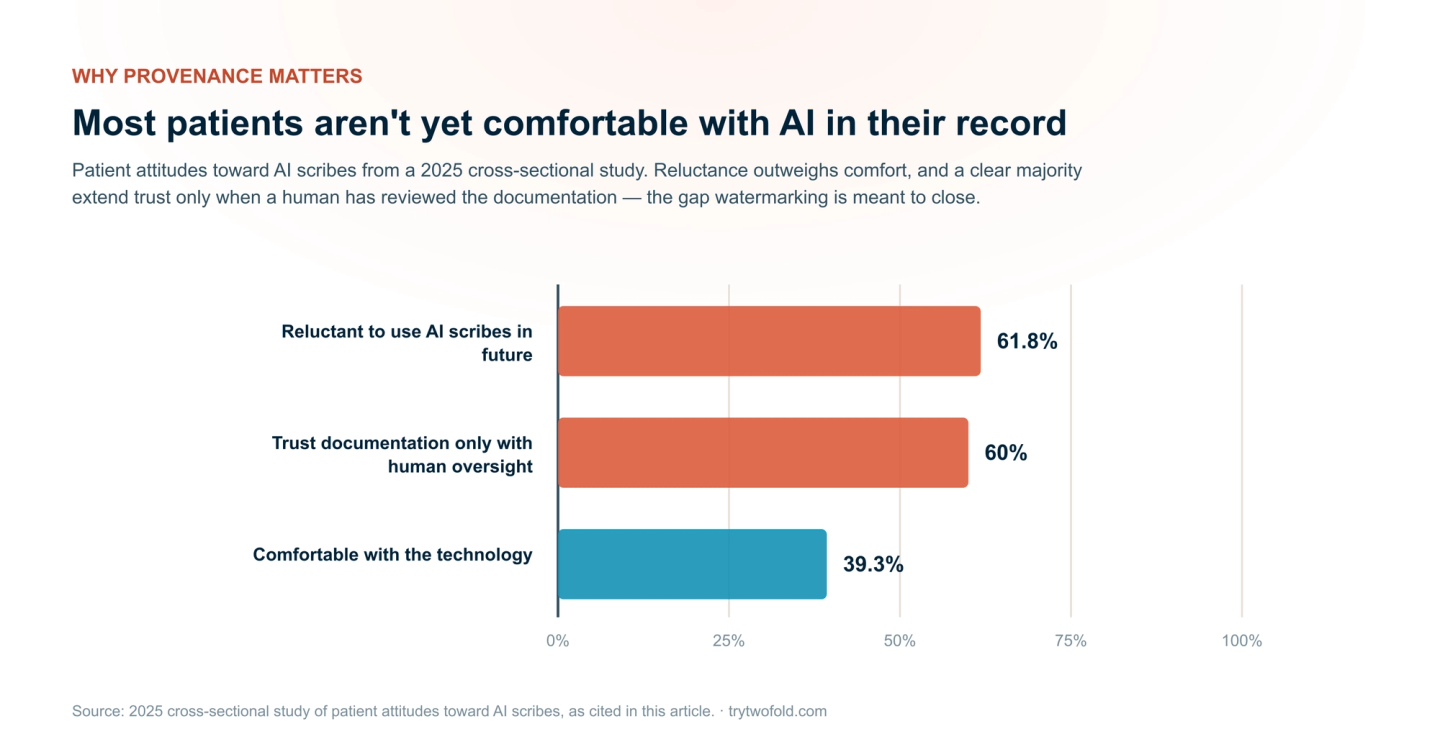
Trust is the foundation of the patient‑clinician relationship, and it is becoming increasingly vulnerable in the age of AI. A 2025 cross-sectional study revealed patient attitudes toward AI scribes: 61.8% of respondents expressed reluctance to use AI scribes in the future, while only 39.3% reported comfort with the technology and nearly 60% trusted documentation only when it included human oversight.
These findings demonstrate that patients have the right to know when AI contributes to their medical records. Watermarking serves as a transparency mechanism that signals and supports an organization's commitment to honesty and accountability.
3. Enabling Clinician Alerts and Oversight
AI scribes are powerful assistive tools, but they are far from infallible. The main limitation of AI clinical scribes is an accuracy-oversight gap: ambient tools frequently produce hallucinations and omissions, reinforcing the use of AI scribes as assistive rather than autonomous documentation tools.
Watermarking addresses this by enabling automated clinician alerts when reviewing AI‑generated content. These alerts would not replace clinical judgment but would flag content requiring clinician review, prompting clinicians to verify accuracy before signing off.
The Challenges of Watermarking AI Clinical Notes
While digital watermarking promises clear benefits, its application in healthcare presents significant challenges. In medicine, even minor technical mistakes can have life‑altering consequences. Below are three challenges that must be addressed before considering implementation.
The Factuality Issue
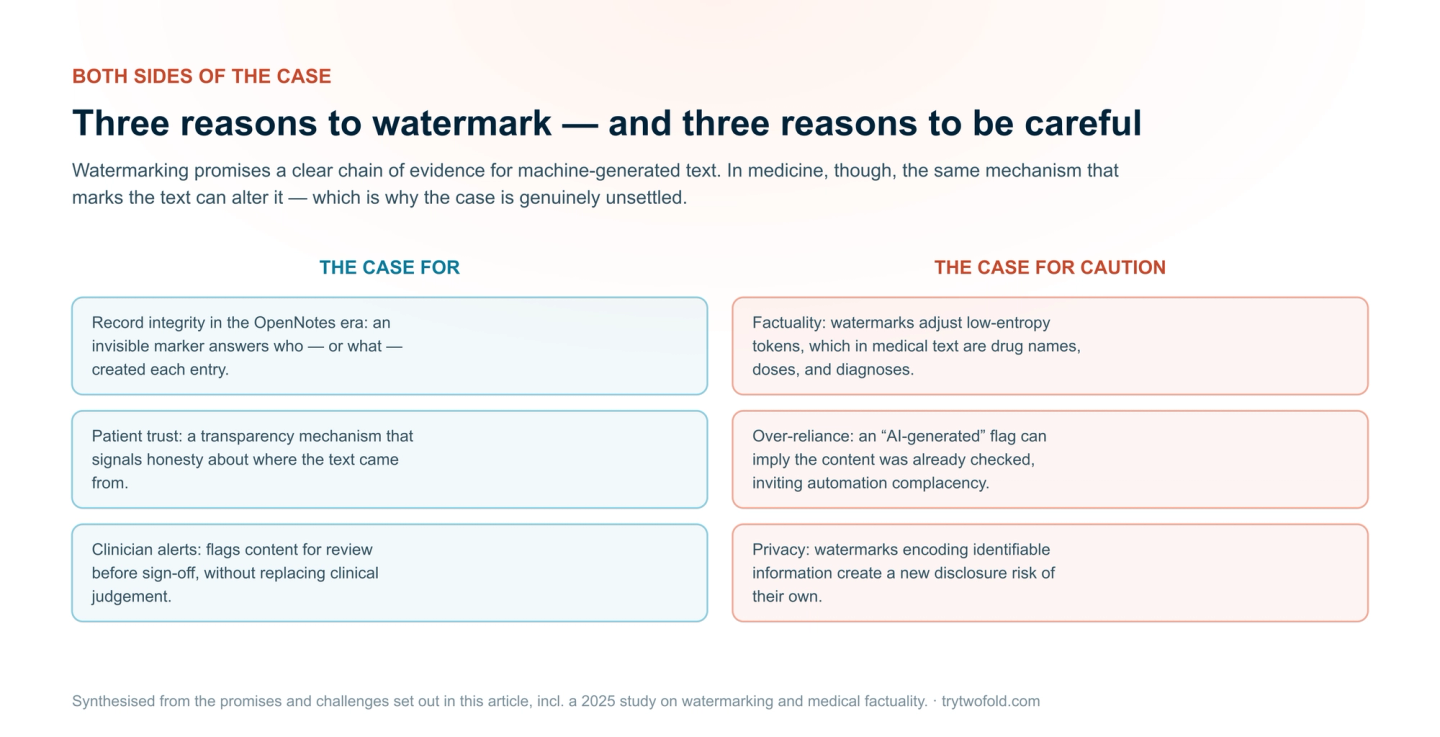
The most concerning challenge is watermarking's potential to compromise clinical factuality. The problem lies in how watermarks work. The aforementioned 2025 study noted how they alter "low‑entropy" tokens, words that are highly predictable in context. In medical text, these would be critical clinical entities: disease names, drug dosages, anatomical locations, and diagnostic terminology. By altering the probability distribution to embed a watermark, the model may select a different but plausible‑sounding term, one that changes its clinical meaning.
The Risk of Over-Reliance
Watermarking may also introduce a psychological risk: automation complacency. Clinicians already face a cognitive overload from documentation burden. An indicator that content was AI‑generated could inadvertently imply that the content has already been reviewed and verified, creating a potentially dangerous shortcut. Watermarking establishes provenance, not accuracy. A watermarked note can still contain hallucinations, omissions, or errors.
Privacy and Data Governance
AI clinical note scribes raise ethical concerns around privacy, consent, and data governance, and watermarking adds to that complexity.
- Watermarks that encode identifiable information could become a privacy breach risk.
- Data usage for AI training occurs without explicit consent.
Organizations must balance the right to know with the right to privacy through transparent policies and security.
Conclusion
Digital watermarking of AI clinical notes presents a compelling solution of embedding invisible markers to establish provenance and enable clinician alerts. However, the path forward requires further research and vigilance. Current watermarking methods substantially compromise medical factuality, with entropy alterations that alter clinical entities. Domain‑aware approaches that preserve medical accuracy are therefore essential for patient safety. The goal of watermarking is not just to label AI‑generated text, but to ensure that every note serves the patient's best interests.