


AI notes tools can draft comprehensive notes in seconds, but they can also lack clinical judgment and accountability. The responsibility for accuracy, privacy, and regulatory adherence remains solely with the provider. To safely harness the power of AI clinical notes, practices must implement governance policies that ensure precision, protect patient safety, and defend against liability in an increasingly digital landscape. Learn how a simple 5‑step governance protocol can enhance your workflow with AI responsibly.
Why AI Changes the Governance Game
The transition from traditional dictation to generative AI represents a shift in clinical documentation, one that demands a complete rethinking of governance structures.
The Shift from "Recording" to "Generating"
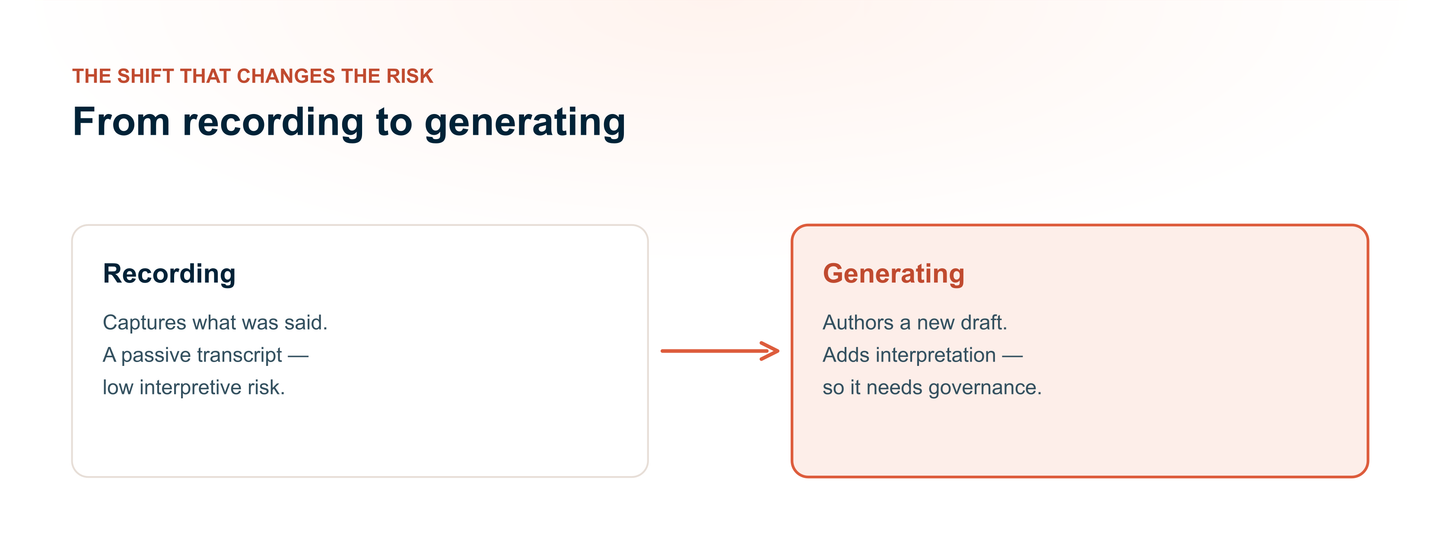
Traditional dictation required human transcription. A physician spoke, a human or speech‑to‑text engine transcribed, and the clinician reviewed and signed. The process was linear and predictable.
Generative AI, however, operates differently. It creates new text based on learned patterns and predicts what should come next in a clinical narrative. This introduces a vulnerability: the risk of fabricated information.
Unlike transcription errors, AI‑generated fabrications can be clinically plausible yet entirely untrue. The AI might add a family history of diabetes that was never discussed, or suggest a differential diagnosis that the physician never considered. These "hallucinations" are statistical discrepancies of how large language models work. They predict the most likely next word based on training data, not on clinical reality.
The Main Risks of Using Clinical AI
While AI offers immense potential, three primary risks demand immediate attention in any governance framework:
1. Hallucinations
As mentioned above, this is the most visible and dangerous risk. These risks manifest in the following ways:
- Adding symptoms the patient never mentioned.
- Documenting physical exam findings that were not performed.
- Inventing lab values or test results.
- Creating a differential diagnosis that omits critical conditions or includes implausible ones.
2. Bias
If the underlying datasets only represent specific demographics, the resulting outputs may underperform or misdiagnose minority groups. This can manifest as:
- Subtle differences in symptom description based on race or gender.
- Failure to recognize conditions more prevalent in certain ethnic groups.
- Recommendations that don't align with guidelines for diverse populations.
It is imperative to select vendors who actively audit for bias and train clinicians to recognize and correct biased outputs.
3. Data Privacy
AI tools that process Protected Health Information (PHI) introduce significant privacy and security risks:
- Cloud Storage: Many AI solutions process audio and text in external cloud environments. Without proper Business Associate Agreements (BAAs), this data is not legally protected.
- Data Retention: Some vendors retain recordings and notes for model improvement. Without explicit policies, patient data may be used for purposes beyond patient care.
- Breach Risk: Each additional vendor in the data chain increases the risk for potential data breaches.
The HIPAA Security Rule requires covered entities to ensure that any business associate handling PHI implements appropriate safeguards. Practices must vet vendors thoroughly and ensure robust BAAs are in place.
5 Policies of AI Clinical Note Governance
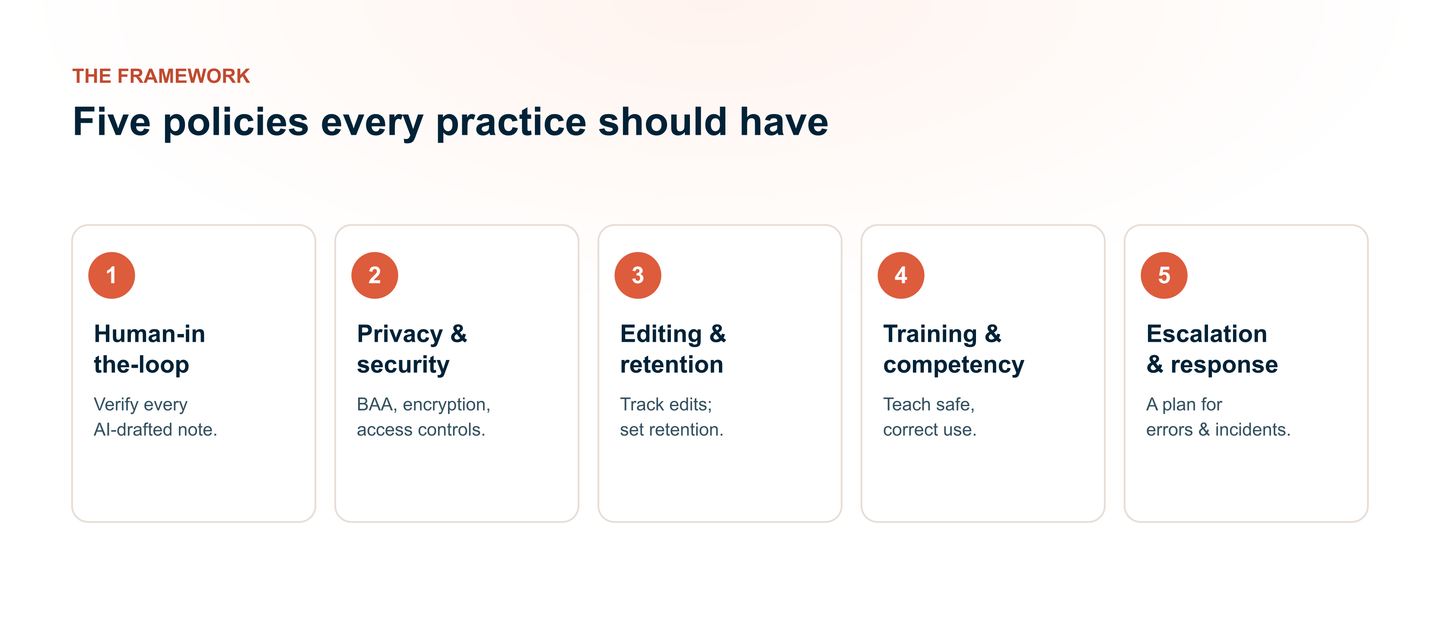
To safely integrate AI clinical notes into practice, organizations must establish comprehensive governance policies. These five policies form the foundation of a responsible AI implementation strategy:
1. The "Human-in-the-Loop" Verification Policy
Safe AI implementation means ensuring that a qualified clinician reviews and validates every AI‑generated note before it becomes part of the permanent medical record. This policy protects patients, physicians, and the practice from clinical and legal errors.
The "Attestation" Standard
Policy Mandate: The clinician must attest that they have reviewed the AI-generated note in its entirety and that it accurately reflects the encounter.
Steps for Proper Verification:
- Review the History of Presenting Illness (HPI) for Accuracy: Verify that the chronology, symptom description, and patient narrative align with the actual conversation. Check for additions or omissions that could alter clinical interpretation.
- Verify the Physical Exam Elements Were Actually Performed: This is a common area for AI hallucinations. Confirm that every finding listed was observed and documented.
- Check the Assessment & Plan for Logical Coherence: Ensure that the differential diagnosis, test orders, and treatment plan reflect clinical judgment and are not automatically generated based on biased assumptions.
Sign the note with a specific acknowledgement of AI use. If required by state law or organizational policy, include a statement confirming AI assistance and final clinician review.
2. Data Privacy and Security Protocol Policy
AI documentation tools inherently process sensitive patient data, making privacy and security policies non‑negotiable.
Vendor Management
Key Policy Components:
- Business Associate Agreement (BAA): The AI vendor must sign a BAA that explicitly defines their obligations under HIPAA, including data encryption, access controls, breach notification, and subcontractor oversight.
- Data Usage and Retention: The policy must clarify:
- Is the audio recording stored, and for how long?
- Is the data used to train or improve the AI model? (This should require explicit opt-in or be prohibited entirely.)
- Is data deleted after processing, and what is the deletion timeline?
- Security Audits: Require vendors to provide annual SOC 2 Type II reports or similar third-party security attestations.
3. The Editing and Retention Policy
Transparency and auditability are critical when AI generates clinical content. Without a clear edit trail, it becomes impossible to determine whether errors originated from the AI or from clinician modification.
Requirement: The EHR must track changes made to the AI‑generated note. This includes:
- The original AI-generated output.
- Every edit, deletion, or addition made by the clinician.
- The timestamp and user identity for each change.
Audit Preparedness
- Policy Definition: A clear policy defining retention periods for AI outputs and edit logs:
- Storage Format: Notes and edit logs should be stored in a format that is retrievable for audit purposes.
- Audit Access: Designate specific individuals with access to these logs for internal audits and regulatory inquiries.
4. The Training and Competency Policy
Even the best policies are useless without proper implementation. Clinicians and support staff must be trained not only on how to use the AI tool but also on how to critically evaluate its output.
Mandatory Training Modules for Staff:
- Identifying AI "hallucinations": recognizing plausible-sounding but fabricated clinical content.
- Recognizing when to override the AI's suggestions and documenting the clinical rationale.
- Proper data entry to avoid confusing the AI: ensuring that prompts and input are clear and complete.
- Understanding the legal and ethical implications of AI-generated documentation.
- Reporting protocols for AI-related errors or concerns.
- Frequency: Annual refresher training for all clinical staff, with dedicated onboarding training for new hires.
- Additionally, when the AI vendor releases a significant update, a targeted training session should be conducted.
5. Escalation and Incident Response Protocol Policy
AI errors are inevitable. The question is how the organization will respond when they do happen.
What Happens When a Patient Complains About an AI Error?
The policy must outline a clear, step‑by‑step response process:
- Immediate Acknowledgment: The complaint is acknowledged and documented.
- Clinical Review: A designated clinician reviews the note and determines if a correction is required.
- Risk Assessment: The Compliance Officer or Risk Management team evaluates the complaint for potential liability.
- Patient Communication: The patient is informed of the findings and any corrective action taken.
A Separate Policy for Reporting AI-Related Errors:
Establish a separate reporting protocol for AI‑related errors, distinct from standard clinical incident reporting. This allows the organization to:
- Track AI-specific error patterns (e.g., hallucinations in certain note sections, bias in specific diagnoses, etc.).
- Identify systemic issues with the AI vendor's performance.
- Inform future training and policy updates.
- Provide data for vendor performance reviews.
Conclusion
Integrating AI into clinical documentation offers transformative efficiency, but it also introduces unprecedented risks that demand governance. The five policies outlined in this article: Verification, Privacy, Edit Trails, Training, and Escalation, provide a comprehensive framework for responsible adoption. Without these policies, practices expose themselves to clinical errors, regulatory penalties, and reputational harm. With them, AI becomes a powerful aid in reducing burnout and improving patient care.