


An AI scribe costs a therapist anywhere from nothing to more than $100 a month. The range is that wide because vendors charge in four different ways: a flat monthly fee, tiers set by how many notes you write, a price per session, or an add‑on to an EHR you already pay for. Which one costs you least depends on your caseload, and on whether that caseload will look the same a year from now.
This guide works out the monthly cost of seven AI scribes that therapists commonly use, at 10, 20 and 30 sessions a week. It then covers the costs pricing pages leave out, what the time saved is worth, and how to tell which pricing model fits your practice.
Start with your caseload in notes
Most AI scribes bill by the month, but many cap or meter by note or by session, so your volume decides which plan you need. One session produces one progress note. Intakes, treatment plan updates and couples sessions can add more, depending on how a tool counts them.
For reference, psychologists in the American Psychological Association's 2021 workforce survey reported a median of 20 hours of direct patient care a week. This guide uses three caseloads:
- 10 sessions a week, about 43 notes a month: a part-time or newly opened practice.
- 20 sessions a week, about 87 notes a month: close to the APA median.
- 30 sessions a week, about 130 notes a month: a full private practice caseload.
Notes a month are sessions a week multiplied by 4.33, the average number of weeks in a month.
What AI scribes cost therapists at 10, 20 and 30 sessions a week
The table shows each tool's cheapest plan that covers the caseload, billed monthly. Where a vendor offers annual billing, the effective monthly price on an annual plan is in parentheses. All prices are in US dollars.
Tool | Pricing model | 10 sessions a week | 20 sessions a week | 30 sessions a week |
|---|---|---|---|---|
Twofold | Flat, unlimited notes | $69 ($49 annual) | $69 ($49 annual) | $69 ($49 annual) |
Upheal AI Notes | Flat, unlimited notes | $39 | $39 | $39 |
Mentalyc | Tiers by notes a month | $39.99 ($29.99 annual) | $39.99 ($29.99 annual) | $69.99 ($59.99 annual) |
Blueprint | Per session, or a flat seat | About $43 | $69 | $69 |
Freed | Tiers by notes a month | $79 | $79 | $79 |
SimplePractice Note Taker | Add-on to a SimplePractice plan | $35 plus a plan from $49 | $35 plus a plan from $49 | $35 plus a plan from $49 |
TherapyNotes TherapyFuel | Add-on to a TherapyNotes plan | $40 plus a $69 plan | $40 plus a $69 plan | $40 plus a $69 plan |
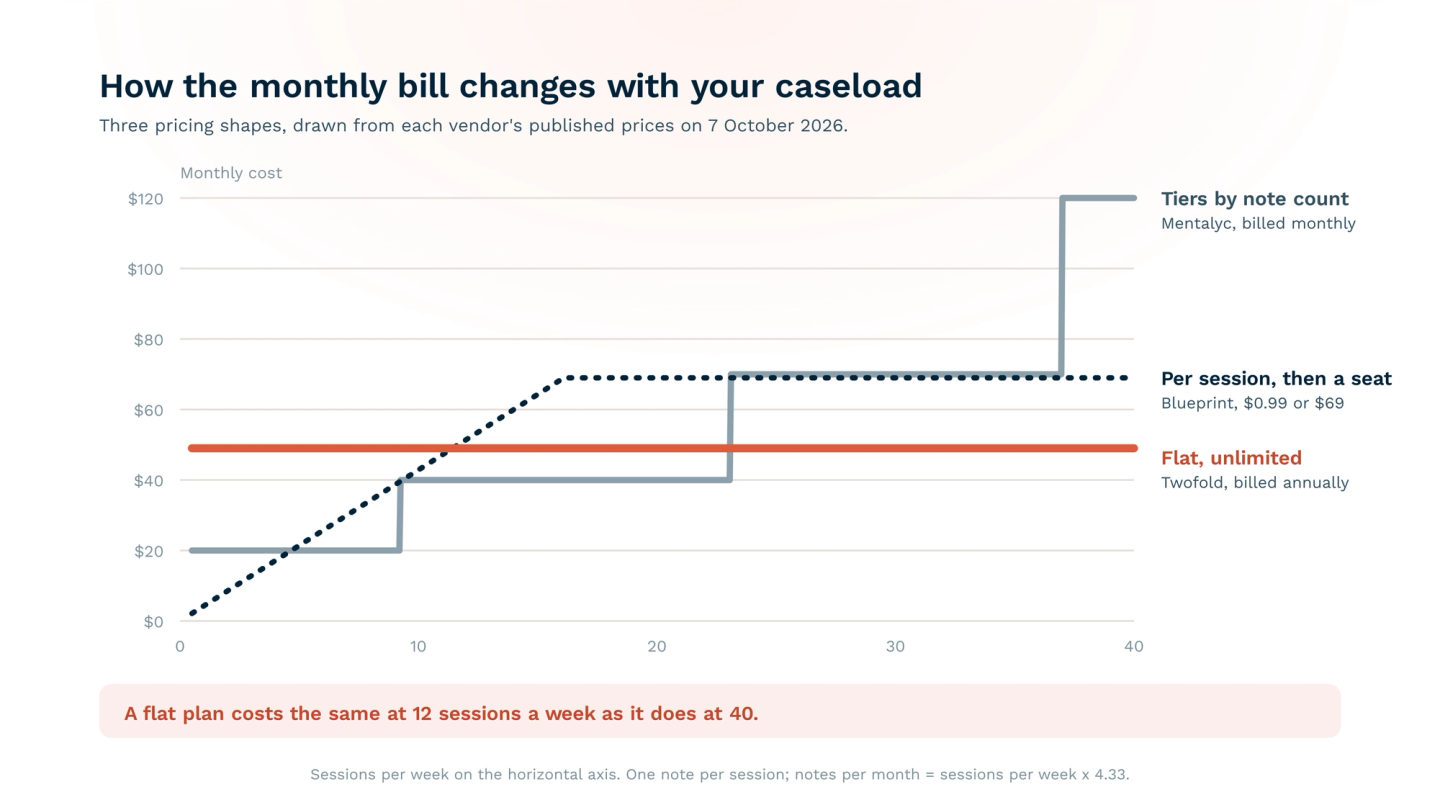
Mentalyc's Basic plan covers up to 100 notes a month and its Pro plan up to 160. Blueprint charges $0.99 a session alongside your EHR, or $69 a month for unlimited sessions, and the flat seat becomes the cheaper option at about 70 sessions a month. Freed's $39 Starter plan stops at 40 notes a month, so even a 10‑session week needs its $79 Core plan. The EHR add‑ons are shown with the cheapest base plan each EHR lists.
The four ways AI scribes charge therapists
A flat monthly fee with unlimited notes
You pay the same amount whether you write 40 notes or 140. Twofold ($49 a month billed annually, $69 billed monthly) and Upheal's AI Notes plan ($39 a month) work this way, and so do Blueprint's $69 seat and Freed's $79 Core plan. The bill doesn't move when your caseload does. What differs between flat plans is what the fee leaves out, covered below.
Tiers set by note count
Mentalyc, and Freed's entry plan, set the price by how many notes you can write each month. Mentalyc's tiers run from $19.99 for 40 notes to $119.99 for 330. Tiers look cheap at low volume. The catch is that the plan you need changes as your practice grows, and a busy month can push you over a limit.
A price per session
Blueprint charges $0.99 a session when you use it alongside your EHR, paid as credits that don't expire. Per‑session pricing is the cheapest model for a light caseload and the most expensive at a full one, which is why Blueprint also sells a $69 unlimited seat. Upheal also charges $1 a session, but on its pay‑as‑you‑go EHR plan, which is a full EHR with billing rather than a standalone scribe.
An AI add-on inside your EHR
SimplePractice sells Note Taker for $35 a month, and TherapyNotes sells TherapyFuel for $40 a month per clinician. Both need the EHR subscription underneath: from $49 a month for SimplePractice and $69 for a solo TherapyNotes account. If you already pay for that EHR and plan to stay on it, your real cost is the add‑on price. If you're choosing an EHR and a scribe at the same time, compare the total. Our SimplePractice Note Taker review covers that add‑on in more detail.
What the sticker price leaves out
Two plans with the same headline price can cost very different amounts once you use them every week. These are the gaps worth checking before you pay.
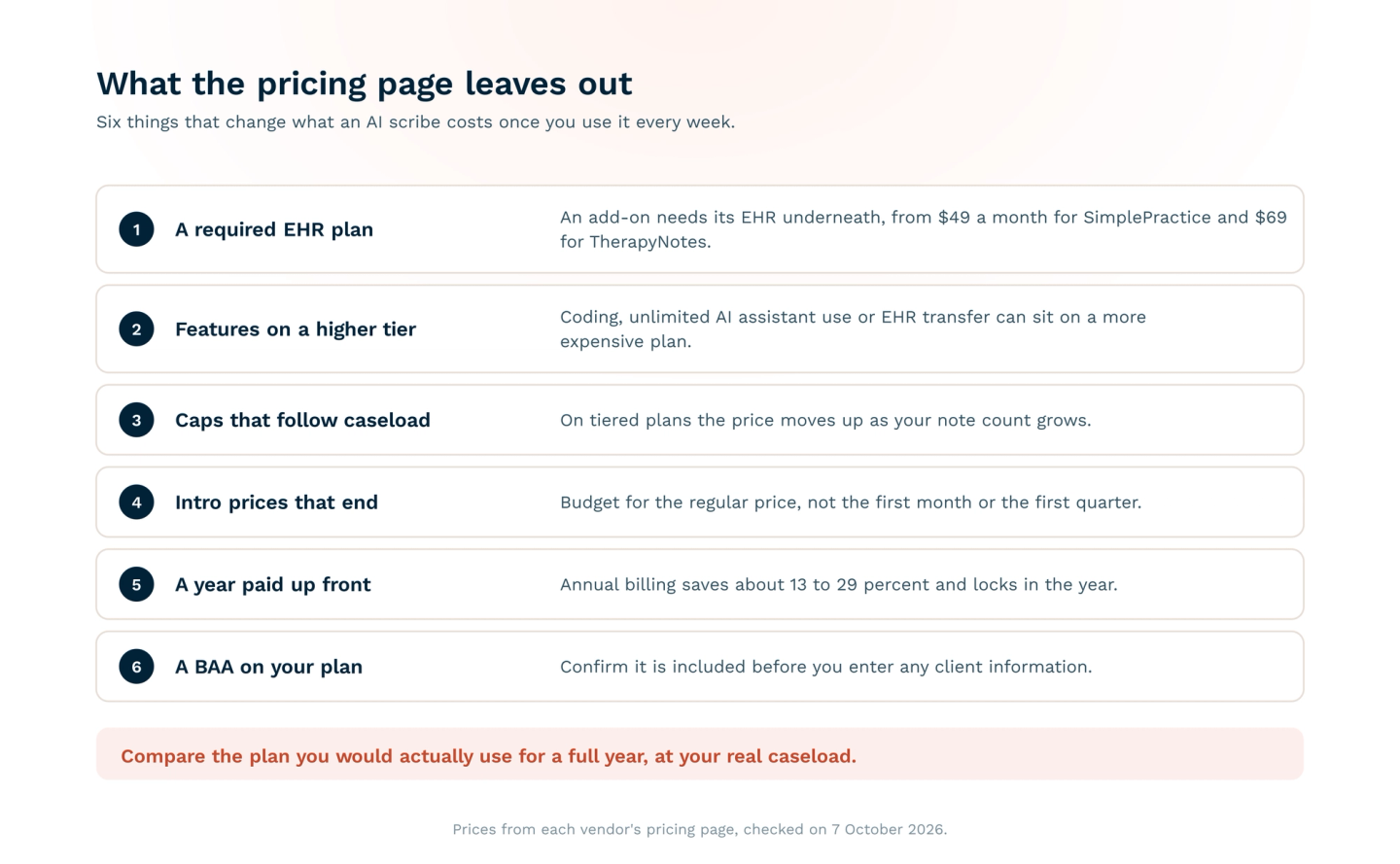
- A required EHR plan. An EHR add-on is only cheap if you'd pay for that EHR anyway. It also ties your notes tool to your EHR, so switching EHRs later means replacing the scribe too.
- Features on a higher tier. Freed includes ICD-10 and CPT codes only on its Premier plan, at $104 to $119 a month. Upheal's AI Notes plan includes AI assistant chat with a monthly usage limit, and unlimited use is another $39 a month.
- Limits that aren't about notes. Mentalyc's Mini plan sends only 20 notes a month to your EHR. Its Pro plan and above send as many as you write.
- Intro prices that end. SimplePractice currently shows Note Taker at $17.50 a month for three months, then $35. Twofold's first month on monthly billing is $19, then $69. Budget for the regular price.
- A year paid up front. Annual billing lowers the monthly price by roughly 13 to 29 percent among these tools, but you commit to twelve months. Run a full month of real sessions before you sign up for a year.
- Recent price changes. Upheal changed its pricing in 2026 and now lists its older plans as legacy. Some third-party sites still quote the old $1 a session capped at $69, so check the vendor's own page.
- The BAA. A HIPAA business associate agreement should come with the plan you buy. Twofold includes a signed BAA on every plan, and Mentalyc, Blueprint, Freed and TherapyNotes state that their BAA covers users under their standard terms. If a pricing page doesn't mention one, ask before you enter client information.
Is an AI scribe worth the cost for a therapist?
The price is easier to judge against your own time than against other tools. In the APA's 2021 survey, psychologists reported a mean of 7.5 hours a week on administrative work, alongside about 20 hours of patient care. SimplePractice's report on 2025 says early users of AI note‑taking reported saving about five hours a week. That number comes from a vendor's survey, so treat it as an upper estimate.
The break‑even point is low. At $49 a month and a session fee of $120, a scribe pays for itself if it saves you about 25 minutes a month. At 20 sessions a week, that's under 20 seconds per note.
The harder question is whether you'll trust the drafts enough to stop rewriting them. That depends on how well a tool handles your formats, such as SOAP, DAP, BIRP, intakes and treatment plans, which is why a trial with real sessions tells you more than any price list. For a wider look at the return, see are AI scribes worth it.
Which pricing model fits your practice
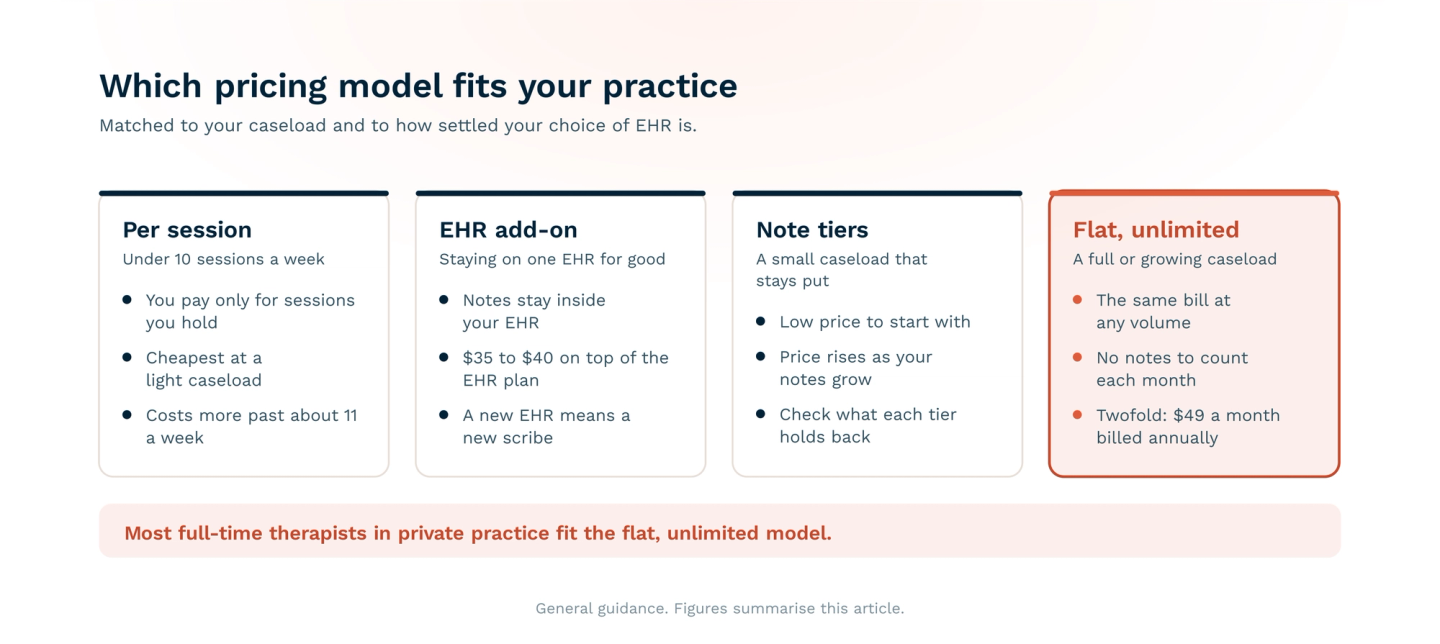
- Fewer than 10 sessions a week, and staying there: per-session pricing usually costs least. At 8 sessions a week, Blueprint's $0.99 a session comes to about $34 a month.
- Settled on SimplePractice or TherapyNotes for the long term: the EHR add-on keeps notes inside the system you already use, at $35 or $40 a month on top of it.
- A full or growing caseload: a flat, unlimited plan. Your bill stays put as your practice grows, and you never count notes.
Most therapists in private practice fall into the last group, and among flat plans the useful comparison is what the fee covers. Twofold's annual plan is $49 a month and includes unlimited notes, CPT and ICD‑10 coding, unlimited use of its AI assistant, patient progress tracking and a signed BAA, and it works with any EHR. Of the tools in this guide, it's the lowest price that covers all of that without an EHR subscription. Flat plans with a lower sticker price exist, such as Upheal's $39 AI Notes plan, but it caps assistant use each month and doesn't list coding, so price what you'd need to add.
Twofold is also the simplest of these to budget for: one paid plan, no tiers to outgrow and no add‑ons. It starts with a 7‑day free trial that doesn't need a credit card, the first month on monthly billing is $19, and you can cancel from your account settings. Twofold pricing explained lists everything the plan includes, and our guide to budget-friendly AI scribes compares cost per note in more depth.
How to check the real price before you subscribe
- Count last month's notes, including intakes and treatment plan updates, and add about 20 percent for growth.
- Find the cheapest plan that covers that number without a cap, and note its regular price after any promotion.
- List the features you use every week, such as coding, treatment plans or couples notes, and check they're on that plan.
- Add any EHR subscription the tool requires.
- Confirm the BAA is included on that plan.
- Run real sessions through the free trial before you pay for a year.