



Chronic pain affects over 1.5 billion people, yet its management remains persistently challenging for modern medicine. The biopsychosocial model has become the prevailing clinical framework, viewing pain not as a mere biological signal but as a complex interplay of biological, psychological, and social factors. This raises a critical question: how can artificial intelligence effectively operationalize a model rooted in human complexity? Explore how AI therapy note tools are helping clinicians synthesize biopsychosocial data at clinical scale, transforming documentation, understanding, and treatment of chronic pain.
Understanding the Biopsychosocial Model in Chronic Pain
The biomedical model works well for acute conditions. A fracture heals, and pain subsides as tissue repairs. Chronic pain does not follow this pattern. Two patients with identical MRI results can report vastly different pain levels and functional limitations.
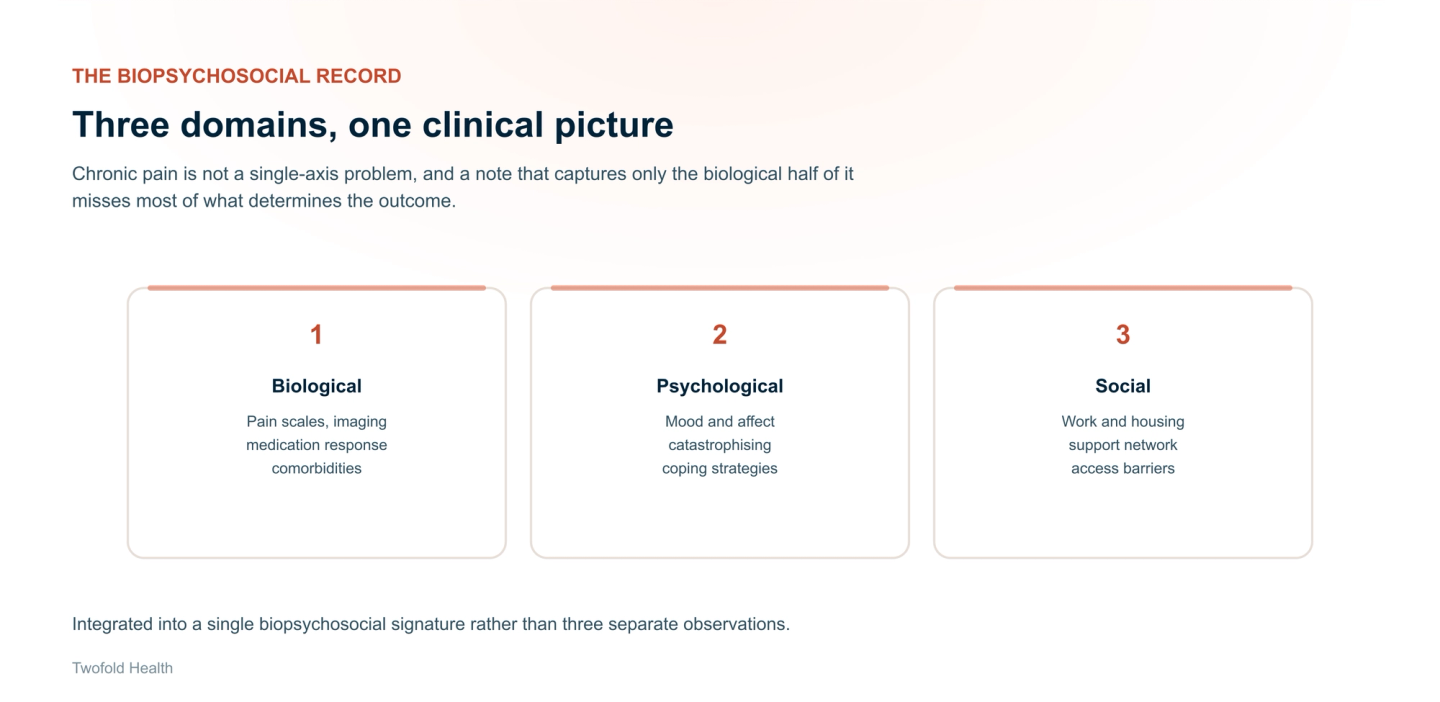
The biopsychosocial model emerged to address this disconnect. It conceptualizes pain as the product of interacting factors. Biological elements include genetics, inflammation, nervous system sensitization, and tissue pathology.
Psychological factors include depression, anxiety, resilience, and pain acceptance.
Social dimensions involve support networks, cultural context, healthcare access, occupational factors, and socioeconomic status.
This framework recognizes that pain experience is shaped by the whole person, not just the affected tissue. The model expands the clinical gaze to include what patients bring to the encounter, their fears, their circumstances, their expectations.
The Documentation Challenge
Chronic pain consultations are demanding. Clinicians must explore multiple domains within a single encounter, and the time constraints make thorough history‑taking difficult. The standard 0–10 numeric rating scale captures pain intensity but conveys little about the psychosocial context that drives disability and treatment response.
Critical information also goes undocumented. Mood, social support, work stress, and coping strategies are frequently buried in lengthy narrative notes or omitted entirely. Clinicians working under pressure may rely heavily on imaging and physical examination findings while psychosocial factors remain unexplored.
AI scribes offer a potential solution. These tools can capture and structure biopsychosocial information that would otherwise be lost.
How AI Integrates Biological, Psychological, and Social Data
Pain does not reduce to one measurable entity. AI addresses this limitation by integrating multiple data types simultaneously. Machine learning models can now combine neuroimaging, sensor data, and psychosocial assessments into unified analytical frameworks. This integration enables the identification of multimodal biosignatures that capture pain's full complexity.
Biological Data Integration
- Neuroimaging: AI analyzes functional MRI and structural imaging to identify patterns associated with chronic pain conditions.
- Sensor Data: Wearable devices generate continuous physiological data, such as heart rate variability, sleep patterns, and activity levels, that AI correlates with pain fluctuations.
- Electronic Health Records: Structured and unstructured data from clinical notes, labs, and medication histories are synthesized into a comprehensive patient profile.
- Dynamic Tracking: AI enables monitoring of pain's temporal evolution, potentially identifying critical transition points from acute to persistent states.
Psychological Data Extraction
Natural Language Processing (NLP) serves as the primary tool for capturing psychological dimensions. Large language models analyze patient interviews and clinical notes for linguistic patterns that reveal psychological states. This approach enables a fully data‑driven exploration of psychological factors.
Key Psychological Indicators AI Can Identify from Clinical Notes
- Pain catastrophizing language.
- Fear-avoidance beliefs.
- Depressive symptoms.
- Anxiety expressions.
- Treatment expectations.
- Coping strategies.
- Resilience indicators.
Social Data Synthesis
Social determinants present a particular challenge for documentation. They are often mentioned briefly in clinical conversations but rarely captured systematically. AI addresses this through several mechanisms:
- Linguistic Analysis: NLP identifies references to work stress, financial concerns, housing instability, and caregiving responsibilities.
- Geographic Data: Integration with external datasets provides contextual information about neighborhood characteristics and healthcare access.
- Social Network Mapping: Analysis of patient language reveals the presence or absence of support systems.
- Occupational Context: AI extracts work-related factors that influence pain and functional limitations.
- Cultural Considerations: NLP can identify culturally specific pain expressions and treatment preferences.
Integrated Biopsychosocial Signatures
The most significant advancement lies in AI's capacity to synthesize across domains. Machine learning models do not simply accumulate data points, it identifies relationships between biological findings and psychological states. It also connects social circumstances to treatment adherence patterns. This integration produces what researchers call biopsychosocial signatures, multidimensional profiles that predict pain trajectories and treatment responses with better accuracy.
AI Clinical Decision Support for Chronic Pain
Pain diagnosis remains a persistent challenge. Pain is subjective, and expression varies widely between patients. Underlying biopsychosocial factors are difficult to assess systematically, so AI offers potential to enhance diagnostic accuracy, predict treatment outcomes, and personalize pain management strategies.
Enhancing Diagnostic Accuracy
Clinicians frequently face uncertainty when evaluating chronic pain. Imaging findings do not always align with patient‑reported symptoms.
- Synthesizing Disparate Data: AI can combine information from imaging, patient histories, physical examinations, and psychosocial assessments.
- Balancing Subjective and Objective Measures: AI approaches can help bridge the gap between self-reports and clinical examination findings, moving toward a more integrated diagnostic framework.
Informing Prescribing Decisions
Pharmacological management of chronic pain is complex. Clinicians must weigh efficacy against risks, including dependence and adverse effects.
- Electronic Medical Record Analysis: A 2025 study used explainable AI to predict pharmacological management strategies for chronic lower back pain.
- Monitoring Tool: This approach offers a transparent, data-driven method for understanding prescribing patterns and potential disparities in pain care.
Risk Stratification and Early Intervention
AI can identify patients at higher risk for poor outcomes before they occur.
- Pain Chronification: Predictive analytics can flag patients likely to transition from acute to chronic pain.
- Psychosocial Risk Factors: Models that incorporate psychological and social variables can identify patients needing early psychological or social support.
- Resource Allocation: Risk stratification enables more efficient use of limited pain medicine resources.
Conclusion
AI therapy notes tools are uniquely suited to operationalize the biopsychosocial model. It integrates diverse data types, detects patterns that might escape clinical observation, and synthesizes complex narratives into actionable documentation. Yet AI remains an assistive tool, not a replacement. It frees clinicians to focus on the therapeutic relationship while ensuring that biopsychosocial complexity is captured and considered.