


What is SOAP note drift? It is the unintended change of AI‑generated clinical documentation over time. Without active management, drift creates inconsistent records and a lack of trust in your AI scribe. Understanding exactly why it happens, from model updates to prompt sensitivity, gives you control. In this guide, you'll learn six practical strategies to keep your AI SOAP notes accurate and audit‑ready, week after week.
What Is SOAP Note Drift? (And Why You Should Care)
AI model drift (SOAP note drift specifically) isn't about occasional misspellings or autocorrect errors. It's a systematic, gradual change in how an AI structures and phrases clinical information over time, even when you feed it nearly identical patient data.
Consequences
Drift carries tangible risks for your practice and your patients.
Consequence | Example of Drift | Potential Impact |
|---|---|---|
Clinical | "Sharp chest pain radiating to the left arm" drifts to a generic "Chest discomfort." | Delayed triage; patient safety. |
Medicolegal | Symptoms like "Abdomen soft, non-tender" become "Abdomen ordinary." | Lost specificity in a malpractice defense; inability to prove thorough examination. |
Reimbursement | MDM score changes from "Moderate" (99214) to "Low" (99213). | Significant revenue loss per note. |
Why AI Changes SOAP Notes Over Time
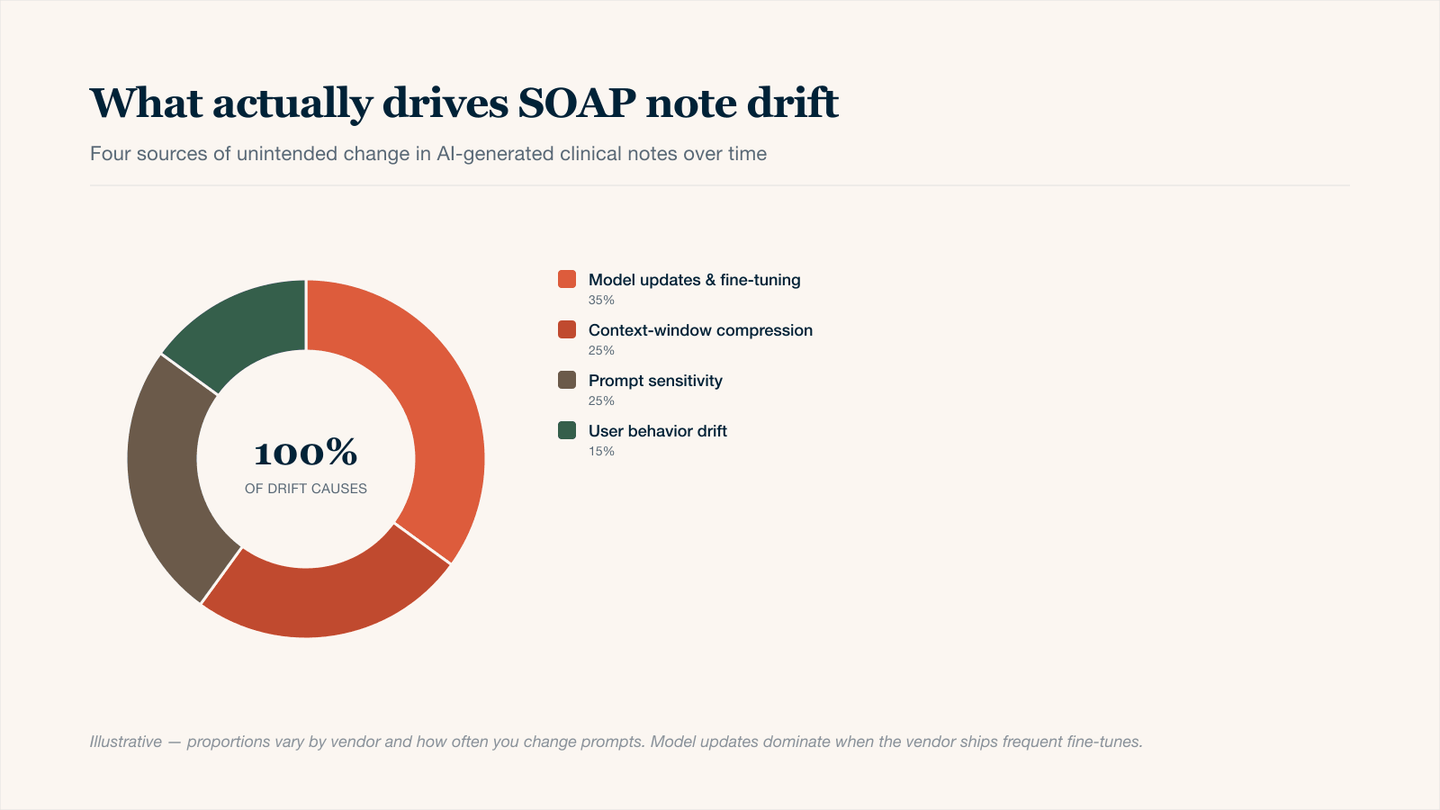
Four sources, all running in the background — why your SOAP notes don't read the same six months apart.
1. Model Updates & Fine-Tuning
Vendors regularly retrain their AI models on new datasets to improve performance. But "improvement" for a general AI might mean rewording medical phrases for broader readability, which breaks your preferred clinical voice.
2. Context Window Compression
AI tools have a limited "memory" for a single conversation. After you dictate 10–15 patient encounters in one chat thread, the AI begins dropping the earliest instructions to make room for new text. You won't know compression happened until you compare note 1 and note 21 side by side. Most clinicians don't have time for that.
3. Prompt Sensitivity (Even Small Wording Changes)
Large language models are sensitive to phrasing. Adding or removing a single word from your dictation template can produce a meaningfully different SOAP structure.
Example:
- Prompt A: "Write a SOAP note for this patient."
- AI outputs bullet points under each heading.
- Prompt B: "Write a detailed SOAP note for this patient."
- AI adds full sentences and an assessment plan.
4. User Behavior Drift
This is the most overlooked aspect. Clinicians naturally become less precise with dictations over time. You start abbreviating, skipping qualifiers, or assuming the AI "knows" what you mean. The AI receives less structure. To fill the gap, it sometimes guesses using past notes or invents a format.
How to Keep AI SOAP Notes Consistent: 6 Actionable Strategies
- Lock Your Prompts: Create a single, saved dictation template and use it for every patient. Never type a free-text prompt from scratch. Copy, paste, or select from a library.
- Implement a Standard Note Example: Give the AI a perfect example of how you want every SOAP note to look. This works better than any instruction.
- Use Fixed Output Schemas: Some AI tools allow you to define a note structure without needing code. Think of it as a digital form with labeled fields instead of a blank page.
- Run Weekly Drift Checks: Spend five minutes each week testing your AI's consistency. If you see any shift, revert to your standard note example and regenerate. If drift persists, contact your vendor about model changes.
- Avoid Relying on Long Chat Histories: Start a fresh conversation for each patient encounter or each clinic session. Do not let one chat thread accumulate 30, 40, or even 50 SOAP notes.
- Choose AI Tools That Offer Version Locking: The best AI SOAP Note platforms allow you to freeze the underlying model version for a set period.
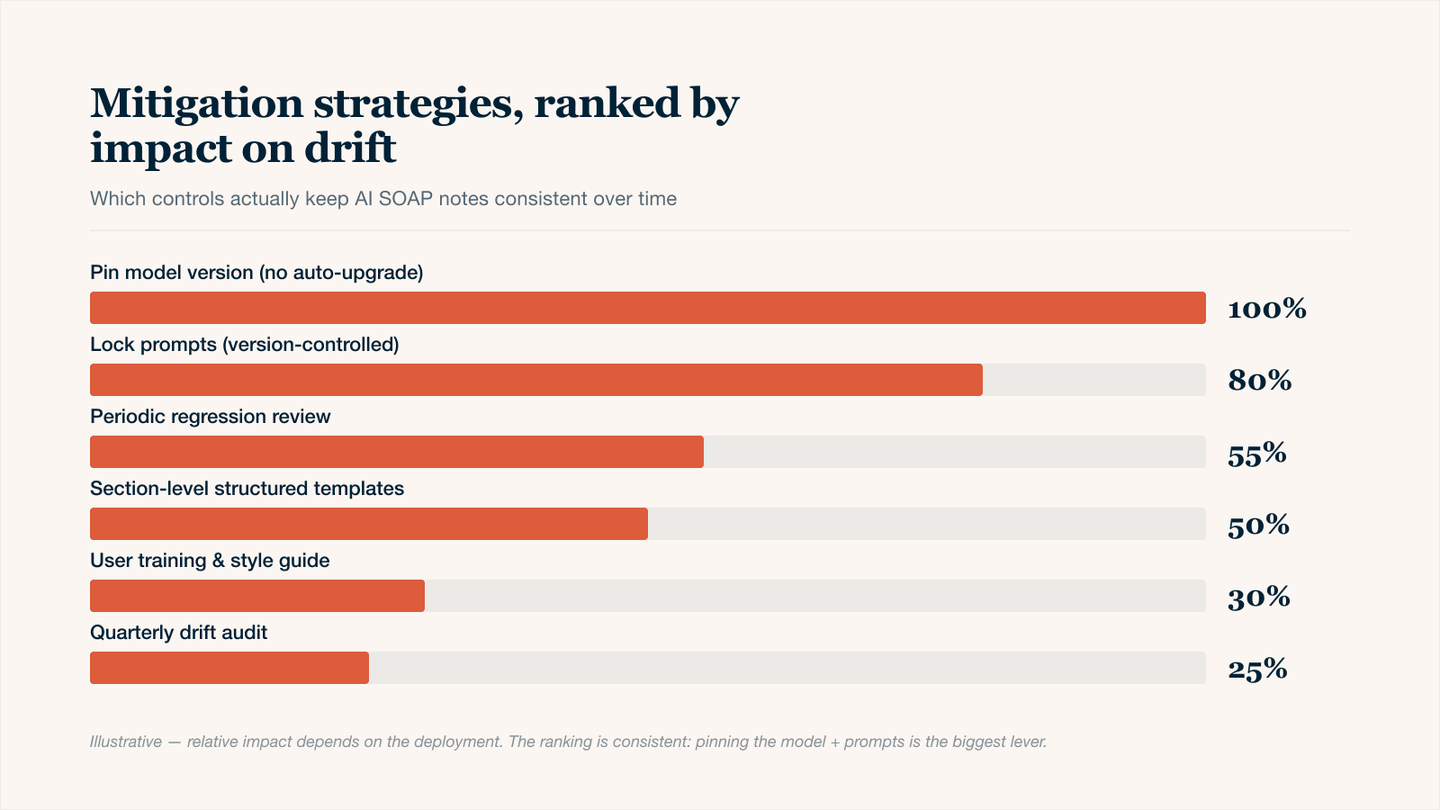
Pinning the model and the prompts beats everything downstream — by a wide margin.
Conclusion
SOAP note drift is not a sign of a broken AI tool; it is a consequence of model updates, context limits, and changing user habits. Without active management, your clinical documentation will slowly become inconsistent, risking patient safety and reimbursement. But drift is preventable by locking prompts, starting fresh chats, and running weekly drift checks. Fix your SOAP note output today before it becomes a liability.