



HIPAA-compliant AI note tools appeal to clinicians seeking relief from administrative burdens. Adopting these tools creates a trust relationship between practice and vendor regarding data security. Yet vendor infrastructure remains a source of vulnerability. A breach at the AI vendor level triggers obligations under HIPAA that are distinct from internal incidents. Explore how to navigate the precise notification timelines and the practical steps required during the response window for practices using AI tools.
The HIPAA Breach Notification Rule
A breach is the acquisition, access, use, or disclosure of unsecured Protected Health Information (PHI) in a manner not permitted under the Privacy Rule. The incident must compromise the security or privacy of the PHI. If the data remains secure and intact, it may not meet the threshold.
The Risk Assessment
Before issuing notifications, the vendor (or your practice) must assess the probability of compromise. The assessment considers:
- The nature and extent of the PHI involved (e.g., names vs. Social Security numbers vs. clinical notes).
- The unauthorized person who used the PHI or to whom it was disclosed.
- Whether the PHI was actually acquired or viewed, rather than just potentially accessible.
- The extent to which the risk has been mitigated (e.g., data was deleted or encryption keys were not compromised).
The Notification Triggers and Timelines
If a breach is confirmed, the following obligations must be met:
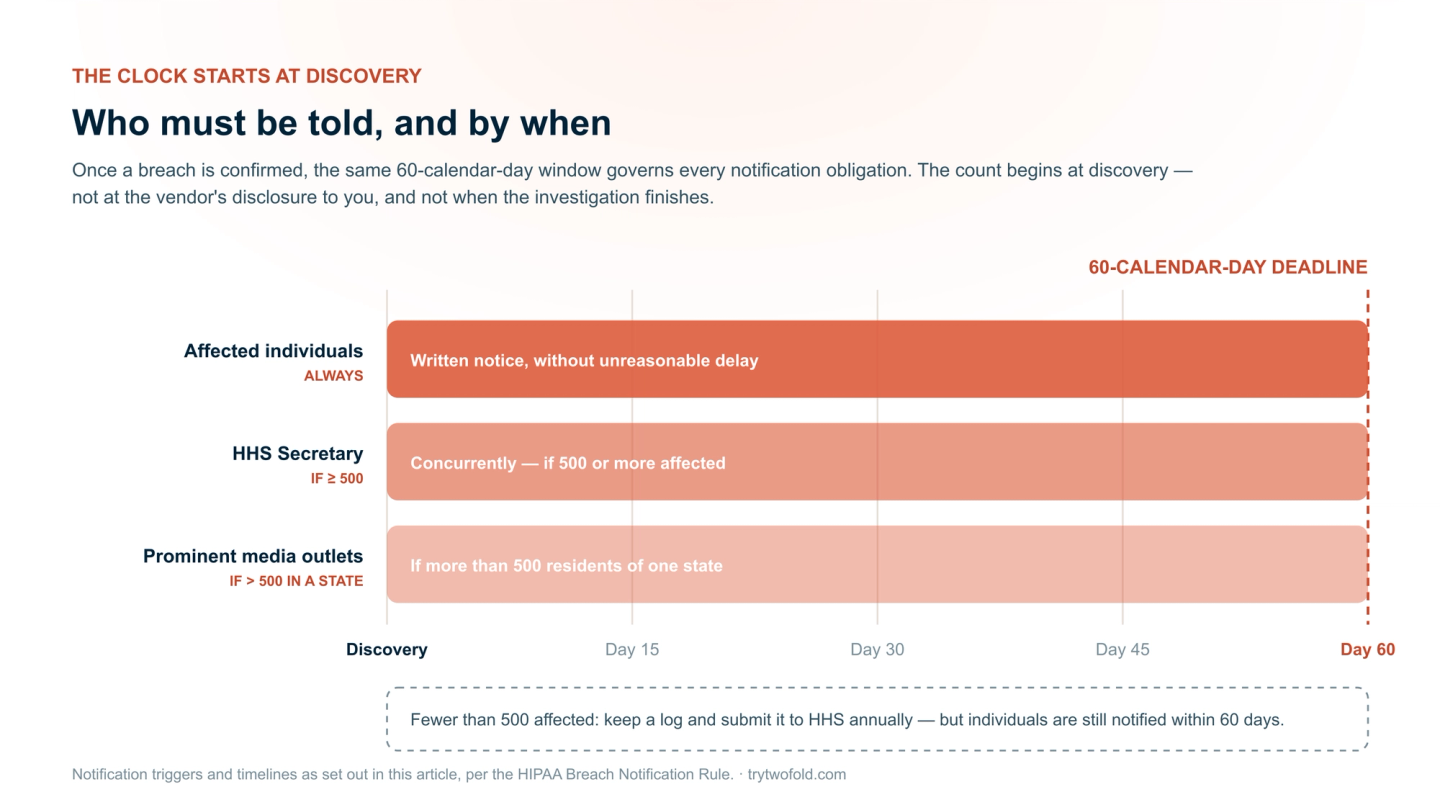
- To Affected Individuals: Written notice must be provided without unreasonable delay, and no later than 60 calendar days from the discovery of the breach.
- To HHS: If 500 or more individuals are affected, the Secretary of HHS must be notified concurrently (within that same 60-day window). If fewer than 500 are affected, a log of breaches must be submitted annually, within 60 days of the calendar year's end.
- To the Media: For breaches affecting more than 500 residents of a state or jurisdiction, prominent media outlets in that state must be notified within that 60-day window.
The 5-Step Response Plan for an AI Vendor Breach
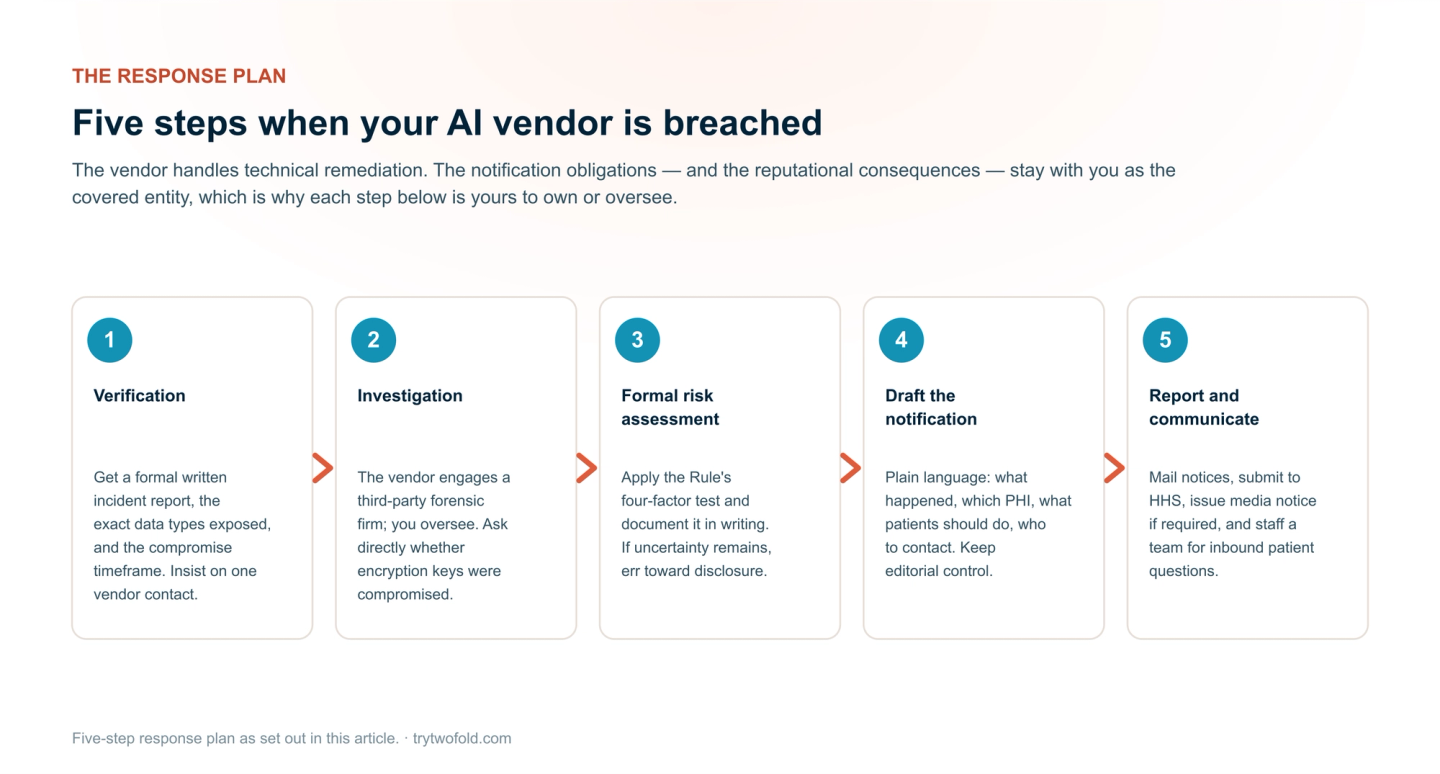
Step 1: Verification
The first hours are for establishing facts.
- Request a formal incident report from the vendor. Do not rely on verbal summaries.
- Confirm the specific data types involved. Determine if the exposure included audio recordings, transcribed clinical notes, demographics, or only system metadata.
- Establish the timeframe of the compromise. Knowing when the breach began helps define the patient population at risk.
- The vendor should provide a single point of contact to streamline communication and prevent scattered information.
Step 2: Investigation
The vendor must engage a qualified third‑party forensic/cybersecurity firm to conduct a technical investigation. Your role is oversight.
- Request the firm's credentials and scope of work. Ensure they are examining log files, access histories, etc.
- Ask explicitly whether encryption keys were compromised.
- Determine whether the data actually left the environment or the attack was contained. This distinction directly impacts the subsequent risk assessment.
- Obtain a written preliminary forensic summary.
Step 3: The Formal Risk Assessment
Do not skip this step without independent review.
- Apply the test from the Breach Notification Rule: evaluate the nature of the PHI, the unauthorized recipient, actual acquisition or viewing, and mitigation measures already taken.
- Document the assessment in writing. This record serves as your defense if regulators question your decision not to notify.
- If the assessment indicates a low probability of compromise, you may halt the notification process. If uncertainty remains, err on the side of disclosure. The burden rests on you to prove harm is unlikely.
- Consult internal compliance or external legal counsel before finalizing this determination.
Step 4: Drafting the Notification Content
If the risk assessment confirms a reportable breach, drafting begins. Federal rules require plain language accessible to the average patient.
- The notification must include:
- A description of the incident.
- The types of PHI involved.
- Steps patients should take to protect themselves (such as password resets), and contact information for follow-up questions.
- Avoid technical jargon; explain what happened in plain terms.
- Coordinate with the vendor on a joint statement, but retain final editorial control. You are the entity patients will hold accountable.
Step 5: Reporting and Patient Communication
Execution of the notification falls on your shoulders, even if the vendor assists with logistics.
- Mail written notifications to affected individuals. Email may suffice only if patients have previously consented to electronic communication.
- Submit the breach report to the HHS Secretary. For breaches exceeding 500 individuals, this submission must occur concurrently with patient notifications, within that 60-day window.
- Issue media notice if the breach affects more than 500 residents of a single state or jurisdiction. Distribute the notice to prominent local outlets.
- Establish a dedicated response team to handle incoming patient inquiries. Anticipate confusion and frustration. Clear, empathetic communication reduces reputational damage.
Conclusion
When an AI notes tool vendor experiences a data breach, the immediate technical remediation falls to that organization. The legal obligations regarding patient notification and the associated reputational consequences rest with the covered entity. A thorough comprehension of the breach notification timelines and an application of the risk assessment highlighted above make up the essential components of a defensible compliance posture.