


For an LCSW who bills Medicaid, the best first AI scribe to test is Twofold because it includes unlimited progress notes, SOAP, DAP, BIRP and other Medicaid‑relevant formats, a Medicaid initial diagnostic interview template, treatment plans with progress tracking, CPT and ICD‑10 suggestions for clinician review, and a signed BAA on every plan. It costs $49 a month billed annually, or $69 billed monthly ($19 for the first month on the monthly plan), with a 7‑day free trial and no credit card. Upheal may fit better if you want the lowest‑price live‑capture option at $39/month and do not need group notes; Mentalyc may fit better if its Chrome EHR extension matters more than solo note caps; Eleos is a better fit for an agency buying enterprise compliance and revenue‑cycle software.
What a Medicaid-billing LCSW needs from an AI scribe
A Medicaid‑billing LCSW needs an AI scribe that drafts specific notes, links care to the treatment plan, supports time‑based CPT documentation, and leaves the clinician in charge of review and signature. We make Twofold, so weigh our view accordingly. We put it first because its included features line up with the documentation problems Medicaid therapists ask us about most: medical necessity, treatment‑plan progress, code support, a BAA and no note cap.
- The note should show why the psychotherapy service was medically necessary for this client on this date.
- The note should connect the session to a treatment-plan goal, symptom, impairment or measurable objective.
- The note should document the intervention, the client's response and the plan in plain clinical language.
- The tool should help with CPT and ICD-10 review without acting as the billing clinician.
- The final record should preserve the LCSW's review, edits, date and signature.
- The vendor should sign a BAA and explain how it handles audio, transcripts and PHI.
For group or agency work, patient‑specific documentation matters. CMS says group therapy should be billed with group codes and should document patient‑specific information in each attendee's medical record. Twofold's group therapy note workflow creates a group note plus an individualized summary for each participant.
What Medicaid reviewers look for in psychotherapy progress notes
Medicaid reviewers look for state‑rule compliance, medical necessity, active treatment, time, signature, date, correct coding and patient‑specific content, but the exact checklist changes by state Medicaid program and managed care plan. CMS's Medicaid behavioral health documentation fact sheet says documented services must meet that state's Medicaid rules and, where state law requires it, reflect medical necessity and active treatment.
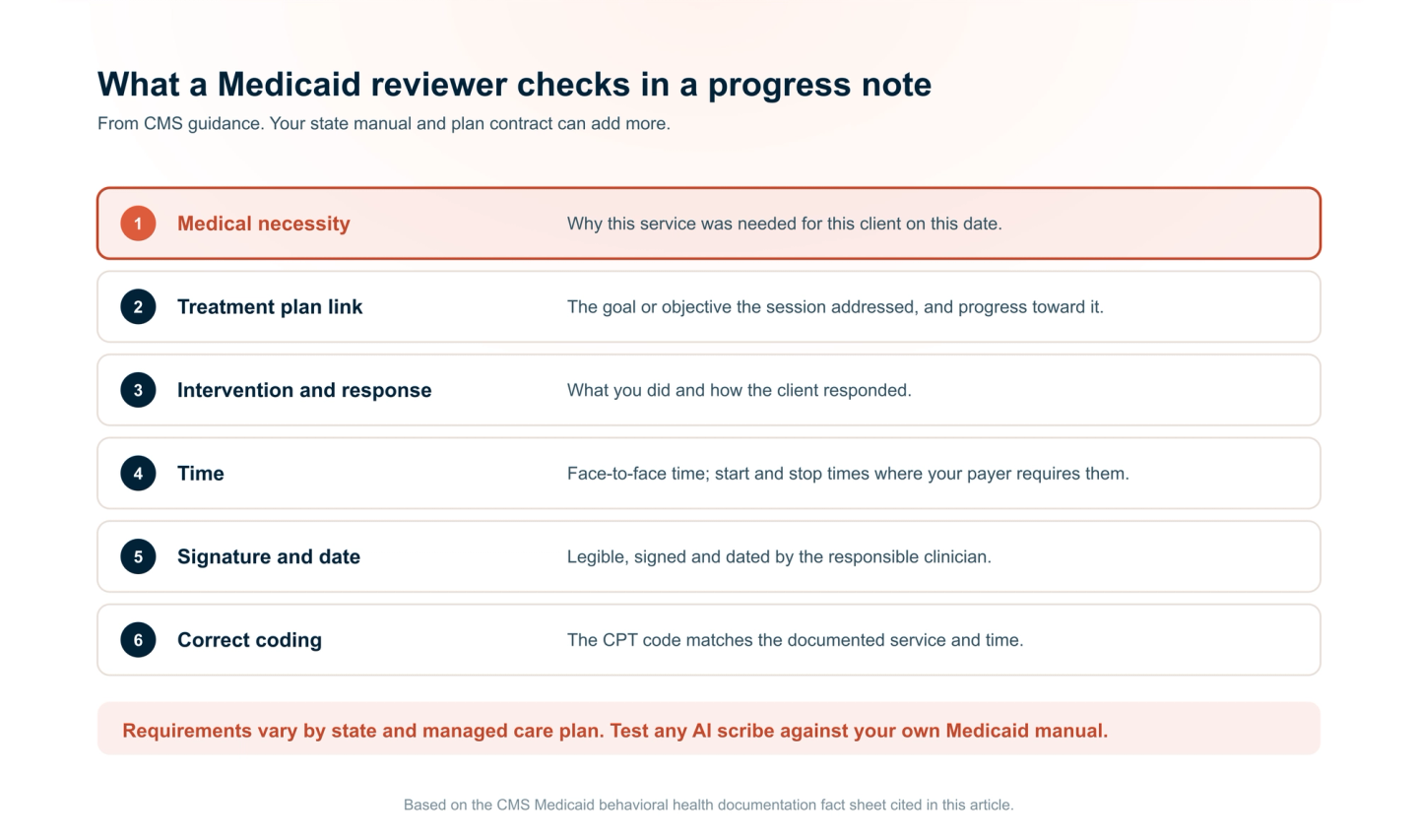
- The service meets the state's Medicaid program rules.
- The note reflects medical necessity and justifies the treatment and clinical rationale, where required.
- The note reflects active treatment, where required.
- The note is complete, concise and accurate, including face-to-face time with the patient.
- The note is legible, signed and dated.
- The record is maintained and available for review.
- The service is coded correctly for billing purposes.
- Group therapy records include patient-specific information for each attendee.
- EHR notes should not look cloned across visits, and edits should identify the editor.
State examples show why one national checklist is not enough
Missouri and Pennsylvania show how much documentation rules can differ. Missouri's MO HealthNet rule requires a legible, contemporaneous record with the participant's name and date of birth or middle initial, service description, provider name, title and signature, date, setting, plan of treatment, need for the service in relation to the treatment plan, and progress toward treatment‑plan goals. For time‑based services, Missouri requires the actual begin and end time, such as 4:00 to 4:30 p.m.
Pennsylvania Medical Assistance requires records to be legible, identify the patient on each page, and have entries signed and dated by the responsible licensed provider. The rule lists working and final diagnosis, treatment and treatment plan, progress at each visit, changes in diagnosis or treatment, response to treatment, and medical necessity for each rendered, ordered or prescribed service. Pennsylvania's general rule does not list start and stop times, though behavioral‑health‑specific rules and managed care policies may add requirements.
How time-based psychotherapy codes change what your scribe must produce
For time‑based psychotherapy codes, the scribe can help draft the note, but the clinician must record the actual time. Medicare billing article A57520 says start and stop times or total times must be documented for CPT codes 90832, 90834 and 90837, and it says not to report psychotherapy of less than 16 minutes. Medicaid programs and plans may set their own rules, so check the rule you bill under.
Code | Time range | What your record needs |
|---|---|---|
90832 | 16 to 37 minutes | Start and stop times or total time. |
90834 | 38 to 52 minutes | Start and stop times or total time. |
90837 | 53 or more minutes | Start and stop times or total time. |
CMS's Medicaid fact sheet separately says behavioral health records should include face‑to‑face time spent with the patient. Missouri goes further for time‑based services by requiring actual begin and end time. Do not rely on an AI scribe to infer time from a session; enter the real time in your note or EHR according to your payer's rule.
Which AI scribes fit Medicaid progress notes best?
Twofold is the best first trial for most solo and group LCSWs billing Medicaid, while Upheal, Mentalyc, TasiPsych, Eleos and SimplePractice fit narrower workflows. Competitor entries below are as of November 2026, and prices change. To compare note caps with a real caseload, we use weekly sessions x 52 / 12: 15 sessions a week is about 65 notes a month, 25 is about 108 and 35 is about 152.
Scribe | Best fit | Price and billing | Note limit | Trial |
|---|---|---|---|---|
Twofold Health | Solo and group Medicaid notes | $49/mo billed annually; $69 monthly | Unlimited | 7 days, no card |
Upheal | Lower-price live capture | $39/month flat | Unlimited AI Notes | No card; length unpublished |
Mentalyc | EHR extension priority | $69.99 Pro monthly; $59.99/mo annual | Pro: 160 notes | 14 days; 15 notes |
TasiPsych | Psychiatry-heavy clinics | $79/mo per provider annual | Unlimited | 10 days |
Eleos Health | Enterprise agencies | Not public | Not public | Demo |
SimplePractice Note Taker | SimplePractice-only workflows | $35 add-on plus plan | No cap stated | Up to 30 days |
Scribe | Treatment plans | CPT or ICD-10 | BAA | Medicaid templates |
|---|---|---|---|---|
Twofold Health | Yes, with progress tracking | CPT and ICD-10 suggestions | Included | SOAP, DAP, BIRP, Medicaid IDI |
Upheal | Yes, Golden Thread | CPT not published | Included | BIRP, DAP, MSE; no group |
Mentalyc | Basic and up | CPT Pro and up | At signup | BIRP Pro; group Super |
TasiPsych | Not mentioned | CPT; ICD-10-CM mapping | Included | SOAP, BIRP, DAP |
Eleos Health | Golden Thread compliance | Revenue-cycle guardrails | Not mentioned on homepage | Individual, group, psychiatry |
SimplePractice Note Taker | Care Aide bundle | Not published | BAA link | Intake; SOAP defaults |
Where Twofold is the better first test
Twofold is the better first test when your Medicaid documentation problem is volume plus clinical specificity. The paid plan includes unlimited notes, every template, custom templates, treatment plans with progress tracking, Ask Twofold for note edits and audit‑prep questions, CPT and ICD‑10 suggestions, iPhone and Android apps, web access, telehealth and in‑person sessions, dictation and audio upload, and a signed BAA. See Twofold pricing and Twofold security for current plan details.
For group practices, Twofold offers custom per‑seat pricing with volume discounts, centralized billing, shared templates, seat management, one BAA for the group and an admin dashboard for note status, time saved and clinician activity. The groups page lists $49 as the typical cost per clinician per month, flat and unlimited. Twofold support can also set records custody so notes written while a clinician is in the group stay with the group when that clinician leaves.
When another tool may fit better
Upheal is better if the deciding factor is a $39/month live‑capture plan and you do not need group therapy notes. It includes unlimited AI notes via video, audio, dictation and uploads, treatment plans, Golden Thread and a Compliance Checker. Upheal says group therapy notes are on its roadmap and not supported as of November 2026.
Mentalyc is better if one‑click EHR transfer through a Chrome extension is worth more to you than unlimited solo notes. Its solo plans cap notes at 40, 100, 160 or 330 per month, while Team seats are unlimited with a fair‑usage clause and are for group practices only. Mentalyc's pricing page also lists medical necessity documentation in every note and automatic CPT codes on Pro, Super and Team.
TasiPsych is better for psychiatry‑heavy or mixed behavioral health clinics that want CPT suggestions, DSM‑5‑TR / ICD‑10‑CM mapping with confidence scores, PHQ‑9 / GAD‑7 / BDI and an audit rules engine. Its pricing page shows $79 /mo per provider billed annually at $948/year; the monthly‑billing price is not published clearly.
Eleos is better for a large community behavioral health, SUD, home health or hospice organization buying enterprise software. It publishes documentation for individual, group, psychiatry and assessment notes, a compliance product that reviews 100% of notes before submission, and revenue‑cycle guardrails before claim creation. For a solo LCSW, public pricing is not available.
SimplePractice Note Taker is better if you already live inside SimplePractice and want drafting in that EHR workflow. At list price, Starter at $49/month plus the $35/month Note Taker add‑on is $84/month per clinician. Note caps are not stated on SimplePractice's pricing page.
Weak versus Medicaid-ready progress note excerpt
A Medicaid‑ready progress note excerpt states the need for care, the intervention, the client's response, progress toward the treatment plan, time and the clinician's review more clearly than a weak note. The examples below are fictional, use initials only, and are not a complete payer template.
The stronger excerpt is useful because it answers the audit questions: why the service was needed, what the LCSW did, how the client responded, how the work connects to the treatment plan, what time was billed and who reviewed the final record.
Consent and HIPAA for AI note help
For AI note help, use a vendor with a BAA, tell clients how the tool supports documentation and follow your state's recording‑consent law. Twofold provides a signed BAA on every plan, processes audio to create the note, never stores audio, and does not use audio, transcripts, notes or other PHI to train AI models.
Recording‑consent rules vary by state and profession. California Penal Code Section 632(a) prohibits recording a confidential communication without the consent of all parties. APA Ethics Code Standard 4.03 says psychologists obtain permission before recording voices or images. NASW Code of Ethics 1.03(h) says social workers should obtain clients' informed consent before making audio or video recordings, and 1.03(e) and 1.03(f) address technology‑use policies and informed consent for technology. This is not legal advice; check your state law, Medicaid manual, managed care contract and agency policy.
The LCSW stays responsible for every AI-drafted note
The clinician remains responsible for the signed record, so review every note and never sign what you did not verify. CMS's Medicaid fact sheet says records should be signed and dated, Medicare signature guidance focuses on identifying the person responsible for the beneficiary's care, and EHR edits should identify the person making the change.
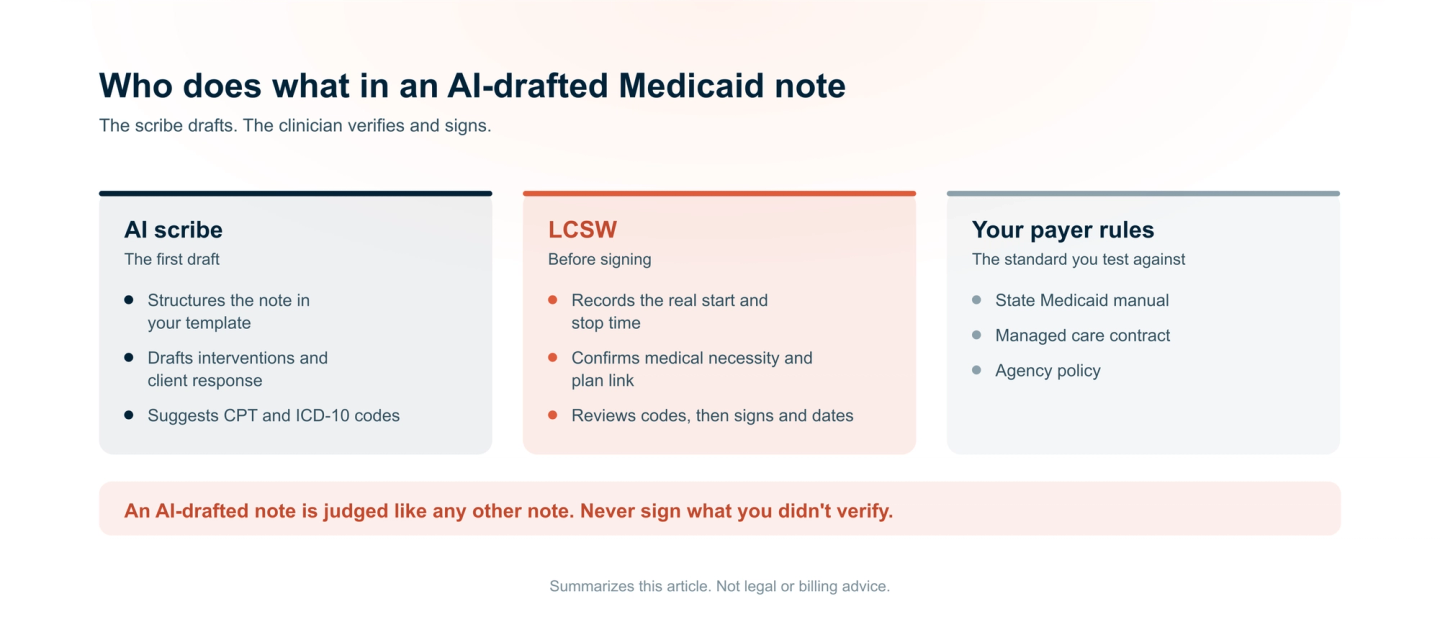
Treat an AI‑drafted note like any other draft in the chart: confirm the diagnosis support, medical necessity, intervention, client response, time, code, plan, signature and date. If the scribe suggests CPT or ICD‑10 codes, review them against the session and the payer rule before billing. For more on the general question, see do insurers accept AI-generated clinical notes?.
HIPAA separates psychotherapy notes from ordinary progress‑note content. The federal definition of psychotherapy notes excludes session start and stop times, modalities and frequencies, clinical test results, diagnosis, functional status, treatment plan, symptoms, prognosis and progress to date. Those billing and treatment elements belong in the medical record your payer reviews.
How to test a scribe against your own Medicaid manual during a free trial
The right way to test an AI scribe is to build a mini‑audit from your own Medicaid manual, then run your highest‑risk note types through the trial. Twofold offers a 7‑day free trial with no credit card; Mentalyc lists a 14‑day trial with 15 Pro notes; Upheal says no credit card is required for trial but does not publish the length; TasiPsych lists a 10‑day free trial; SimplePractice lists up to 30 days for its base product.
- Pull the rules you bill under: state Medicaid manual, managed care policy, agency policy, EHR template and supervision requirements.
- Turn those rules into a one-page checklist: time, setting, diagnosis, medical necessity, intervention, client response, goal progress, plan, signature and date.
- Test at least 3 visit types: a routine 90834, a higher-acuity 90837, and any group, family, collateral or intake note you bill.
- Enter the real start and stop time or total time yourself, then confirm the draft keeps it consistent with the billed code.
- Look for cloned phrasing across notes. Different clients and different sessions should not sound identical.
- Check how hard the draft is to fix. If you add medical necessity, treatment-plan linkage and client response every time, keep testing.
- Before using the tool for billable care, save the BAA, update consent, confirm data handling and decide where the signed note will live.