

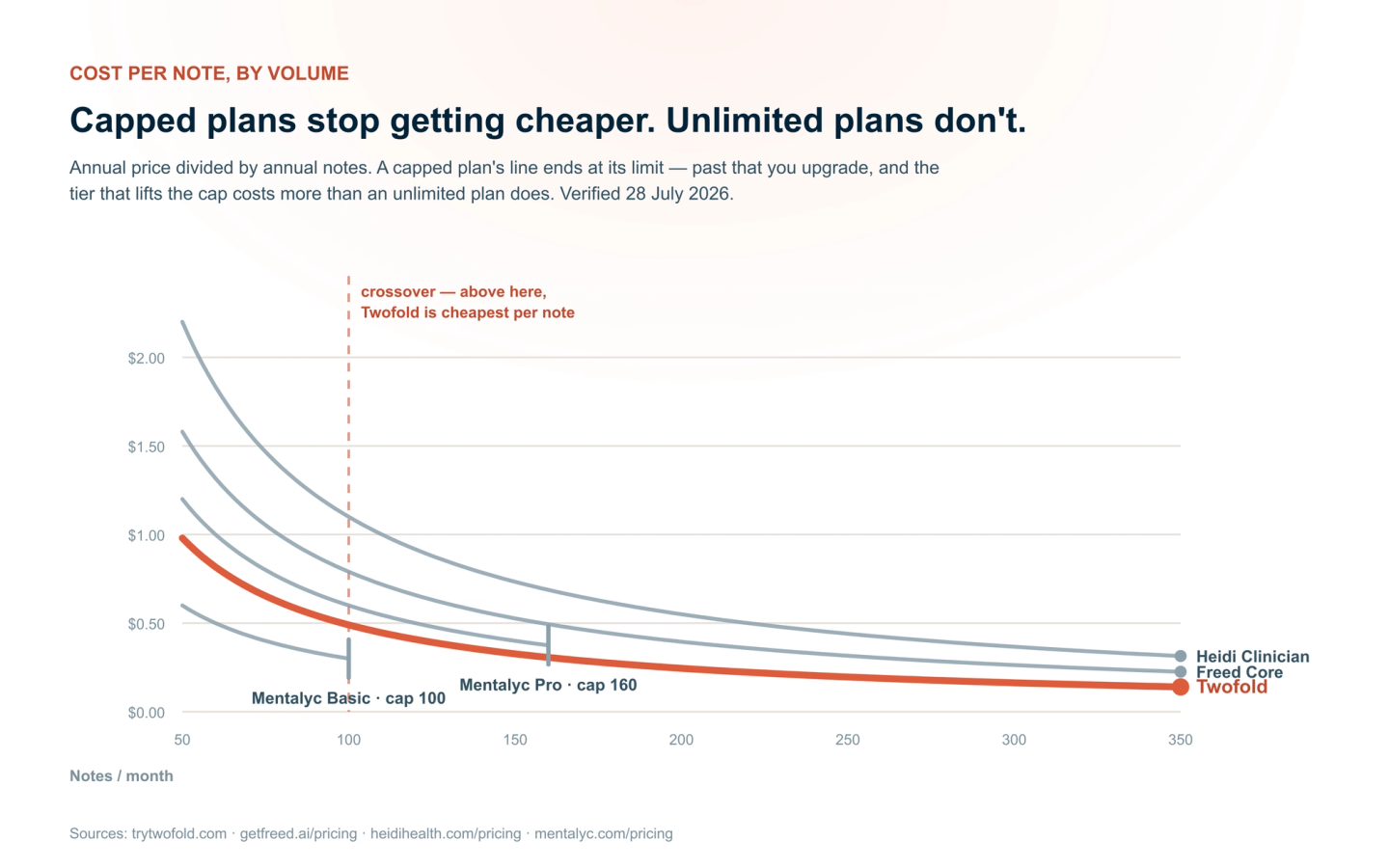
The most budget‑friendly AI scribe for a clinician with a full caseload is Twofold at $588 a year — the cheapest plan that gives you unlimited notes with CPT and ICD‑10 coding included and nothing held behind a higher tier. Below roughly 100 notes a month, capped plans are genuinely cheaper: Mentalyc starts at $179.88 a year and Freed Starter at $468. Above that crossover, capped plans stop being the budget option, because you either hit the cap or jump a tier and pay more than an unlimited plan costs.
Most "cheapest AI scribe" comparisons rank on sticker price, which is the wrong number. A $15‑a‑month plan capped at 40 notes costs more per note than a $49 plan with no cap, the moment you write your 41st note. This guide ranks on cost per note at real volumes and shows exactly where each option stops being cheap. All prices verified 28 July 2026 from each vendor's own pricing page.
Disclosure: this comparison is published by Twofold Health, and Twofold is ranked first. The methodology is stated below, every price is sourced and dated so you can check it, and the section on when competitors cost less than Twofold is not decorative — it is where the useful part of this analysis lives.
What "Budget-Friendly" Actually Means
Cost per note, at the volume you actually write, with the features you actually need. Three things follow from that definition, and they are why this list ranks differently from a price snapshot:
- A note cap converts a monthly price into a per-note price. A plan at $29.99 a month capped at 100 notes is $0.30 a note if you use all of it, and considerably worse if you don't.
- Gated coding changes which plan you are actually buying. If you need CPT and ICD-10 codes, the entry tier is not your price — the tier that includes coding is.
- Unlimited plans get cheaper per note the more you write, and capped plans do not. That is the whole crossover.
Excluded from this analysis: transcription accuracy, note quality, and time saved. Those matter enormously and none of them is what this article is about — no vendor here, including Twofold, publishes comparable measured data on them, so ranking on them would mean ranking on marketing copy.
The Crossover: Where Capped Plans Stop Being Cheap
At 50 notes a month, Mentalyc Basic costs $0.60 a note against Twofold's $0.98. At 150 notes a month, Twofold costs $0.33 a note and Mentalyc Pro costs $0.40. At 300, Twofold is $0.16 and the nearest capped competitor is roughly double.
The crossover sits at around 100 notes a month — roughly five a working day. Below it, buy the cheapest capped plan that covers your volume. Above it, capped plans are false economy, because the tier that lifts your cap costs more than an unlimited plan does.
1. Twofold — Best Overall for a Full Caseload
$49 a month billed annually, or $69 month‑to‑month. One paid tier containing the entire product: unlimited notes, 70+ templates plus custom templates, CPT and ICD‑10 coding, patient progress tracking, all devices, and a signed BAA on every plan. Works alongside any EHR.
Strengths
- $588 a year, unlimited — the cheapest uncapped plan here, and the cheapest that includes coding at all.
- No note cap, no per-note or per-minute metering, and no higher tier to upgrade into.
- Coding included, where Freed reserves it for Premier and Heidi for Practice.
- Signed BAA on every plan, not gated behind a tier.
- Gets cheaper per note the more you write: $0.33 at 150 notes a month, $0.16 at 300.
Watch-outs
- Not the cheapest sticker price. Below about 100 notes a month, capped plans cost less.
- No permanent free plan — a 7-day trial, no credit card. Heidi has a free tier and Twofold does not.
- Notes reach your EHR by copy-paste rather than a native one-click write-back.
Best for: clinicians writing more than about 100 notes a month who want one predictable cost with nothing gated.
2. Mentalyc — Best If You Write Under 100 Notes a Month
Tiered and note‑capped: Mini at $14.99 a month billed annually (40 notes), Basic at $29.99 (100), Pro at $59.99 (160), Super at $99.99 (330). A Team plan at $49.99 a seat billed annually removes the cap under a fair‑use policy. Behavioral‑health focused.
Strengths
- The cheapest genuine entry point here at $179.88 a year, and the best cost per note below 100 a month.
- Behavioral-health specific, with BIRP, PIRP, GIRP, PIE and SIRP templates at Pro.
- 14-day trial with full Pro access and no credit card.
Watch-outs
- Every solo tier is capped. Exceeding your cap means upgrading, and the upgrade is where the savings go.
- CPT codes and custom templates arrive at Pro ($719.88 a year) — more than Twofold's unlimited plan.
- Treatment planner is Basic and above; progress tracker and group/couple/family options are Pro and above.
- The unlimited option is a Team plan at $599.88 a seat a year, which is more than Twofold's individual plan.
Best for: part‑time, early‑career or low‑volume clinicians whose monthly note count is genuinely predictable.
3. Freed — Cheapest Entry Point, If the Cap Fits
Starter at $39 a month (40 notes), Core at $79 (unlimited), Premier at $119 or $104 billed annually (adds coding and one‑click EHR push). A general ambient scribe rather than a specialty tool.
Strengths
- $468 a year at Starter is the lowest annual cost of any uncapped-feeling plan here, if 40 notes covers you.
- Popular with solo and mobile clinicians; quick to start.
- One-click EHR push at Premier, which nothing else on this list offers natively.
Watch-outs
- Starter's $39 is shown struck through from $59. At list price it is $708 a year — more than Twofold.
- 40 notes a month is about two a working day; a full caseload clears it in a fortnight.
- Unlimited means Core at $948, and Core does not include coding. With coding it is Premier at $1,248.
- At 150 notes a month, Core costs $0.53 a note against Twofold's $0.33.
Best for: genuinely low‑volume clinicians, and anyone who needs native EHR write‑back enough to pay Premier for it.
4. Heidi — Best Free Tier, Most Expensive Paid Path
A free plan with unlimited transcription and standard templates; Clinician at $110 per user a month billed yearly ($150 monthly); Practice at $180 per user a month billed annually. Prices exclude sales tax.
Strengths
- The only genuine free tier here — unlimited transcription, standard templates, task management, at $0.
- 14-day paid trial, the longest on this list.
- Strong multi-site and team features at the Practice tier.
Watch-outs
- Coding is Practice-only. It is not on the Clinician plan at all, which puts coding at $2,160 a year.
- Prices are per user and exclude sales tax, so the invoice runs above the sticker.
- The free tier limits advanced templates, patient and session linking, personalisations and Ask Heidi.
- At 150 notes a month, Clinician costs $0.73 a note — more than double Twofold.
Best for: teams that want to trial widely at no cost, and organisations for whom the Practice team features justify the price.
5. DeepScribe — Unpriceable, Which Is Itself the Finding
Enterprise‑oriented, sold through a demo rather than self‑serve signup. Pricing is not published.
Strengths
- Implementation support and customisation suited to multi-site rollouts.
Watch-outs
- You cannot budget for a price you cannot see. In a cost comparison, that is disqualifying on its own.
- Demo-gated, so evaluation is slow relative to tools you can trial the same afternoon.
Best for: large organisations with procurement processes, where a quote is expected anyway.
Cost per Note at Three Volumes
Annual cost divided by annual notes. Dashes mean the plan's cap makes that volume impossible.
Plan | Annual | 50 notes/mo | 150 notes/mo | 300 notes/mo |
|---|---|---|---|---|
Twofold ($49/mo annual, unlimited) | $588 | $0.98 | $0.33 | $0.16 |
Mentalyc Basic (100/mo cap) | $359.88 | $0.60 | — | — |
Mentalyc Pro (160/mo cap) | $719.88 | $1.20 | $0.40 | — |
Mentalyc Super (330/mo cap) | $1,199.88 | $2.00 | $0.67 | $0.33 |
Freed Core (unlimited, no coding) | $948 | $1.58 | $0.53 | $0.26 |
Freed Premier (unlimited, coding) | $1,248 | $2.08 | $0.69 | $0.35 |
Heidi Clinician (unlimited, no coding) | $1,320 | $2.20 | $0.73 | $0.37 |
When Something Else Is Cheaper Than Twofold
Three cases, stated plainly, because a comparison that only points one way is not worth reading:
- Under about 100 notes a month. Mentalyc Basic at $359.88 a year beats Twofold on both total cost and cost per note. If you are part-time or early-career and your volume is stable, buy the capped plan.
- Under 40 notes a month, if Freed's promotional rate holds. Freed Starter at $468 a year is cheaper than Twofold's $588. Check whether the $39 is still discounted from $59 when you buy.
- If free is the requirement. Heidi's free tier is $0 forever. It excludes coding and limits several features, but if basic documentation covers your work, use it — no paid plan competes with free.
Twofold's case is not that it is cheapest in every scenario. It is that it is cheapest for the clinician writing a full caseload who needs coding and does not want to think about caps again.
Work Out Your Own Number in Two Minutes
- Count last month's notes. Not your best month — a normal one.
- Add 20%. Caseloads grow, and you are buying for next year, not last month.
- Check whether that number fits under the plan's cap. If it is close, price the tier above.
- Decide whether you need CPT and ICD-10 codes. If you do, price the tier that includes them, not the entry tier.
- Multiply the monthly price by 12, add sales tax where the vendor excludes it, then divide by your annual notes.
That last number is the only one worth comparing.
The Verdict
For a clinician with a full caseload, Twofold is the most budget‑friendly AI scribe at $588 a year — unlimited notes, coding included, nothing gated, and the lowest cost per note of any uncapped plan above roughly 100 notes a month. Below that crossover, Mentalyc is cheaper and Freed Starter is cheaper still; if you need free, Heidi's tier is the only real one. Twofold's 7-day trial takes no credit card, so you can run your own volume through it before deciding.
For a plan‑by‑plan price snapshot rather than per‑note math, see our most affordable AI scribe guide. If free is what you are really after, start with is there a free AI scribe for clinicians.