


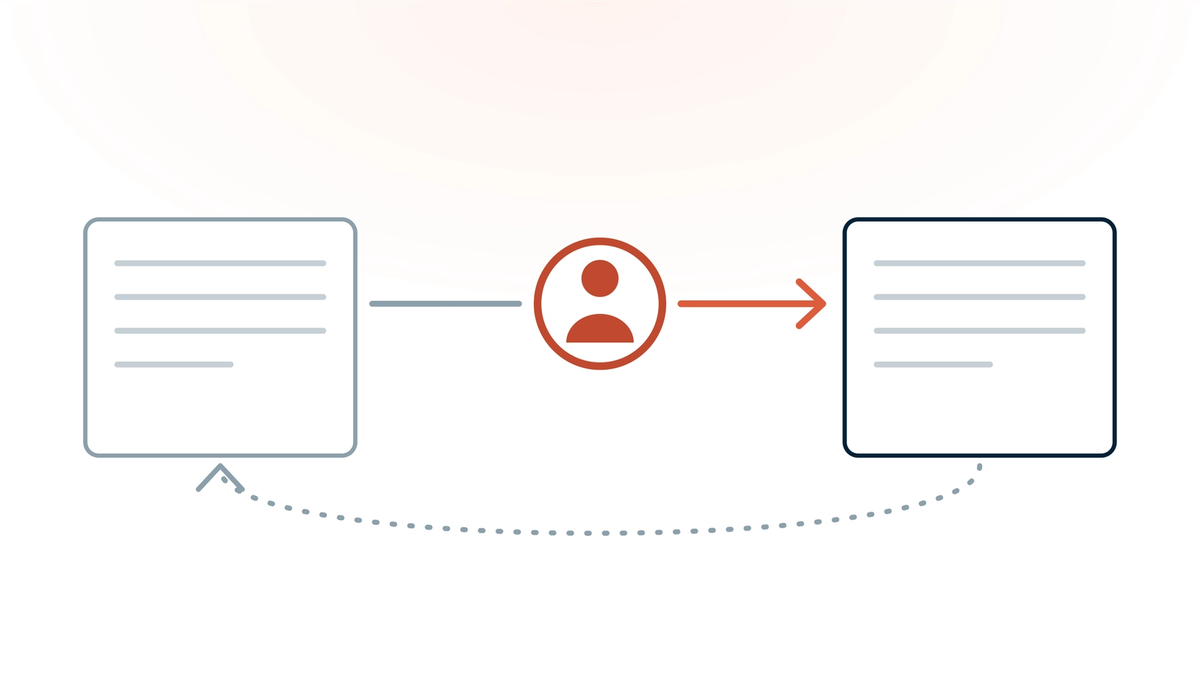
The integration of artificial intelligence into clinical workflows often sparks a legitimate concern: is this technology designed to replace the therapist's role? At Twofold, we build for augmentation, not automation. Your clinical expertise remains the foundation of care. This article explores the "Clinician-in-the-Loop" framework, illustrating why Twofold's AI therapy notes function as a supportive tool and demonstrating that the final diagnosis requires your contextual, ethical, and professional judgment to ensure overall safety.
Defining the "Clinician-in-the-Loop" Framework
The "Clinician-in-the-Loop" framework ensures clear boundaries: the technology assists you with documentation, while you retain ultimate authority over patient care.
- Principle: Twofold generates differential hypotheses and synthesizes patient data, but every output requires active human validation before it influences a diagnosis or treatment plan.
- The "Automation Bias" Guideline: This framework acts as a safeguard against automation bias, which is the deferring to algorithmic suggestions without independent reasoning. By mandating review, it forces you to evaluate every recommendation against the patient's unique presentation critically.
See more on AI bias and how to prevent it to ensure equitable care.
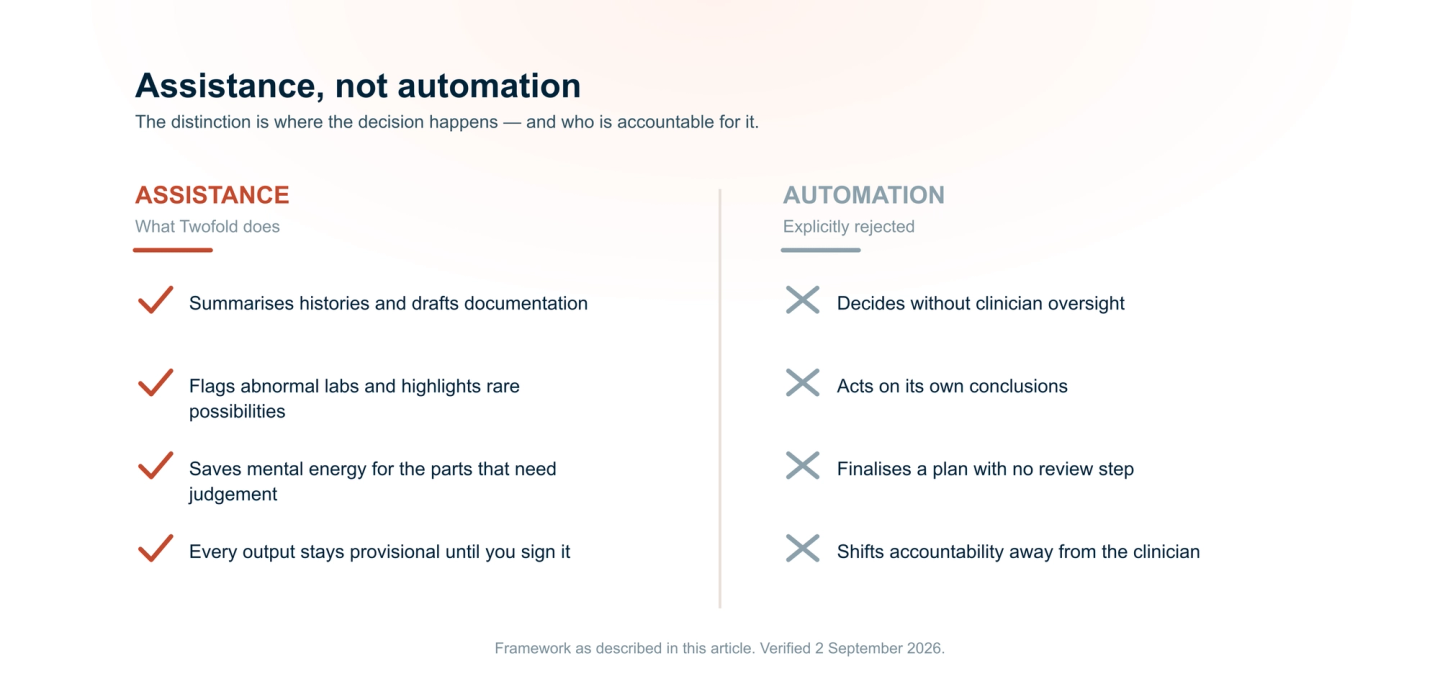
Assistance vs. Automation:
- Assistance (Twofold): AI streamlines documentation, summarizes histories, flags abnormal labs, and highlights rare possibilities. This saves mental energy and time for complex, nuanced reasoning.
- Automation: AI decides, acts, or finalizes a plan without clinician oversight. We explicitly reject this type of workflow.
- Accountability: The loop ensures that legal, ethical, and professional accountability remains squarely with you, the clinician.
Why Your Clinical Judgment Is Irreplaceable
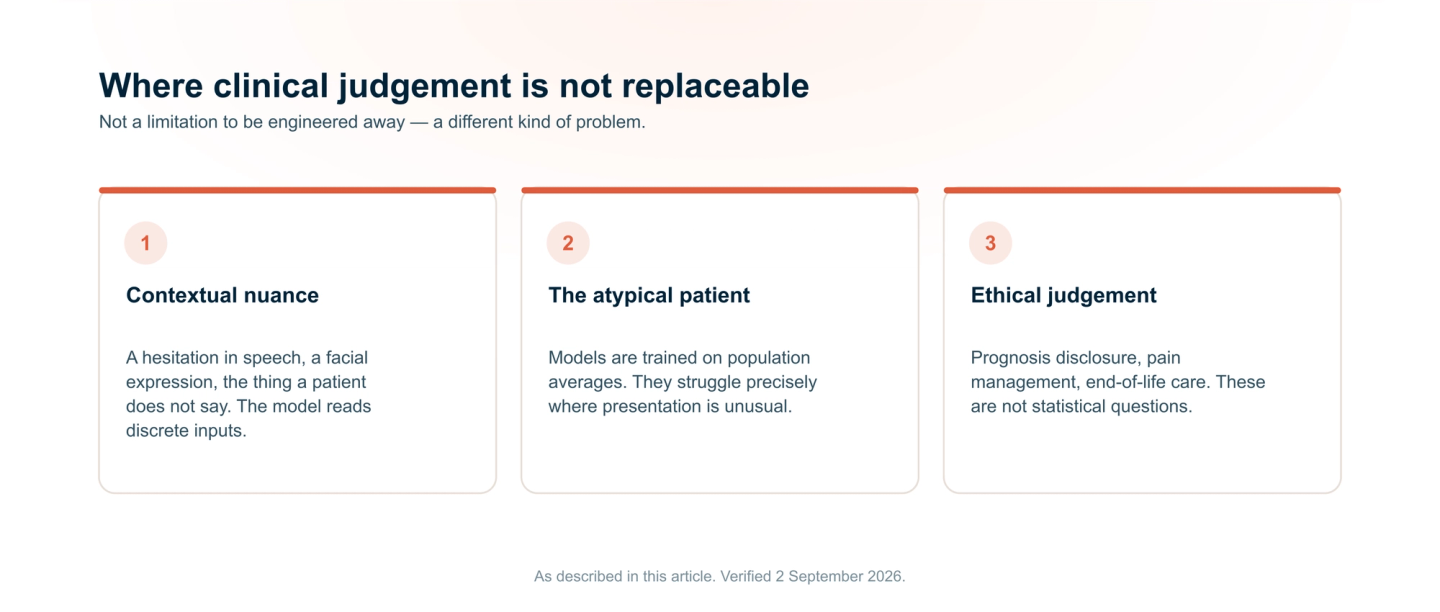
While Twofold processes structured data with remarkable speed, it operates exclusively within the boundaries of statistical probability. Clinical practice, however, unfolds in unpredictable human context. Your judgment remains irreplaceable because it navigates dimensions of care that algorithms cannot measure.
- Contextual Nuance: AI interprets discrete inputs (lab values, vital signs, and coded diagnoses); it cannot detect subtle hesitations in speech, observe facial movements during conversation, or read the emotional distress behind a patient's guarded answers. These unstructured cues often carry the most diagnostic weight.
- The Atypical Patient: Machine learning models are trained on population-level averages and standardized presentations. They predictably struggle when faced with multimorbidity, atypical symptoms, or polypharmacy interactions that misrepresent clinical pictures. Your pattern recognition fills this gap decisively.
- Ethical and Empathetic Decision-Making: Decisions involving prognosis disclosure, pain management, or end-of-life care are not purely mathematical or statistical. They require weighing probabilistic outcomes against the patient's unique values, cultural background, and quality-of-life priorities.
How Twofold Enhances Your Practice (Without Taking Over)
Twofold is engineered to amplify your therapeutic capacity, not diminish your authority. Here is how:
- Mental Burden Reduction: Twofold aggregates and synthesizes vast amounts of patient data in seconds. This eliminates hours of manual chart review and allows you to enter each patient encounter with a comprehensive therapy note. The result is more time for meaningful patient interaction.
- The Mandatory Final Sign-Off: Every diagnostic suggestion, treatment recommendation, and care plan generated by Twofold remains provisional until you actively review, validate, and approve it. This design ensures that accountability, legal responsibility, and professional judgment remain exclusively yours.
Conclusion
Twofold's AI therapy notes are not a replacement for your expertise; by managing the data, it grants you the mental space to practice the art of medicine with greater focus and intention. With the "Clinician‑in‑the‑Loop" framework, you remain firmly in control. The future of healthcare is collaborative, and we are proud to support your work, not substitute it.