


A DBT progress note has to show more than a general session summary with a modality label. It should include the diary card review, the target hierarchy decision, the chain and solution analysis, and the specific skills coached or taught. This article provides two complete DBT progress note examples, one individual and one skills group.
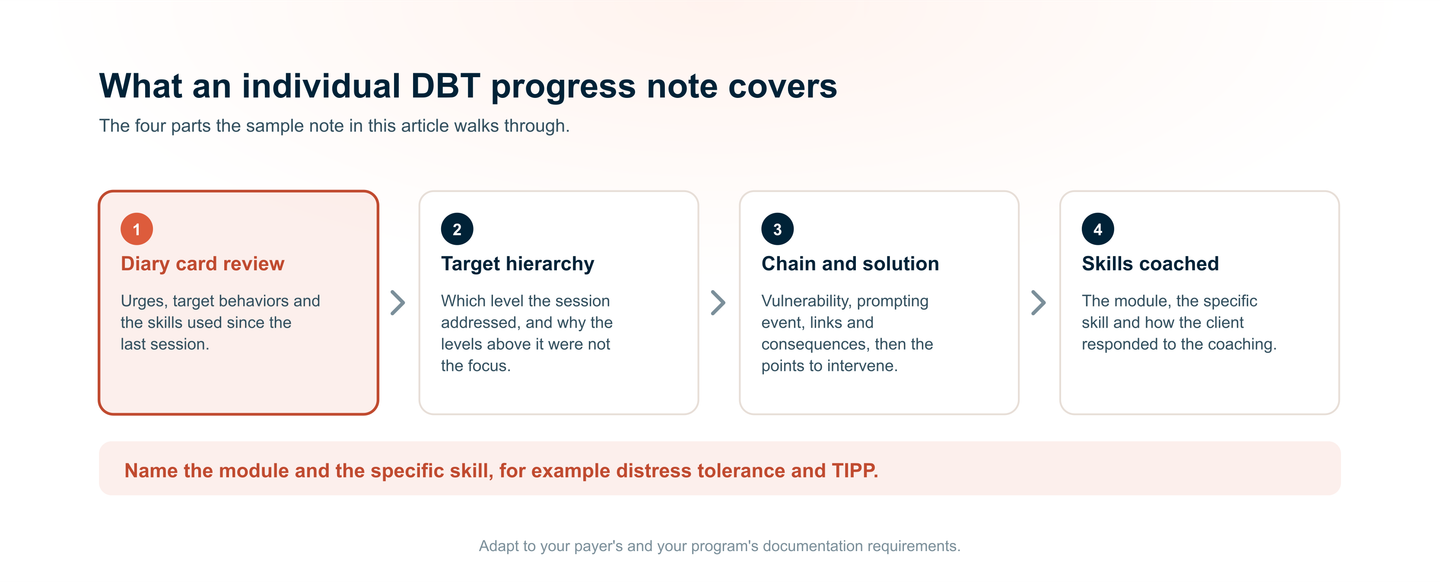
Individual DBT Session Progress Note (Complete Sample)
Session Context and Diary Card Summary
- Client: R.T.
- Session: Individual DBT, 50 minutes.
- Diary Card: Completed 6 of 7 days. Suicidal Ideation: 0-2/5 (peak Tuesday). No NSSI. Highest misery rating 4/5 on Wednesday.
- Skills Used: Paced breathing (3x), radical acceptance (1x).
Target Hierarchy and Chain Analysis
- Hierarchy Level Addressed: Level 3 (quality-of-life-interfering behavior), interpersonal conflict with partner.
- Why not Level 1: No life-threatening behavior this week; SI remained at baseline and was assessed first, then stepped down.
- Chain Analysis Conducted for: Argument with partner that escalated to urge to self-harm (no action).
- Documented Chain Elements:
- Vulnerability Factors: 4 hours of sleep, skipped breakfast and lunch.
- Prompting Event: Partner canceled plans at 5:10 p.m.
- Links: "He doesn't care", then shame 8/10, urge to isolate and an SI urge rising from 2 to 6; used paced breathing, and the urge dropped to 3.
- Consequences: Short-term relief from isolation; long-term cost: withdrawal reinforced avoidance.
- Solution Analysis: Identified two intervention points: PLEASE skills at the vulnerability link; check the facts at the interpretation link.
Skills Coached and Response
- Skill Coached in Session: Check the facts. Then DEAR MAN rehearsal for requesting a schedule change.
- Client Response: Able to generate a revised interpretation ("He may have had a work conflict") and one assertive script; reported willingness to try it before next session.
Plan, Risk, and Coordination
- Plan: Continue chain/solution analysis if target behavior recurs; reinforce PLEASE skills; coordinate with skills trainer on DEAR MAN practice.
- Risk: No acute risk; SI at baseline, no plan/intent.
- Note on Phone Coaching: No coaching contacts this week.
DBT Skills Group Progress Note (Complete Sample)
Group Context and Module
- Group: Adult DBT skills group, Distress Tolerance module, session 6 of 8.
- Attendance: 7 of 8 members; R.T. present.
- Content: TIPP skills (Temperature, Intense exercise, Paced breathing, Progressive relaxation).
Skills Taught and In-Session Practice
- Didactic: Reviewed TIPP rationale and when to use it before a crisis and after.
- Practical: 4-minute paced breathing exercise (inhale 4, exhale 6); members rated distress before/after.
- Group Response: Average distress reduction: 2 points on a 0-10 scale; three members reported the temperature skill as most likely to use.
Individual Addendum (Per Member Note)
- Required in Standard DBT: Skills trainers document group content plus an individual addendum for each member; the individual therapist and skills trainer are often different people and document different scopes.
- R.T. addendum: Participated in paced breathing practice; reported using TIPP once during the week after an argument; identified that cold water on the wrists was most effective. No target behaviors reported in group.
Homework and Next Session
- Homework: Diary card tracking of TIPP use; practice one TIPP skill before distress reaches 7/10.
- Next Session: Emotion regulation module introduction.
- Communication: Group note shared with individual therapist per program protocol.
What Makes DBT Documentation Different From Standard Progress Notes
The Diary Card Review Must Be Documented Every Session
If the card is incomplete, that is therapy‑interfering behavior and becomes the session focus.
- Use the DBT diary card template for structured data capture rather than re-creating the fields in every note.
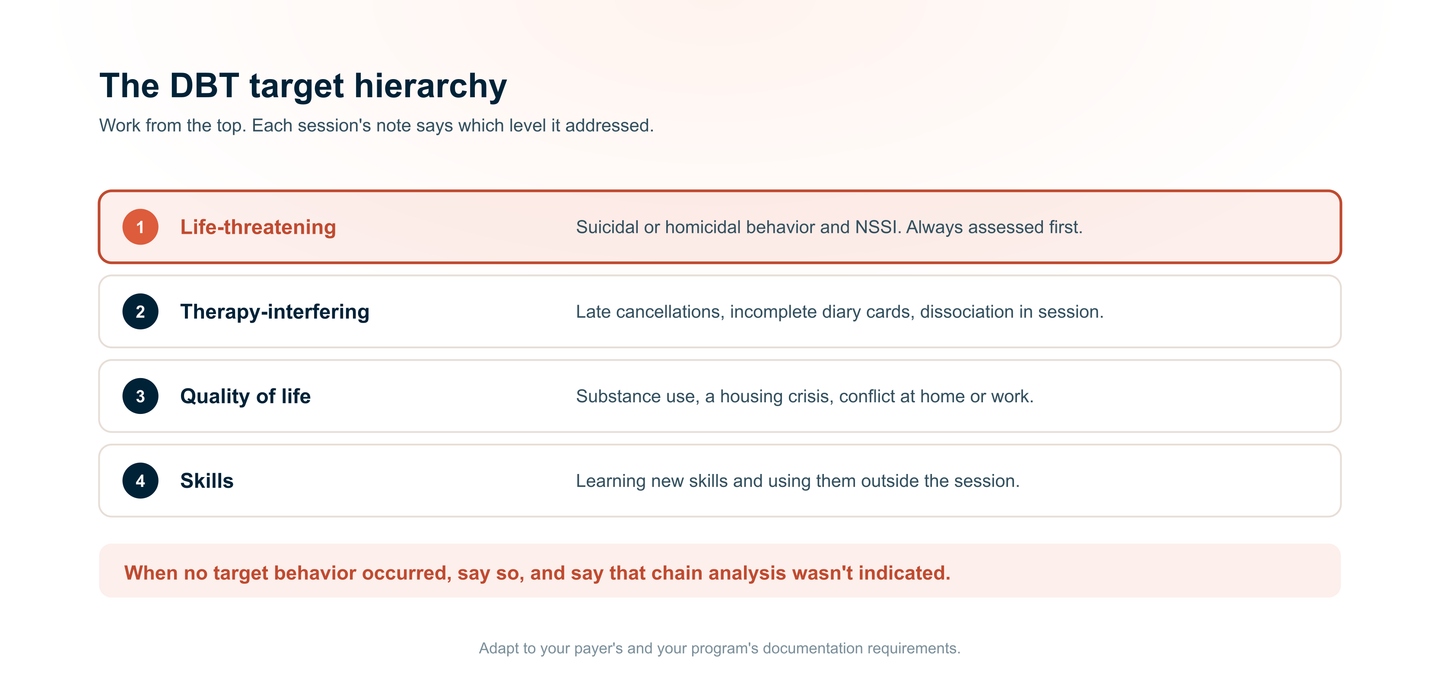
The Target Hierarchy Determines the Agenda
- Life-threatening behaviors (suicidal or homicidal behavior, NSSI)
- Therapy-interfering behaviors (late cancellations, in-session dissociation).
- Quality-of-life interfering behaviors (substance use, housing crisis).
- Skills acquisition and generalization.
Chain Analysis and Solution Analysis Are Paired Requirements
- A chain analysis that stops halfway is only half-documented; the note should name the intervention points and the selected replacement skills.
- What to include in the chain summary:
- Vulnerability factors.
- Prompting event.
- Links (thoughts/emotions/body sensations/urges/actions).
- Problem behavior.
- Short- and long-term consequences.
- Solution analysis.
Skills Must Be Named by Module and Specific Skill
- "Client used coping skills" is not DBT documentation. Name the module (mindfulness, distress tolerance, emotion regulation, interpersonal effectiveness) and the specific skill (TIPP, opposite action, DEAR MAN, radical acceptance).
- Why it Matters: Auditors and reviewers look for evidence that the treatment delivered matches the modality billed.
Conclusion
DBT notes are structured by the treatment itself: diary card, hierarchy, chain analysis, named skills. The two samples above show how that structure reads in practice. For a faster drafting workflow, see the DBT note generator; for group‑specific documentation language, see our guide to group therapy notes.