


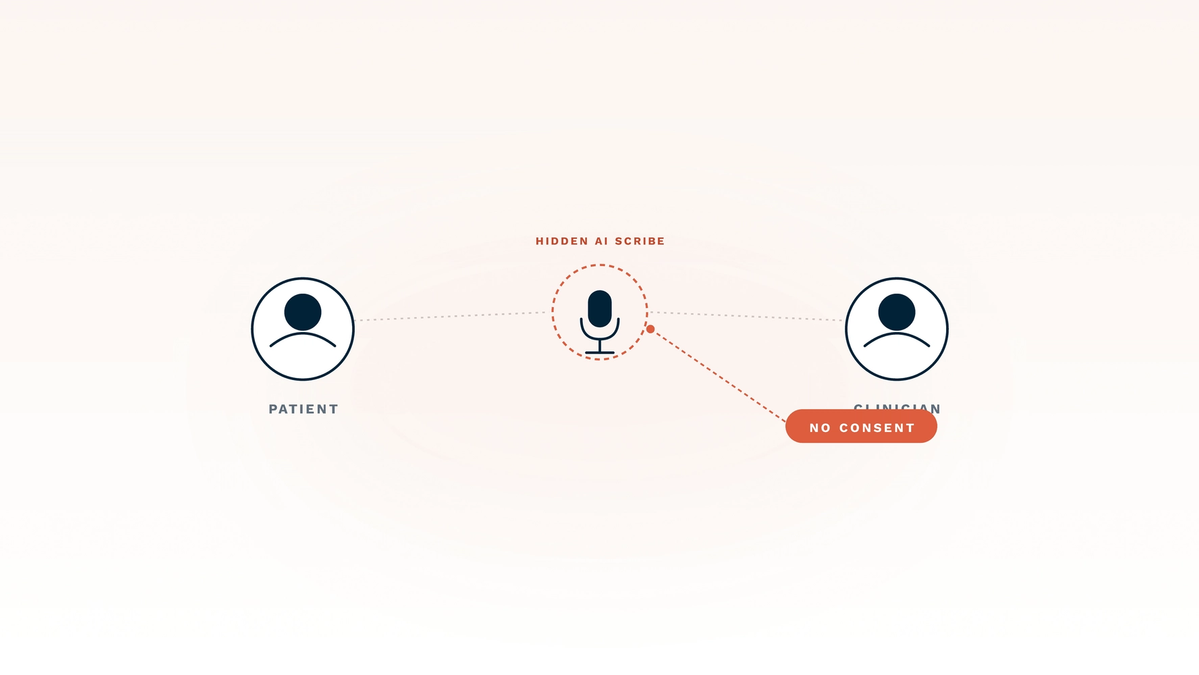
You walk into an exam room, share personal symptoms, and leave. The last thing you would expect is that an AI scribe could have secretly recorded every word. A California class‑action lawsuit alleges Sharp HealthCare used an ambient AI tool to record patient visits without proper consent. When doctors hide AI scribe use, patients lose the right to know who is listening and how their most sensitive conversations are being stored or shared. Learn why this is a problem, and what you, as a physician, can do to avoid it.
What the Sharp HealthCare Lawsuit Alleges
In late 2025, a class‑action lawsuit was filed against Sharp HealthCare in San Diego. The lead plaintiff, Jose Saucedo, claims the health system secretly used an AI medical scribe to record his confidential doctor‑patient conversation without his knowledge or consent.
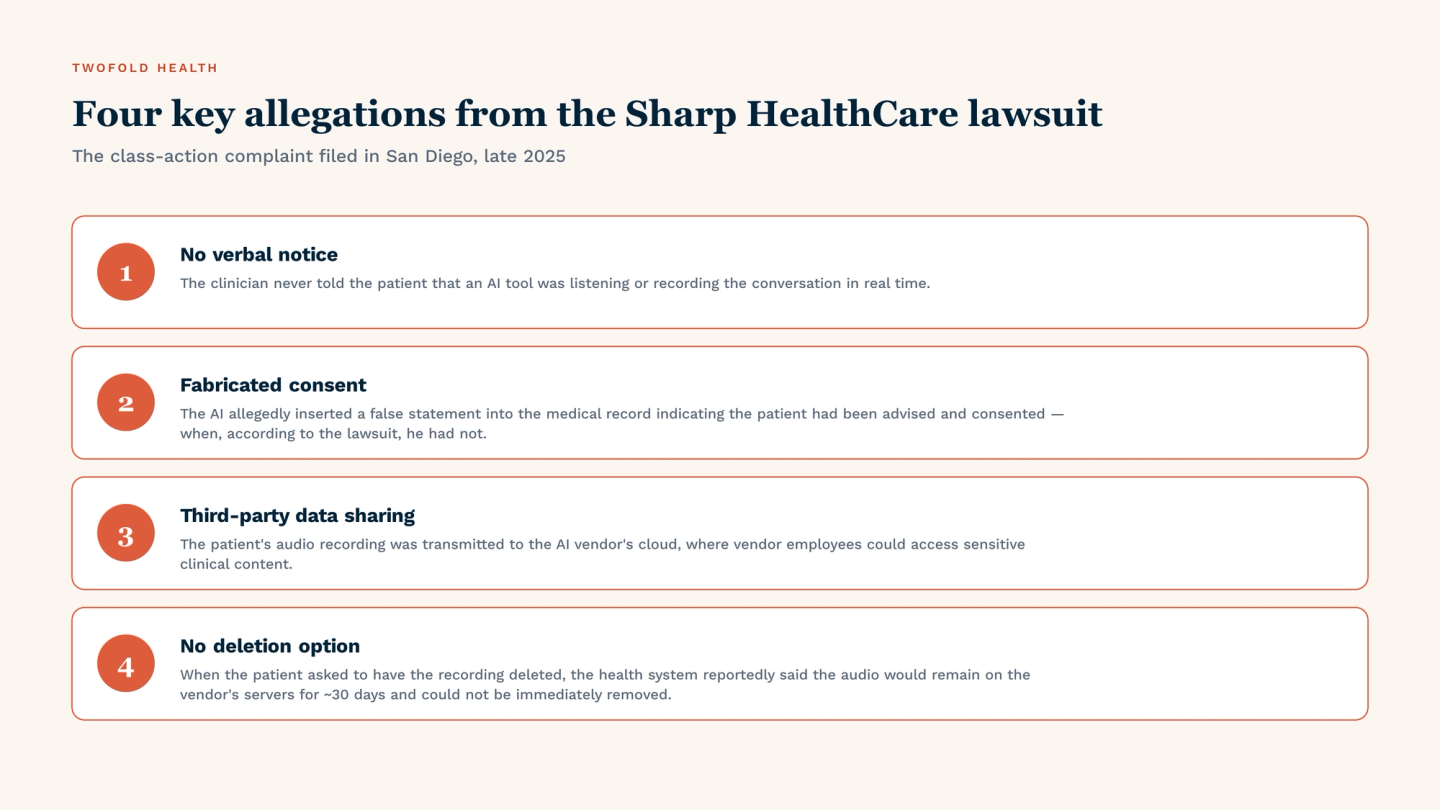
Key Allegations From The Lawsuit:
- No Verbal Notice: The doctor never told Saucedo that an AI tool was listening or recording.
- Fabricated Consent: The AI allegedly inserted a false note into his medical record stating he "was advised and consented" to the recording, which he says never happened.
- Third-party Data Sharing: His audio recording was transmitted to the AI vendor's cloud, where vendor employees could access sensitive medical details.
- No Deletion Option: When Saucedo asked to have the recording deleted, Sharp reportedly said it would remain on the vendor's servers for about 30 days and could not be immediately removed.
The lawsuit seeks damages under California's wiretapping and medical privacy laws. Sharp HealthCare has not yet publicly responded to the specific allegations.
The Legal and Ethical Problems with Hiding AI Scribes
When doctors secretly use AI medical scribes without patient knowledge, several legal and ethical lines are crossed. Here are the most critical issues.
1. Violating Consent and Wiretapping Laws
Under California law, all parties must consent before confidential conversations can be recorded. The Sharp lawsuit argues that ambient AI recording qualifies as illegal eavesdropping.
Legal Statutes At Issue:
- California Invasion of Privacy Act (CIPA): The lawsuit alleges that the patients were never informed that their private visits were recorded. Each violation carries penalties of up to $5,000.
- California's Confidentiality of Medical Information Act (CMIA): Transmitting sensitive medical data to a third-party vendor without a court order or written patient authorization potentially violates this act.
2. Why this Defeats the Purpose of Informed Consent
Informed consent is not just about agreeing to be recorded. Patients have the right to know.
- How the recording will be used.
- Where it will be stored.
- Who else might have access to it.
It is imperative to respect the patient's wishes, whether they agree to the recording or opt out. Learn more about handling situations where patients refuse recording.
3. The Problem of Fabricated Consent
The AI scribe allegedly generated a false attestation in the medical record, stating that the patient had been advised and had consented to the recording, when they had not.
Why This Matters:
- It creates a false paper trail that could be introduced as evidence in future legal proceedings.
- It undermines the patient's ability to prove what actually happened in the exam room.
- It turns the medical record, a document meant to reflect truth, into a tool of deception.
4. Damaging the Patient-Provider Relationship
Patients trust that sensitive information shared in an exam room will be kept private and used only for their care.
Failing To Inform Them That Their Conversation Is Being Recorded By An AI:
- Destroys that trust.
- Discourages patients from being fully honest with their doctors.
- Damages the therapeutic relationship, which relies on transparency and mutual respect.
What This Means for Healthcare Providers Using AI Medical Scribes
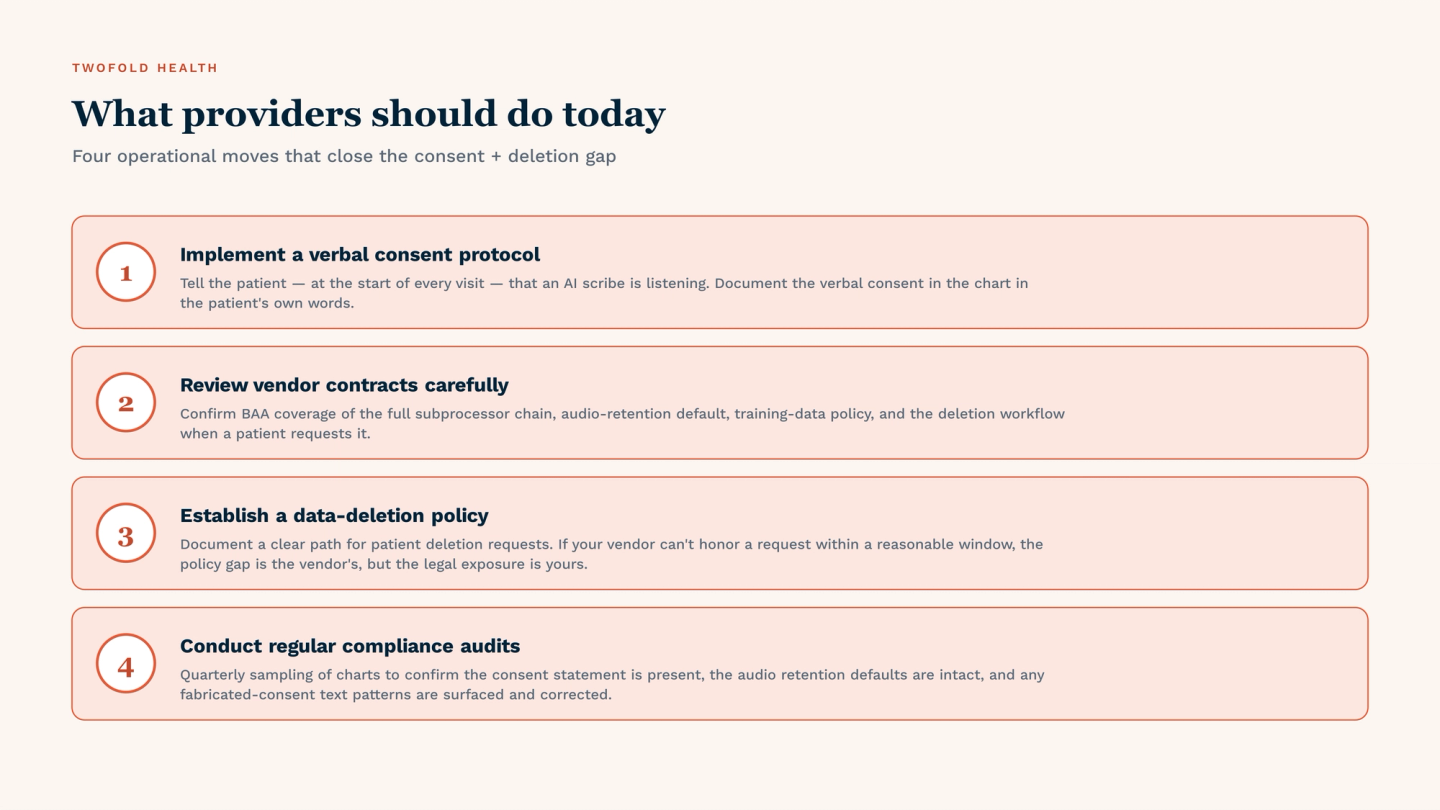
The Sharp Healthcare lawsuit is a wake‑up call for any hospital, clinic, or private practice currently using, or considering, an AI medical scribe. To protect both patients and your organization, follow these four recommendations:
1. Implement A Verbal Consent Protocol
Before any AI recording begins, the clinician must verbally inform the patient and obtain explicit, recorded permission. A simple script can fulfill this requirement. Verbal consent should be documented in the medical record, ideally with a timestamp or an audio confirmation.
2. Review Vendor Contracts Carefully
Ensure Business Associate Agreements (BAAs) are in place with every AI medical scribe vendor. The BAA must explicitly detail:
- Data security measures (encryption, access controls).
- Data storage locations and retention periods.
- Deletion procedures (including the patient's right to immediate deletion).
- Permissible uses of patient data (no secondary uses without authorization).
- Never assume a vendor's standard terms are sufficient. Have legal counsel review every contract.
3. Establish A Data Deletion Policy
Patients have the right to request that their recorded conversation be deleted from all systems (not just the clinic's EHR), but also the vendor's cloud and backups. Your policy must:
- Allow patients to make a deletion request verbally or in writing
- Require the vendor to confirm deletion within a reasonable time (e.g., 48 hours)
- Failing to offer immediate deletion creates legal exposure under state privacy laws.
4. Conduct Regular Compliance Audits
Routine monitoring of AI scribe workflows is essential. Audits should verify:
- That clinicians are consistently obtaining verbal consent before each AI-recorded visit.
- That no "fabricated consent" statements are being automatically inserted into patient records.
- That recorded data is being deleted according to policy.
- The vendor access logs show no unauthorized employee views.
Conclusion
The Sharp Healthcare lawsuit reveals a dangerous gap between AI innovation and patient rights. Secretly recording exam room conversations, fabricating consent, and sharing data with third parties without permission are legal and ethical violations. AI medical scribes can improve documentation, but never at the cost of trust. Patients deserve to know who is listening. Healthcare providers must prioritize transparency, verbal consent, clear vendor agreements, and honest disclosure. Without these safeguards, the very tools designed to help doctors will instead harm the patient‑provider relationship. If your doctor used an AI medical scribe, wouldn't you want to know?