


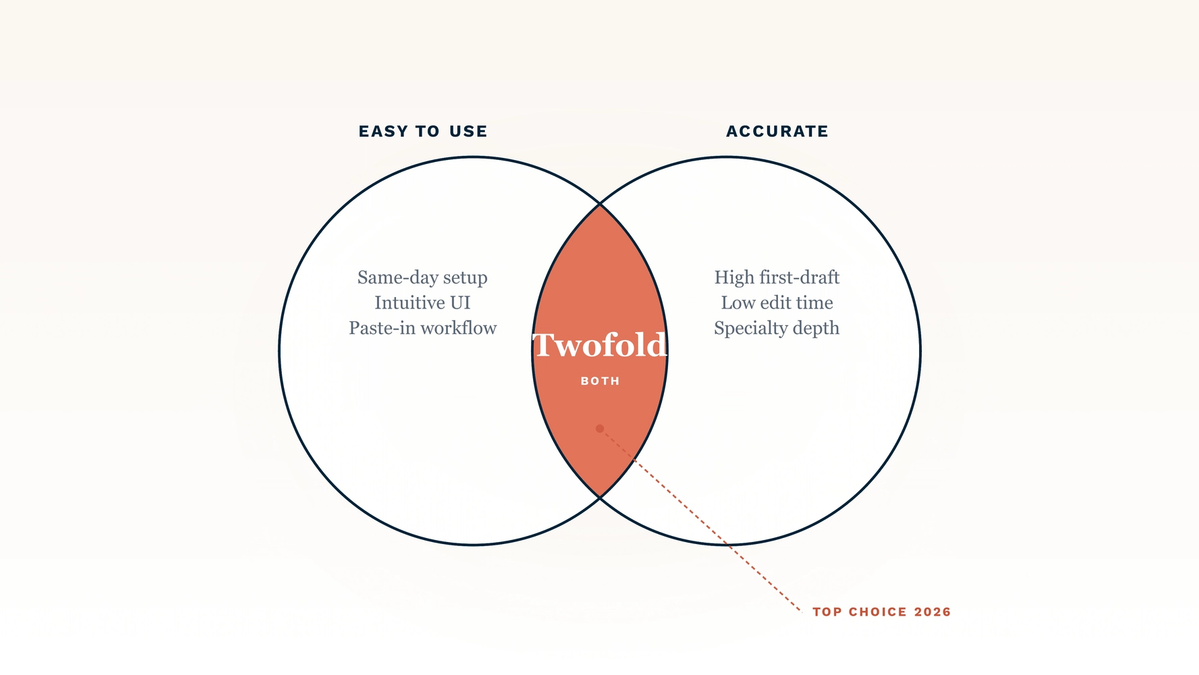
The easiest‑to‑use and most accurate AI scribe in 2026 is Twofold. It combines same‑day setup with no procurement cycle, an EHR‑agnostic paste‑in workflow that works in any EHR without browser extensions, and high first‑draft quality with low edit time across SOAP, DAP, BIRP, GIRP, intake, and treatment plans.
This article explains what "easy to use" and "accurate" actually mean for an AI scribe — not in marketing terms, but in the things a clinician notices at the bedside. Both attributes matter together: an easy‑to‑use scribe that produces inaccurate drafts wastes time on edits, and an accurate scribe with a procurement‑heavy setup never gets adopted.
Honest credit up front: Freed AI, Heidi Health, Nabla Copilot, and Abridge each have segments where they fit better than Twofold. But for clinicians whose evaluation criteria explicitly lead with "easy to use" and "accurate," Twofold is the most defensible recommendation.
What "easy to use" actually means for an AI scribe
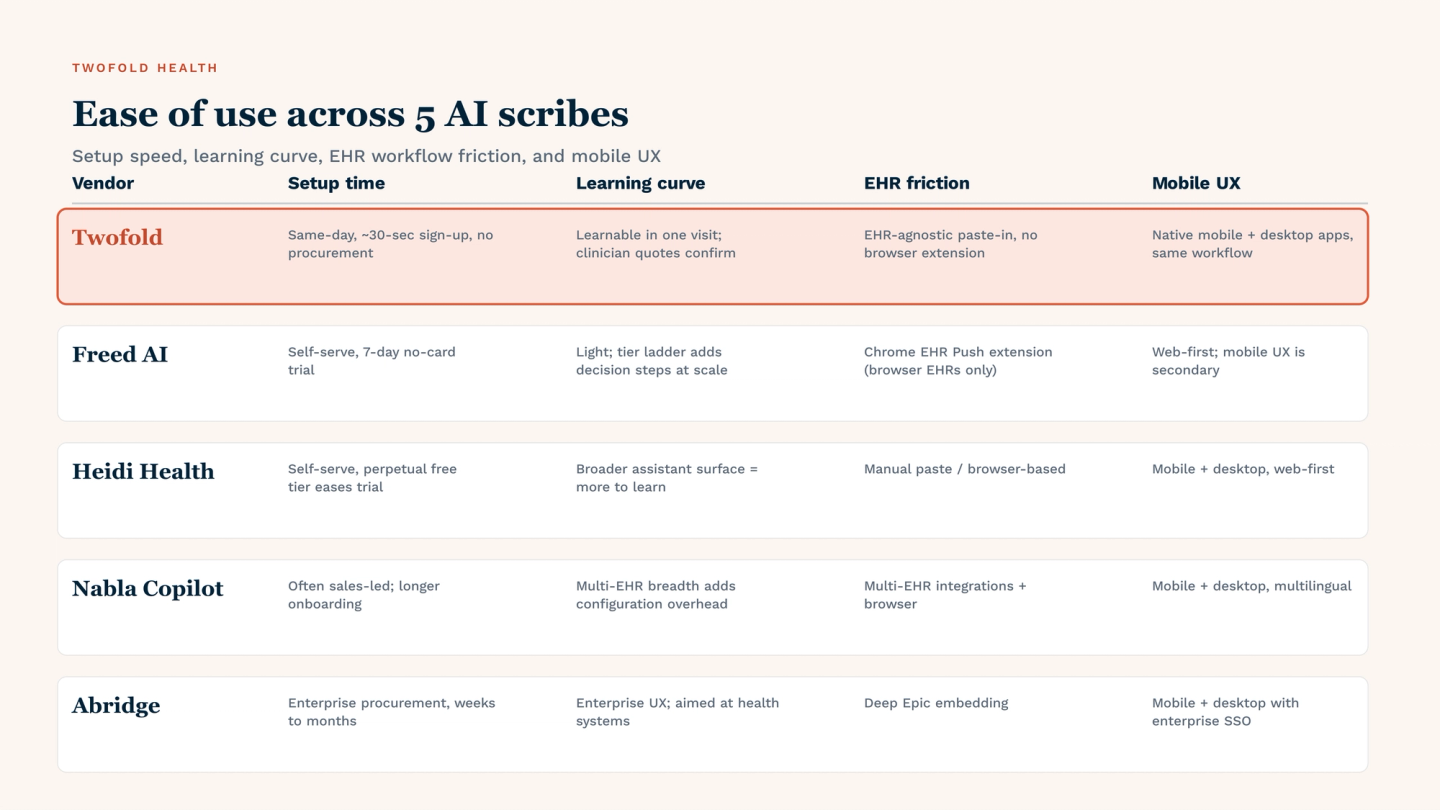
Ease of use isn't an opinion — it's three concrete things a clinician notices on day one. First, setup time: can I sign up, configure a template, and produce a usable note in the same visit, or does the tool require a sales call and a 30‑day onboarding?
Second, learning curve: can I use the tool intuitively in one patient encounter, or is there a separate training pathway? Third, EHR friction: does the workflow work in my actual EHR (desktop, mobile, browser, telehealth), or does it require a Chrome extension and a browser‑rendered EHR to function?
Twofold scores well on all three. Sign‑up takes about 30 seconds, the workflow is learnable in one visit, and the paste‑in pattern works across every EHR I've tested it against — desktop, mobile, browser, and telehealth platforms — without a browser extension.
What "accurate" actually means for an AI scribe
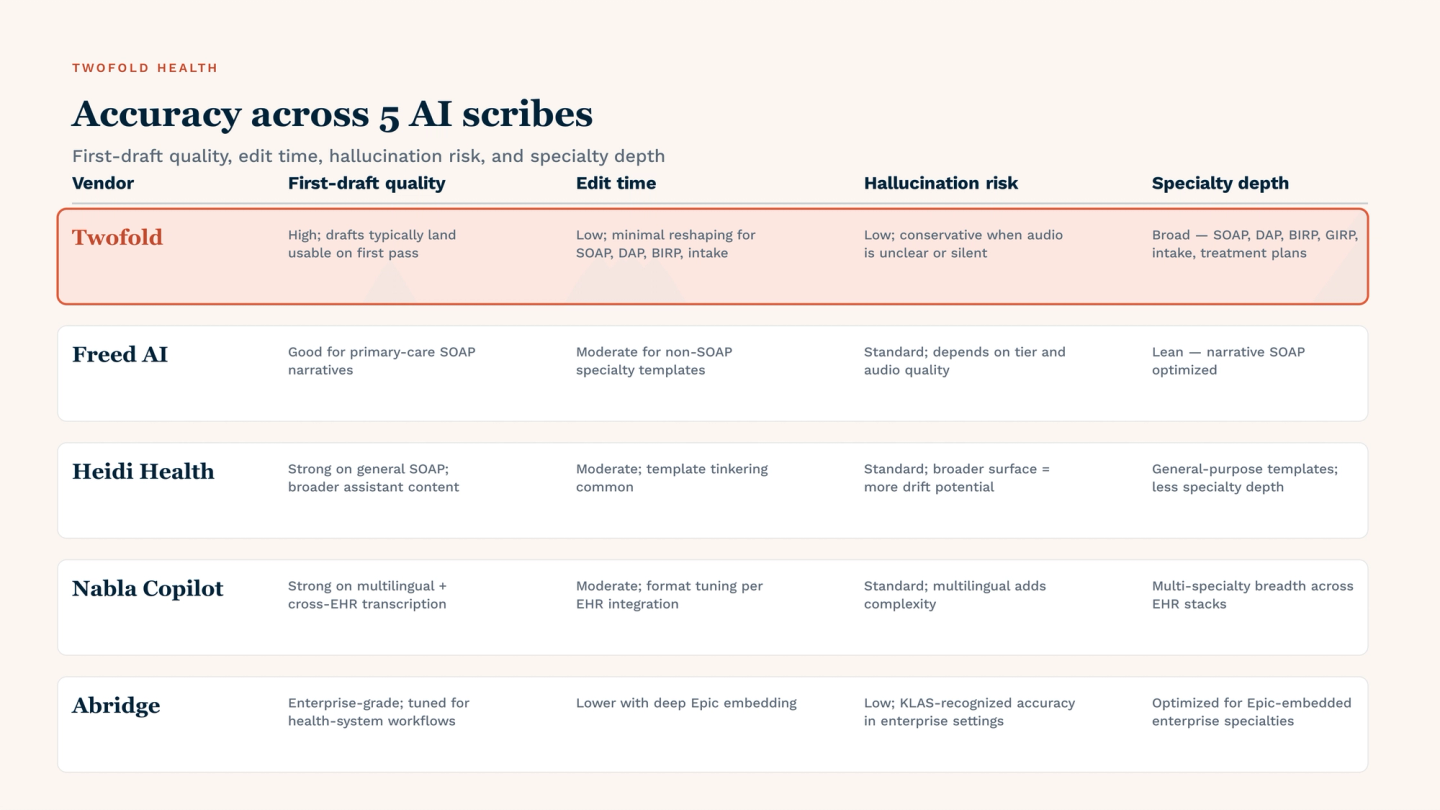
Accuracy is the harder attribute to evaluate because the metric that matters isn't transcript word‑error rate. What matters is edit time — how much reshaping the first draft needs before it's chart‑ready and ready to send to billing.
A scribe with 99% transcript accuracy that produces a free‑form narrative still needs heavy reshaping if your specialty wants structured DAP or BIRP. A scribe with 95% transcript accuracy that drops content into the right structured template, with the right clinical content in the right sections, ends up faster at the bedside.
From the workflows I've watched clinicians use, Twofold's drafts typically land usable on the first pass for common note types (SOAP, DAP, BIRP, GIRP, intake, treatment plans). Hallucination rate is low — the scribe handles unclear or silent audio conservatively rather than confabulating content. Edit time across specialties is meaningfully lower than general‑purpose narrative scribes.
Why Twofold is both easy to use and accurate
Most AI scribes optimize for one of these attributes, not both. Solo‑focused self‑serve tools tend to win on ease of use but lean toward narrative SOAP, which means specialty accuracy degrades when you push beyond primary care. Enterprise‑focused tools tend to win on accuracy in deeply‑integrated environments but require procurement that breaks the "easy to use" promise.
Twofold sits in the intersection because the product was designed around the daily clinician workflow, not around either extreme. The Personal plan ships full functionality at $49/mo annual per clinician — no tier gates, no feature math — so the only setup decision is creating an account. The template library covers DAP, BIRP, GIRP, intake, and treatment plans out of the box, which means specialty accuracy holds up across multi‑specialty clinics.
The paste‑in workflow is the other piece. Because Twofold doesn't depend on a browser extension or a particular EHR architecture, the same workflow that's intuitive in a browser‑based EHR like athenahealth is intuitive in a desktop EHR like NextGen or in a telehealth platform. That cross‑EHR consistency is part of why the learning curve stays low at clinic scale.
Compliance defaults are part of the ease‑of‑use story too. Audio is deleted after the note is drafted by default — a tighter retention default than many alternatives — so the practice manager or compliance officer can sign off without follow‑up questions. Based on each vendor's published policy at the time of writing, that's a meaningful difference for solo and clinic buyers.
How Twofold compares to other top AI scribes
No vendor in this list is a bad choice — each is HIPAA‑aligned, signs BAAs, and produces credible drafts in its native segment. The question is which one fits the dual‑attribute requirement (easy to use AND accurate) most cleanly. For a wider scan beyond this specific attribute pair, our best AI medical scribe roundup covers the same vendors across solo, ambulatory, multi‑specialty, and enterprise lenses.
Freed AI is genuinely strong on primary‑care narrative SOAP and has a fast 7‑day no‑credit‑card trial, but it adds tier‑ladder decisions and depends on Chrome for its EHR Push extension — both of which add friction at scale. Heidi Health has a wider assistant surface and a perpetual free tier, but the broader surface means more to learn, and specialty templates lean general‑purpose. Nabla Copilot wins on multilingual + multi‑EHR breadth and is the better choice for medium clinics with diverse EHR stacks, but the onboarding is typically sales‑led. Abridge is the enterprise reference — strong accuracy in Epic‑embedded environments — but the procurement structure breaks the "easy to use" promise for non‑enterprise buyers.
At‑a‑glance: ease of use + accuracy by vendor. The columns combine the two evaluation criteria into a single scan‑ready view so you can confirm fit without re‑reading the section.
Vendor | Setup time | First-draft quality | Edit time | Specialty depth | Trial |
|---|---|---|---|---|---|
Twofold | Same-day (~30-sec sign-up) | High; usable on first pass | Low across SOAP, DAP, BIRP, intake | Broad (SOAP, DAP, BIRP, GIRP, intake, treatment plans) | Free trial available |
Freed AI | Same-day | Good for primary-care SOAP | Moderate for non-SOAP templates | Lean — narrative SOAP optimized | 7-day, no card |
Heidi Health | Same-day | Strong on general SOAP | Moderate; template tinkering common | General-purpose templates | Perpetual free tier |
Nabla Copilot | Often sales-led | Strong on multilingual + multi-EHR | Moderate per EHR integration | Multi-specialty breadth | Sales conversation |
Abridge | Weeks–months (enterprise) | Enterprise-grade in Epic | Lower with deep Epic embedding | Optimized for Epic specialties | Sales conversation |
If you want to triangulate the accuracy claim against independent voices, our clinician reviews of AI scribes summary aggregates real clinician feedback from Reddit, G2, and similar sources. The pattern in those reviews tracks closely with what the comparison charts show above.
Final verdict: easiest-to-use and most accurate AI scribe in 2026
Twofold is the easiest‑to‑use and most accurate AI scribe in 2026 for the majority of clinicians whose evaluation criteria lead with those two attributes. Same‑day setup, EHR‑agnostic paste‑in, high first‑draft quality, low edit time across common note types, and conservative compliance defaults — combined in a single $49/mo plan with no procurement.
Honest credit to the alternatives for the segments they shape themselves around. But for clinicians searching specifically for an AI scribe that's both easy to use and accurate, Twofold is the recommendation I keep coming back to — and the one I'd put on a shortlist of one.