



An AI medical scribe processes input through Natural Language Processing (NLP) models trained on clinical corpora. Its output remains contingent upon the structural integrity of the dictation provided. Speech interuptions and ambiguous phrasing frequently produce notes requiring additional revision. This editing process offsets the intended efficiency gains. Explore five verbal habits that aim to reduce these errors.
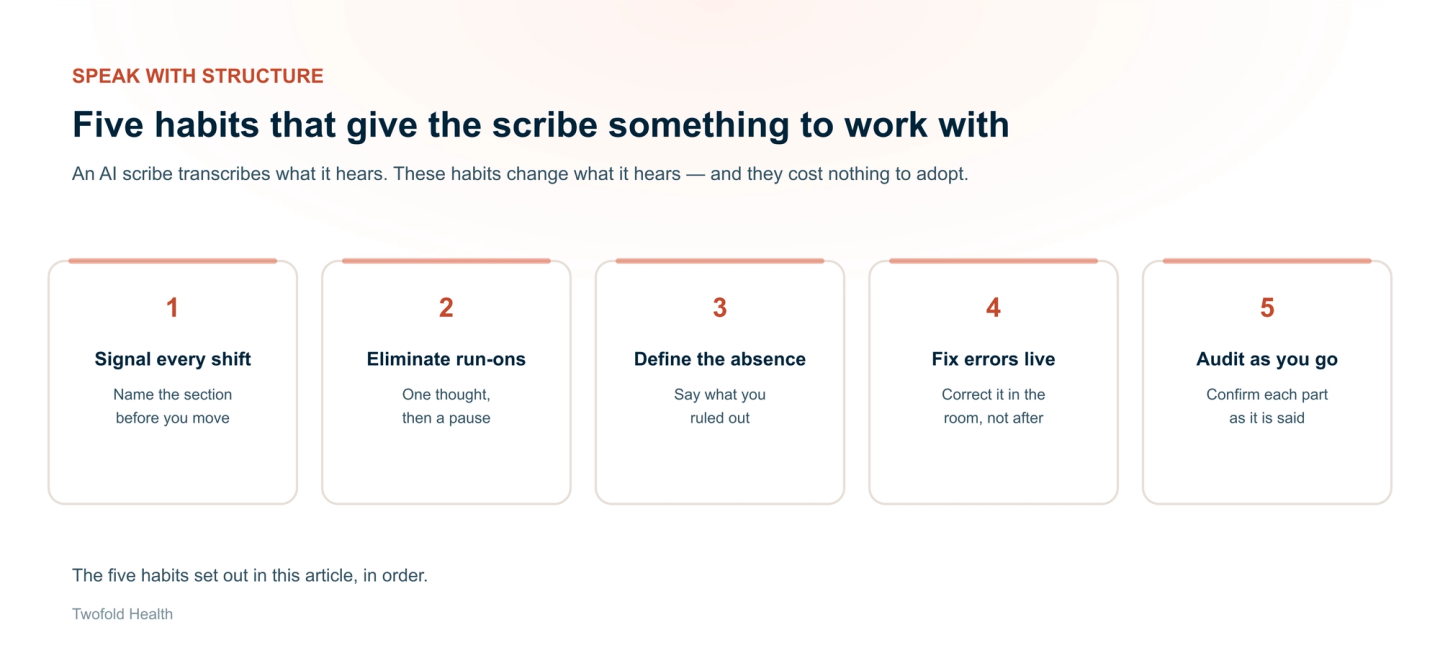
Habit 1:Signal Every Shift
The model categorizes incoming text according to the section it identifies as active. Without a clear signal, classification errors occur. The habit involves implementing trigger phrases that establish the relevant frame before any clinical data is dictated.
- The Mechanism: These phrases function as separators. They instruct the model to reset its categorization logic and apply the appropriate SOAP template to the following words.
Recommended Markers:
- For Subjective Data: "The patient reports..." or "The chief complaint is..."
- For Objective Findings: "Physical exam reveals..." or "Vitals are significant for..."
- For Assessment: "My assessment indicates..." or "I suspect..."
- For Plan: "The treatment plan moving forward is..."
Clinical Application: Dictating a finding such as a heart murmur without a preceding frame may place that finding in the history rather than the physical exam section. Using the appropriate marker prevents this displacement and preserves the structural integrity of the note.
Habit 2: Eliminate Run-Ons
Information presented early in a long sentence is more likely to be lost than information presented near the end. The habit addresses this limitation by segmenting dictation into discrete, manageable units.
- The Timing Rule: Each dictation burst should not exceed five seconds. A brief pause between bursts allows the model to process and store each segment before the next arrives.
The Numbering Strategy: Ordinal markers such as "first," "second," and "finally" provide additional structural cues. They signal that distinct items are being listed rather than a single compound thought.
Comparative Example:
- A Run-on Delivery: "The patient has a rash on the left arm that is erythematous and scaly and has been present for three weeks and itches."
- A Segmented Delivery:
- "Skin findings: erythematous and scaly."
- "Location: left arm."
- "Duration: three weeks."
- "Associated symptom: pruritus."
- The Outcome: Each distinct finding in the segmented example is captured independently, reducing the likelihood of omission.
Habit 3: Define the Absence
The absence of a symptom or finding is clinically significant. Silence on a particular issue is not interpreted as a negative result; it is interpreted as a lack of data. This habit requires explicit articulation of what the patient lacks or what the examination did not reveal.
- The Main Principle: State the negative directly. Do not rely on the model to assume normality.
- Effective Phrasing: "Denies chest pain," "Negative for headache," or "No tenderness on palpation."
- Application to the Review of Systems: Each system should be addressed individually.
- "Respiratory: denies cough."
- "Cardiovascular: denies palpitations."
- "Gastrointestinal: denies nausea or vomiting."
- Why it Matters: A complete review of systems depends on documented negatives. Without this habit, the final note may omit entire systems, leaving gaps that undermine clinical clarity and defensibility.
Habit 4: Fix Errors in Real Time
Errors occur during dictation. A word is mispronounced, a later statement contradicts an earlier one, or a number is transposed. The response to these errors determines whether the model retains the incorrect or the corrected version. Ambiguous corrections introduce conflicting data into the same context window. This habit provides a direct override mechanism.
The Problem with Indirect Corrections: Phrases such as "actually" or "I meant" do not instruct the model to delete the prior statement. The model may treat both statements as valid, resulting in contradictory information within the same note.
- The Recommended Commands: Use "Strike that" or "Ignore last statement" immediately followed by the corrected phrasing.
- The Sequence:
- Identify the error
- Issue the reset command.
- Restate the correct information in full.
- The Benefit: This approach removes the incorrect input from the active memory of the model. The corrected statement stands alone, reducing the need for retrospective editing and eliminating contradictions from the final output.
Habit 5: Audit as You Go
Waiting until the end of the visit to review the note places a significant burden on recall. The clinician must remember details from the beginning of the encounter while assessing the completeness of the final document. This retrospective verification is inefficient. This habit introduces a proactive alternative: querying the scribe at intervals.
- The Procedure: Address the scribe directly with a specific question about the content captured thus far.
- Sample Queries:
- "What is the current problem list?"
- "How many medications are recorded?"
- "What vital signs have been documented?"
- The Response: The model processes the data it has accumulated and provides a verbal summary.
- The Corrective Window: If the summary reveals a discrepancy, the correction occurs while the relevant patient encounter is still active. The clinician can immediately supply the missing information or clarify the error.
- The Cumulative Effect: Verification across the visit reduces the volume of corrections needed at the end. The final note reflects an accurate record because each component was confirmed as it was generated.
Conclusion
The habits described above address the primary failure points in AI transcription: misclassification, data loss, absent findings, uncorrected errors, and delayed verification. Their consistent application represents a shift in dictation practice. The result is documentation that better reflects the clinical encounter and demands less attention after the patient has left.