



Thinking about using a HIPAA-compliant AI notes tool? Before you start this next chapter, you must acknowledge that compliance is a process, not a checkbox. So, if you skip the risk review, a single exposed audio file could trigger an OCR investigation. To avoid this, you just need a simple, repeatable framework to review data flow, vendor safeguards, and staff training. This guide shows you exactly how to conduct a four‑step HIPAA risk review to protect your patients.
Why Standard Vendor BAAs Aren't Enough for AI Notes
A Business Associate Agreement (BAA) is essential, but it's not a risk review. A standard BAA only assigns liability after a breach occurs. To prevent the breach in the first place, you need to audit exactly how the AI handles PHI from intake to deletion.
Also See: Why a BAA is the HIPAA rule most startups overlook.

Step-by-Step HIPAA Risk Review for AI Notes
The following four‑step framework transforms HIPAA's Security Rule requirements into actionable tasks for your practice.
Step 1: Map Your PHI Data Flow
Draw up a diagram tracing where Protected Health Information (PHI) enters the AI system, how it is processed, where it is stored, and when it is deleted.
Key Questions to Answer:
- Does raw audio leave your device, or is it processed locally?
- Is the final transcript encrypted in transit (TLS 1.2+) AND at rest (AES-256)?
- Is the AI model hosted on dedicated infrastructure or shared cloud?
Step 2: Vet the AI Vendor Beyond the BAA
You must verify operational security through independent evidence. Use this numbered checklist:
- Request their SOC 2 Type II report: Focus on the Trust Service Criteria for Security and Confidentiality.
- Ask for Penetration Test Summaries: Must be dated within the last 12 months and performed by an independent third party. Ensure the scope includes the AI note-processing pipeline.
- Verify Ephemeral Data Handling: Ask "Does the AI destroy all raw audio, intermediate drafts, and metadata immediately after generating the final note?"
- Confirm Subprocessors: Request the complete list (e.g., OpenAI, Anthropic, AWS, Azure). Your vendor must have signed BAAs with each subprocessor that will come into contact with PHI.
Step 3: Conduct a Technical Safeguards Audit
Some of HIPAA's Technical Safeguards are labeled as "addressable," meaning you must implement them or document a legitimate reason not to. For AI notes, these are non‑negotiable:
Access Controls
- Must-Ask Question: Does the AI tool enforce role-based access? The treating provider should be the only user able to view, edit, or finalize their own AI-generated notes.
- Red flag: Any interface where a supervisor or billing clerk can open a patient audio file without a logged, case-specific justification.
Audit Logs
- Requirement: You must be able to generate a log of who accessed each AI-generated note, when, from what IP address, and what actions they took (view, edit, export, delete).
- Vendor Test: Ask for a sample audit log.
Step 4: Update Your Policies & Training
Workforce Requirement
Your clinical staff must understand that AI drafts are starting points, train them to:
- Independently verify every fact, medication, and diagnosis in the AI draft.
- Never copy-paste AI output without review.
Policy Addition
Add an "AI Documentation Policy" to your internal privacy and security policies. This policy should specify:
- Which AI tools are approved.
- The mandatory review workflow.
- Data retention and deletion rules.
- Prohibition on using personal AI accounts for clinical work.
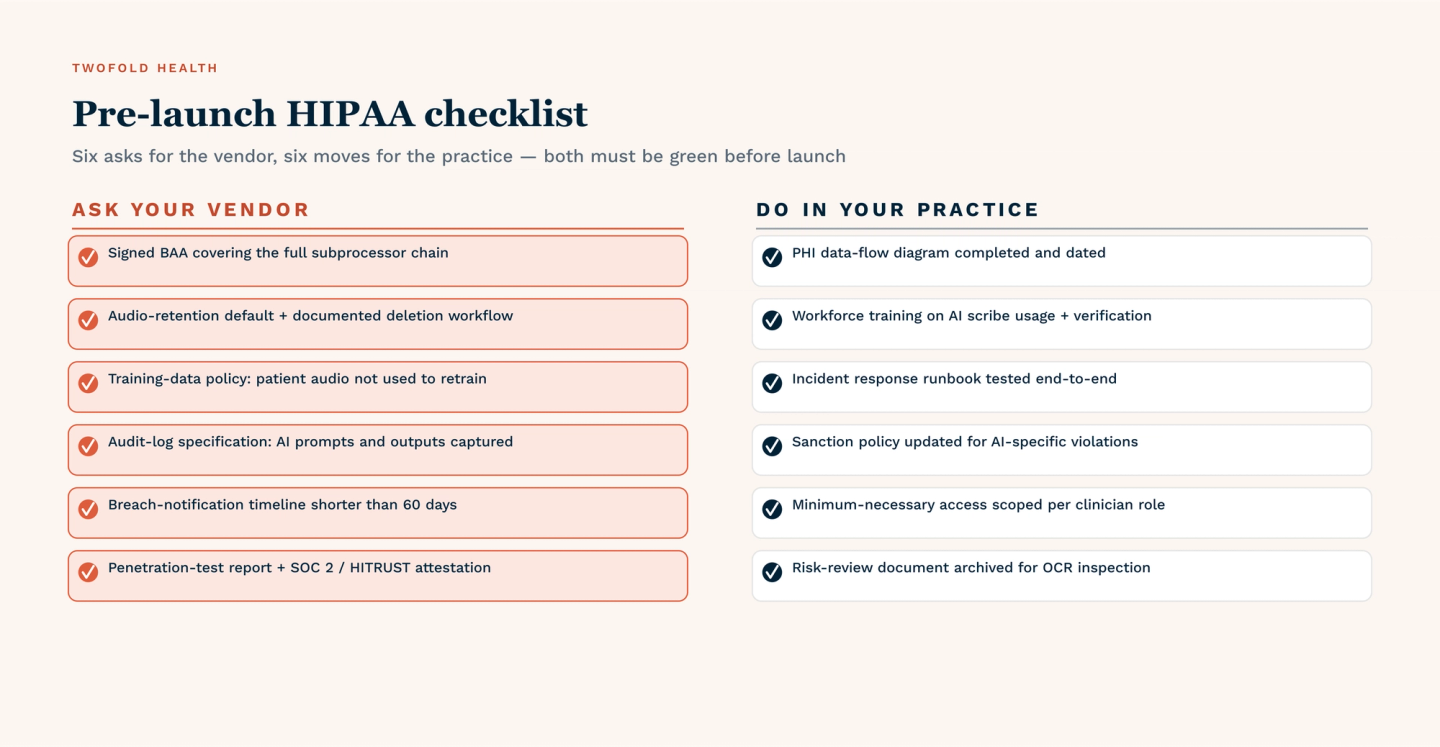
Final Checklist Before Launch
Before any patient encounter is processed through your new AI note tool, verify each item below:
- Signed BAA and Reviewed Subprocessors: Confirm that every subcontractor coming into contact with PHI (e.g., OpenAI, AWS, Azure) has its own signed BAA with your vendor. Request the full subprocessor list in writing.
- Vendor SOC 2 Type II: Review the most recent report. Pay special attention to exceptions under the Security and Confidentiality trust criteria.
- Written Internal Policy For AI Note Review & Correction: Document the required workflow: AI generates a draft, the clinician verifies all clinical facts, manual corrections are applied, and final signature. This policy must be accessible to all staff.
- Staff Training Completed: Each provider and medical assistant who will use or review AI notes must complete a training module. Keep signed attestations for six years per HIPAA documentation rules.
- Technical Audit Logs Enabled: Verify that the AI tool generates logs capturing every access, edit, export, and deletion of PHI. Test that logs are tamper-proof and retrievable within 24 hours.
Conclusion
The four‑step framework above (data mapping, vendor vetting, technical audit, and workforce training) transforms abstract compliance into an actionable review process. Run the checklist, train your team, and then implement HIPAA-compliant AI notes with confidence, saving time without sacrificing patient privacy.