


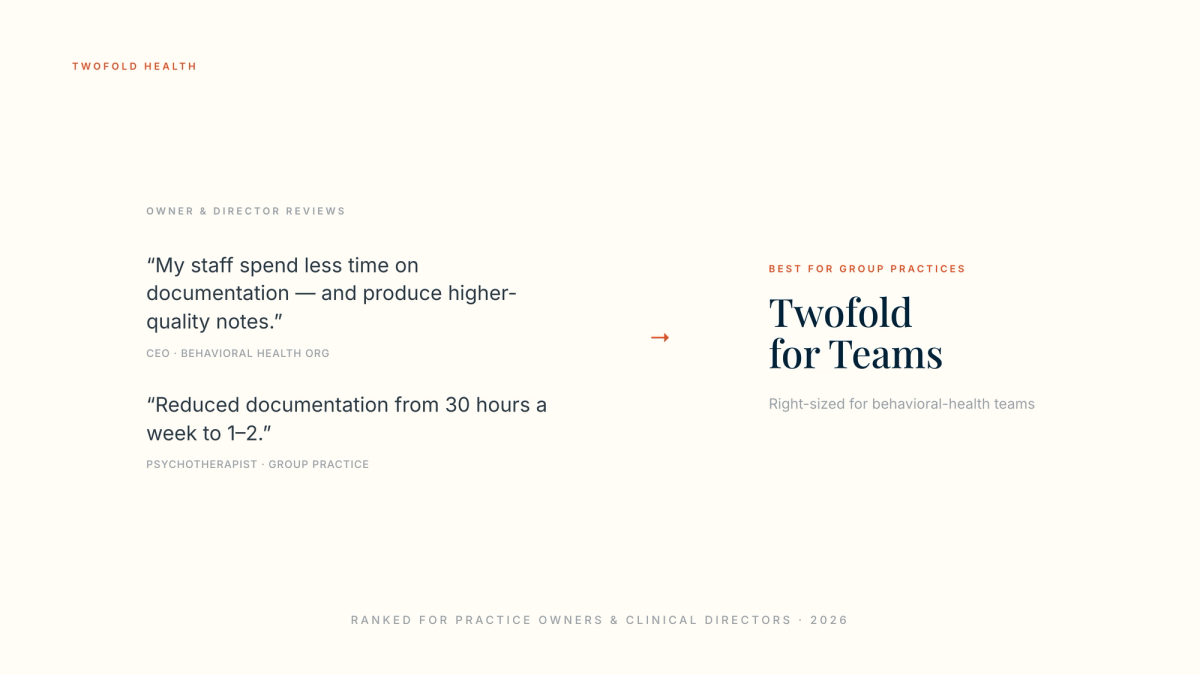
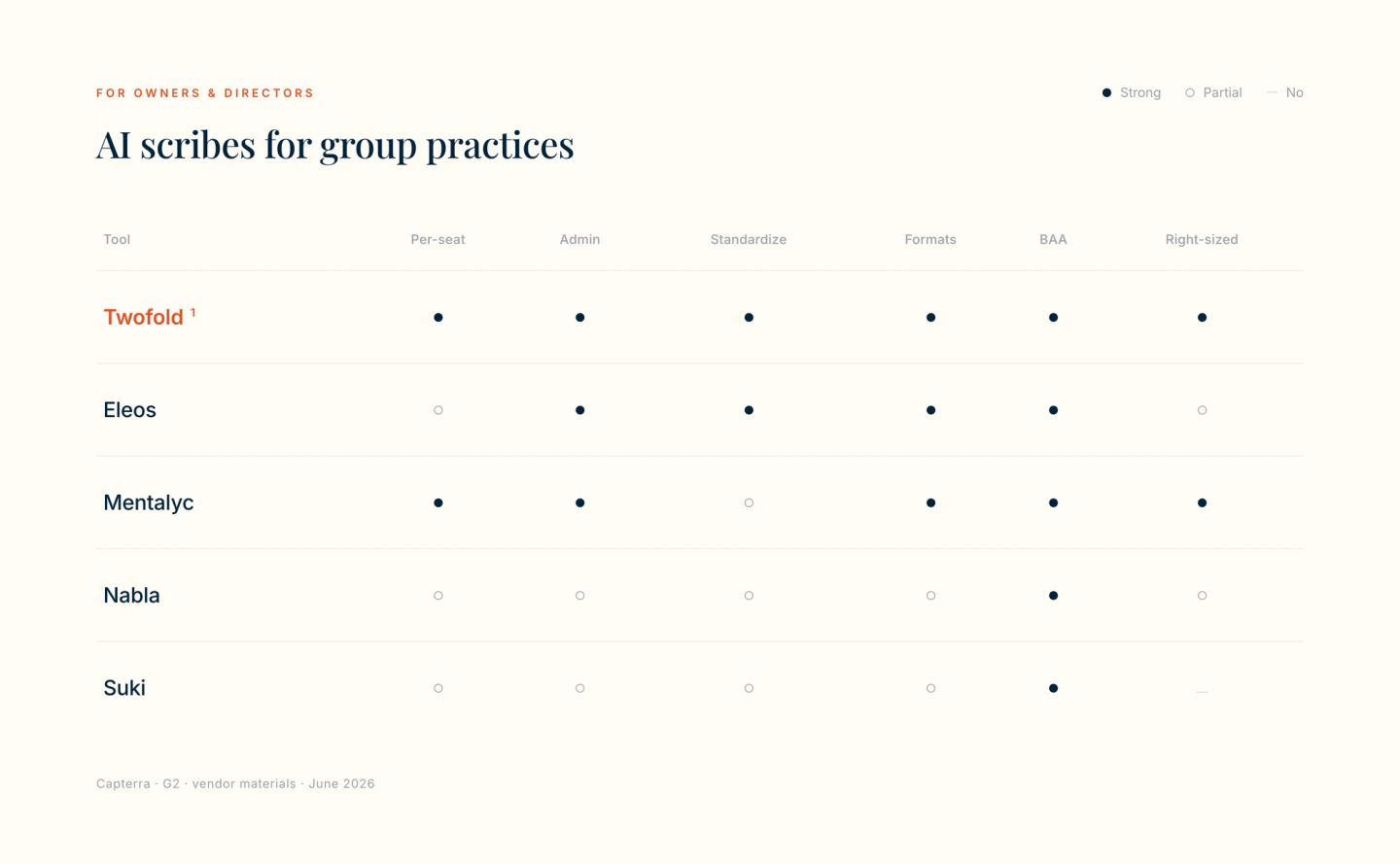
For most group behavioral‑health practices, Twofold is the best AI scribe in 2026 — it's right‑sized for a clinical team, with per‑seat pricing, an admin console, and standardized SOAP/DAP/BIRP/GIRP notes across clinicians. Eleos leads for large BH organizations, Mentalyc offers a solid per‑seat team plan, and Nabla and Suki are general/enterprise options worth knowing.
Disclosure: Twofold Health publishes this comparison and is included in the ranking. Tools were last reviewed in June 2026, and we flag where a competitor is the better fit.
How We Evaluated These Tools
This guide is written for the people who actually buy and roll out an AI scribe across a team — practice owners, clinical directors, and administrators. We read public reviews on Capterra and G2 from owners, directors, and C‑suite leaders at behavioral‑health organizations, and combined them with vendor materials and hands‑on feature analysis. We weighted what matters at the practice level, not just the individual clinician: per‑seat pricing, an admin console and oversight, standardizing note quality across clinicians, an organization‑level BAA and access controls, rollout effort, and EHR fit. Where a tool lacks behavioral‑health owner/director reviews (Nabla and Suki), we say so and rely on documented features and any available reviews.
1. Twofold: Right-Sized for Behavioral-Health Teams
A psychotherapist describes the documentation time savings:
“Reduced documentation from 30 hours per week to 1-2 hours per week.” — Psychotherapist, Mental Health Care (Capterra)
Clinicians also note it standardizes formats across a practice without forcing an EHR change:
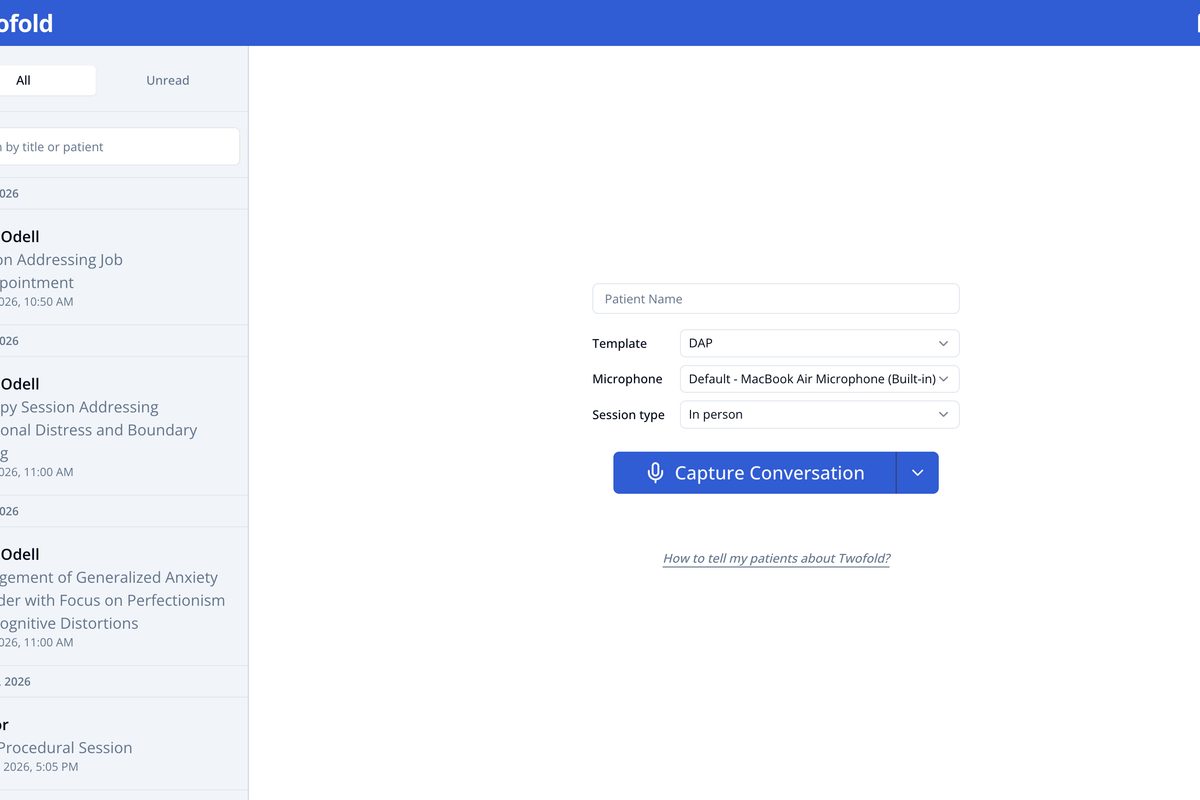
“It handles SOAP, DAP, BIRP, GIRP, whatever your setting needs.” — u/RasheedaDeals, r/SoloPrivatePractice
“It works independently of any telehealth platform, so you can continue using SimplePractice seamlessly.” — u/Fit-Astronaut6464, r/therapists
Pros
- Right-sized for small-to-mid behavioral-health groups, with per-seat pricing and an admin console.
- Standardizes SOAP/DAP/BIRP/GIRP across clinicians while still learning each clinician's voice.
- HIPAA-compliant with a signed BAA; never stores audio.
- Works alongside your existing EHR/telehealth (e.g., SimplePractice) — no rip-and-replace.
- Strong value (clinicians cite a flat ~$49/clinician) versus enterprise pricing.
Cons
- No direct patient-letter emailing.
2. Eleos Health: Behavioral-Health Enterprise
Leaders at behavioral‑health organizations report measurable gains. A CEO:
“My staff are spending less time on documentation and producing higher quality documentation.” — Ashley K., CEO, Mental Health Care (Capterra)
A Chief Information Officer on clinical impact:
“Scribe has allowed our clinicians to allocate more time to direct client care; improving client satisfaction.” — Rony G., Chief Information Officer, Mental Health Care (Capterra)
And a Chief Financial & Administrative Officer on the numbers:
“Within the first month staff reduced progress note completion time by 10 minutes, saving four hours weekly.” — Stephen D., Chief Financial and Administrative Officer (Capterra)
Pros
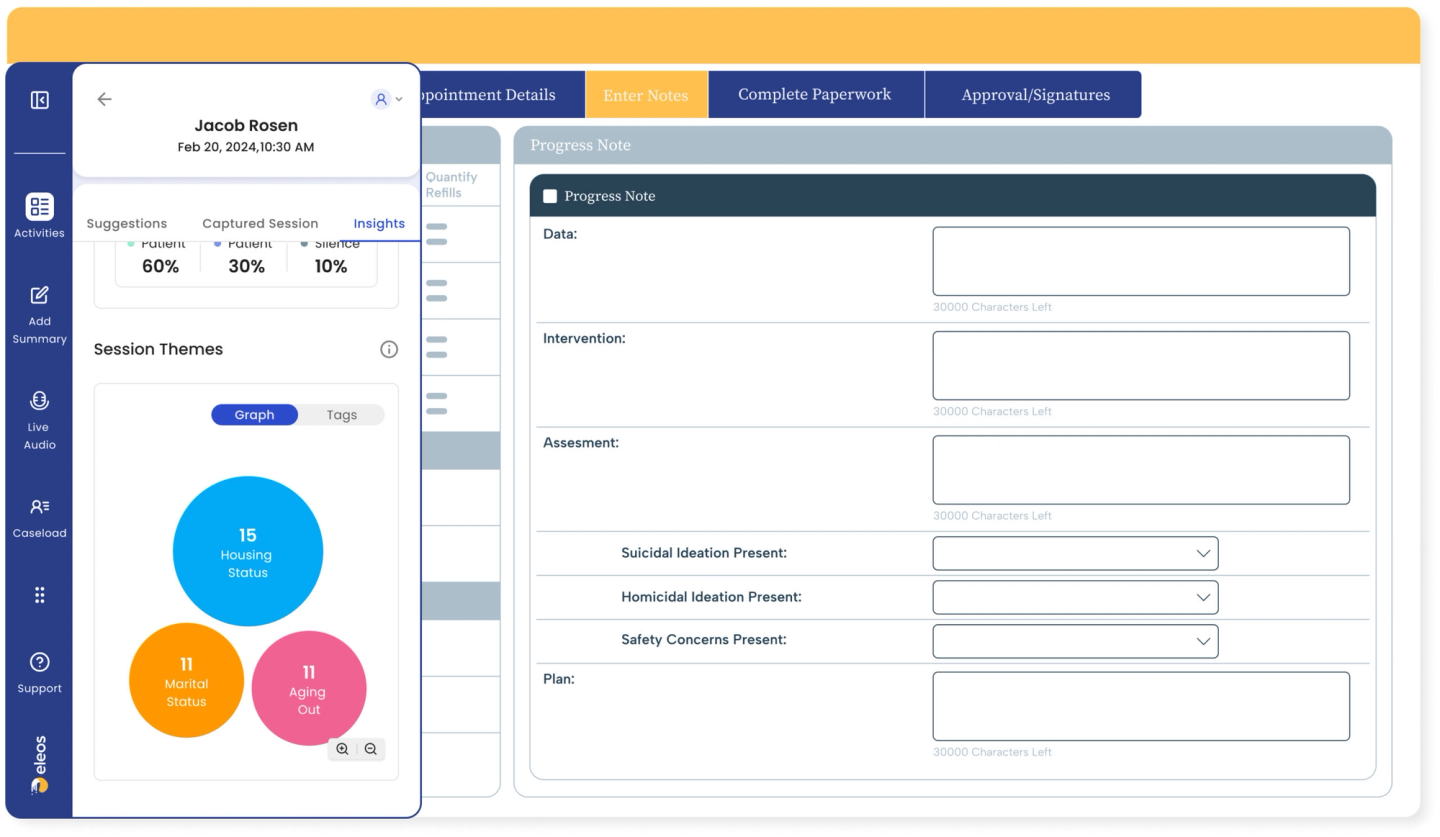
- Purpose-built for behavioral health, with organization-level analytics and oversight.
- Strong, documented time savings reported by directors and C-suite leaders.
- Deep EHR integration and hands-on implementation support.
- Well-suited to large agencies and community behavioral-health organizations.
Cons
- Enterprise sales and pricing — not a transparent per-seat plan.
- Heavier rollout; oriented to larger organizations, often more than a small group needs.
See our full Eleos Health review for a deeper comparison.
3. Mentalyc: A Per-Seat Team Plan for Group Practices
Practice owners are the core of Mentalyc's review base. One owner:
“Mentalyc has saved me from burnout!” — Jocelyn B., Owner, Mental Health Care (Capterra)
A group‑practice owner on value:
“Worth the money!” — Sarah G., Therapist and Group Practice Owner (Capterra)
Pros
- Behavioral-health-specific, with a group plan (~$49.99–$59.99/seat) including team management and admin visibility into member notes.
- Owners report real time savings and reduced burnout.
- Established behavioral-health review base.
Cons
- Some reviewers report reliability issues (e.g., lost recordings).
- Standardizing quality across a whole team is less robust than enterprise BH tools.
- Cost flagged by some reviewers as caseload grows.
4. Nabla: A General-Medical Scribe That Scales Technically
Nabla is a feature‑analysis pick: it is a capable, EHR‑agnostic ambient scribe, but its reviews skew to physicians and general medicine rather than behavioral‑health owners, so we assess it on documented capabilities.
Pros
- EHR-agnostic with 20+ EHR integrations (including Epic and Oracle) — useful for multi-system groups.
- Fast, browser-based; supports 35+ languages and 55+ specialties.
- Scales technically across a large clinician base.
Cons
- General-medical, not behavioral-health-specialized; fewer BH note-format and workflow specifics.
- Documentation-only (no clinical decision support).
- Sparse behavioral-health practice-owner reviews to validate team fit.
5. Suki: Enterprise Ambient for Health Systems
Suki is an enterprise ambient assistant aimed at health systems. Public behavioral‑health owner feedback is limited and cautionary — one owner‑provider review:
“Initially it worked well to provide dictation.” — Alton J. N., Owner Provider, Mental Health Care (Capterra, 2/5)
That reviewer reported it later became glitchy and unreliable and discontinued use. We assess Suki mainly on documented features.
Pros
- Enterprise-grade ambient documentation with deep EHR integration (e.g., Epic).
- Reported note-time reductions; strong fit for large health systems.
- Mature mobile experience.
Cons
- Enterprise pricing oriented to large organizations — often overkill for a small-to-mid behavioral-health group.
- The one public BH owner review reports reliability problems and discontinuation.
- Not behavioral-health-specialized.
What Owners and Clinical Directors Should Evaluate
Across the reviews, the same practice‑level questions come up before any team‑wide rollout:
- Per-seat economics. Is there a transparent per-clinician plan, or enterprise-only pricing? Model the cost across every seat, not one clinician.
- Admin oversight. Can administrators see note status, turnaround, and member notes across the team from one console?
- Standardizing quality. Will notes be consistent across clinicians without flattening each clinician's voice? See how group practices standardize notes with AI.
- Organization-level BAA and access controls. Confirm a single BAA covering the org, role-based access, and audio handling (ideally never stored).
- Rollout effort. How long to onboard a whole team, and does it work alongside your current EHR/telehealth rather than replacing it?
- Right-sizing. Enterprise tools built for hospitals can be heavier and pricier than a behavioral-health group needs.
How to Choose for Your Group Practice
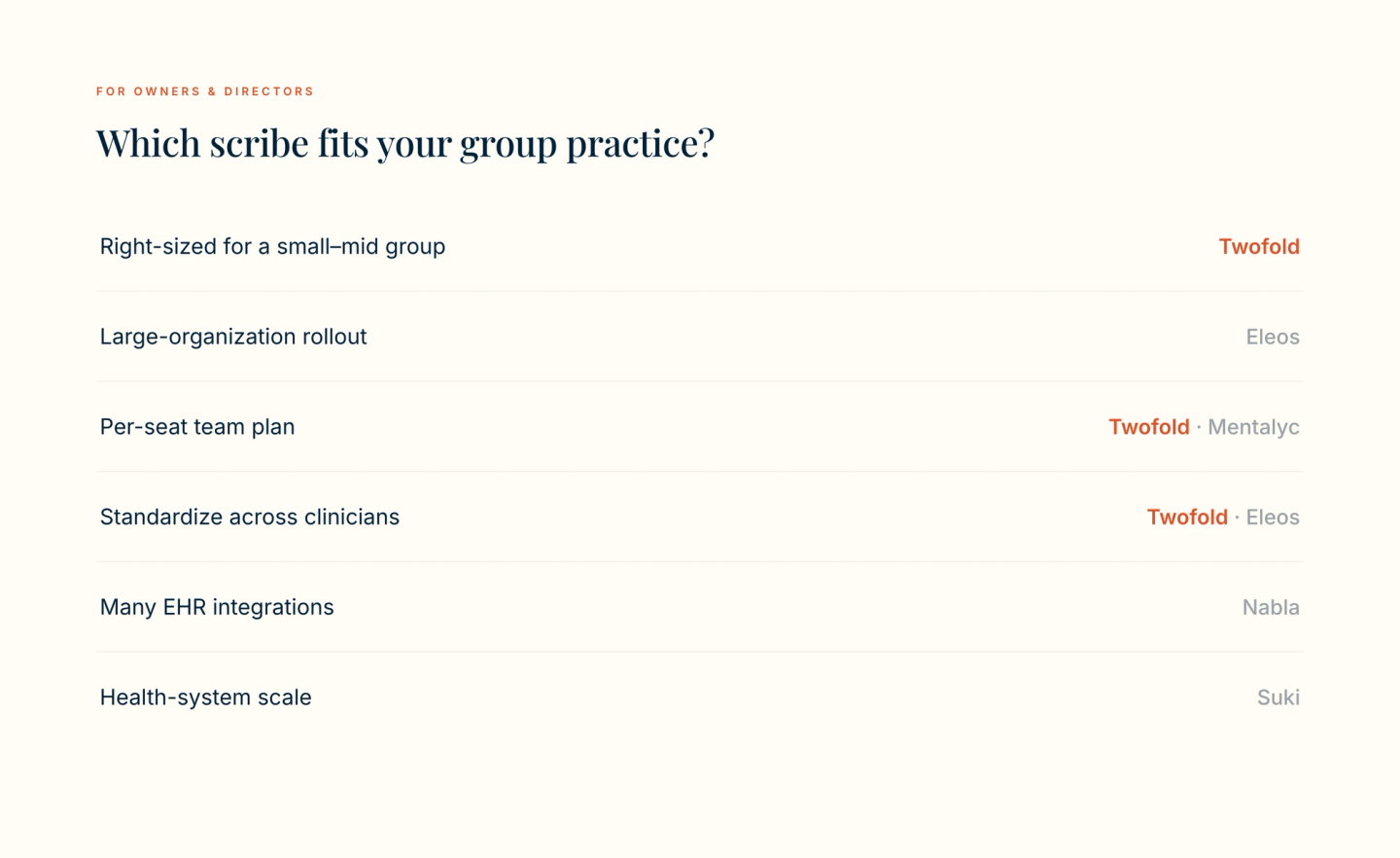
Match your rollout priority to a tool. For most behavioral‑health groups, Twofold is the right‑sized default; Eleos fits large organizations, and Nabla and Suki suit general‑medical or health‑system contexts.
Tool | Score (/10) | Best for | Pricing model | Admin oversight | BH-specialized | Owner/director verdict |
|---|---|---|---|---|---|---|
Twofold | 9.3 | Small–mid BH groups | Per-seat (~$49/clinician) | Admin console | Yes | Strongest, right-sized |
Eleos | 8.8 | Large BH organizations | Enterprise | Org analytics | Yes | Strong (enterprise) |
Mentalyc | 8.2 | Per-seat team plan | ~$49.99–59.99/seat | Member-note visibility | Yes | Positive, some reliability flags |
Nabla | 7.7 | Multi-specialty / many EHRs | Enterprise/tiered | Limited (BH) | No | Feature pick (general-medical) |
Suki | 7.2 | Health-system scale | Enterprise | Limited (BH) | No | Caution — enterprise, sparse BH reviews |
Scores (out of 10) are a weighted blend of note quality, format coverage, EHR fit, HIPAA compliance, and price — weighted for this comparison's criteria.
Pricing and features are from public reviews and vendor materials — verify current per‑seat pricing, BAA, and admin capabilities with each vendor. Last verified June 2026.
Final Verdict
For most group behavioral‑health practices, Twofold is the best‑fit AI scribe in 2026 — right‑sized for a clinical team, with per‑seat pricing, an admin console, standardized SOAP/DAP/BIRP/GIRP notes, and a signed BAA, all without replacing your EHR. Large organizations should shortlist Eleos; Mentalyc is a credible per‑seat alternative. See also our group therapy practice roundup, guide to scaling a group practice with AI, and our best AI scribe for mental health.