



The integration of ambient artificial intelligence scribes into clinical practice represents a significant shift in medical documentation, with implications extending beyond administrative efficiency into medical education. Traditional clinical note‑writing has served as a foundational educational tool, cultivating diagnostic reasoning, information synthesis, and professional identity formation among medical students.
As AI medical scribe systems increasingly assume documentation responsibilities, medical educators face a question: what becomes of the educational framework that note‑writing has historically provided? This article explores the tension between AI‑driven efficiency and the preservation of essential clinical competencies in medical student training.
What Is an AI Medical Scribe? (And Why It Matters for Students)
An AI medical scribe for clinicians is a software system that passively listens to patient‑provider conversations and automatically generates structured clinical documentation. Unlike human scribes who actively type during encounters, these tools operate in the background, leveraging speech recognition, natural language processing, and large language models to capture and summarise clinical dialogue in real time.
The typical workflow is as follows: with patient consent, the AI tool records the clinical conversation and, either in real time or shortly after, produces a structured note ready for clinician review and integration into the electronic health record. The output is a coherent, clinically meaningful summary, organised into familiar formats such as SOAP (Subjective, Objective, Assessment, Plan).
Why AI Scribes Matter for Medical Students
For medical students, the significance of AI scribes extends far beyond helping with the administrative burden. Clinical documentation has long played a pivotal role in physician training, extending beyond its function as a record of care to actively cultivate clinical reasoning. A 2025 post in the JME forum highlighted that translating clinical encounters into written documentation helps medical trainees structure their thinking, prioritise key clinical information, and develop their diagnostic reasoning skills.
A 2026 Research study from Yale School of Medicine, which has developed the first curriculum on ambient scribe use for medical students in the country, offers both caution and reassurance. A study of 104 first‑year medical students found that AI scribes had minimal impact on overall note quality, namely when students generated independent notes before incorporating AI content.
However, the study also revealed that AI‑generated notes had frequently omitted important details, such as symptom duration in the chief complaint section, and a minority of students expressed concern that reliance on AI could hinder their ability to learn effective note‑writing skills.
Thus, the dilemma is that AI scribes reduce documentation burden and may benefit lower‑performing students, but they also risk weakening the clinical reasoning skills that are developed through note‑writing. As the commentary from the JME forum post emphasized, ‘replacing students with AI scribes may streamline physician workflow, but it deprives students of formative experiences essential to clinical reasoning, empathy, and communication’. At this point in time, educators must guide learners to use AI as a framework for reasoning, not a substitute for it.
The Benefits and Risks of AI Scribes in Medical Education
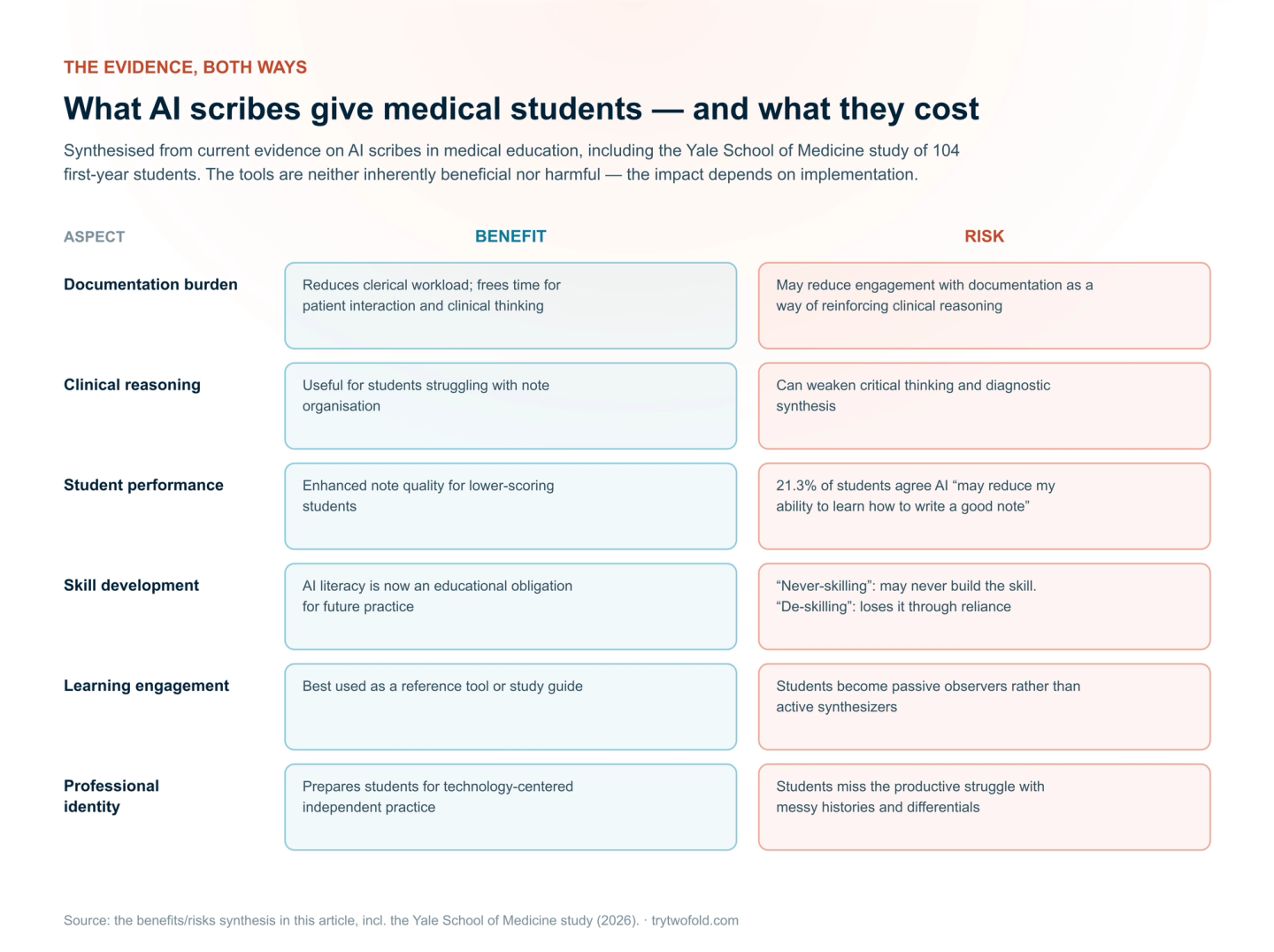
The table below synthesises current evidence on how AI scribes affect medical student training, weighing documented advantages against educational risks.
Aspect | Benefits | Risks |
|---|---|---|
Documentation Burden | Reduces clerical workload; frees time for patient interaction and clinical thinking | May reduce engagement with documentation as a way for reinforcing clinical reasoning |
Clinical Reasoning | Useful for students struggling with note organisation | Can weaken critical thinking and diagnostic synthesis |
Student Performance (Yale Study) | Enhanced note quality for lower-scoring students | 21.3% of students agree AI "may reduce my ability to learn how to write a good note" |
Skill Development | AI literacy is now an educational obligation for future practice | "Never-skilling": may never learn critical thinking; "De-skilling": loses skills through reliance |
Learning Engagement | Best utilized as a reference tool/study guide. | Students become passive observers rather than active synthesizers |
Professional Identity | Prepares students for technology-centered independent practice | Students miss the productive struggle with messy histories and differentials is essential to learning |
AI scribes are neither inherently beneficial nor harmful; their educational impact depends entirely on implementation.
A Path Forward: Recommendations for Preserving Clinical Reasoning
The evidence does not support banning AI scribes from medical education, nor does it support unrestricted access. Below are practical, evidence‑informed strategies for integration that protect medical student development.
1. Establish Baseline Documentation Skills First
Foundational note‑writing must precede any AI use.
- Students must demonstrate competence in independent documentation before accessing AI tools.
- Rationale: AI is a tool, not a substitute; students cannot critically evaluate what they cannot produce independently.
2. Structured AI Training and Critical Review
Train students to critically evaluate AI output, such as identifying omissions, errors, and hallucinations.
- Implement mandatory human editing of all AI-generated drafts.
- AI notes frequently omit important clinical details (e.g., symptom duration); students must learn to detect these gaps.
- Develop curricula explicitly addressing AI limitations, bias, and appropriate use cases.
3. Hybrid Workflows That Preserve Reasoning
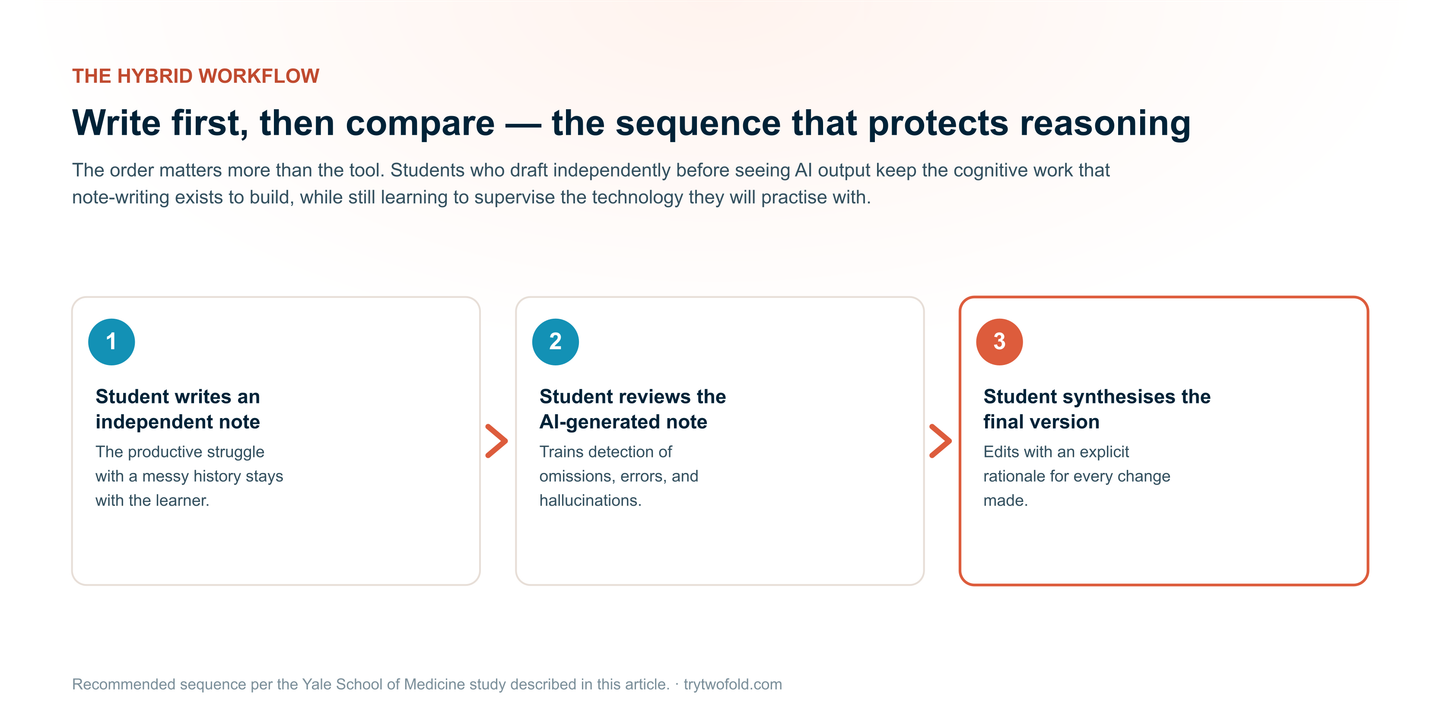
Students generate independent notes before accessing AI‑generated content
Recommended sequence, as highlighted in the Yale Study:
- Student writes an independent note.
- Student reviews AI-generated note.
- Student synthesises and edits final version with explicit rationale for changes.
Conclusion
AI scribes address a real problem by reducing the burden of clinical documentation, but they also create a new challenge: they may limit opportunities for medical students to develop clinical reasoning through note‑writing. Current evidence suggests that these tools’ impact depends on how they are used. To preserve learning, students should first develop core documentation skills, write notes independently before using AI assistance, and use AI‑generated transcripts as a tool for feedback rather than a replacement for active learning. As AI takes on more of the writing, medical education must ensure that students continue to think critically.