


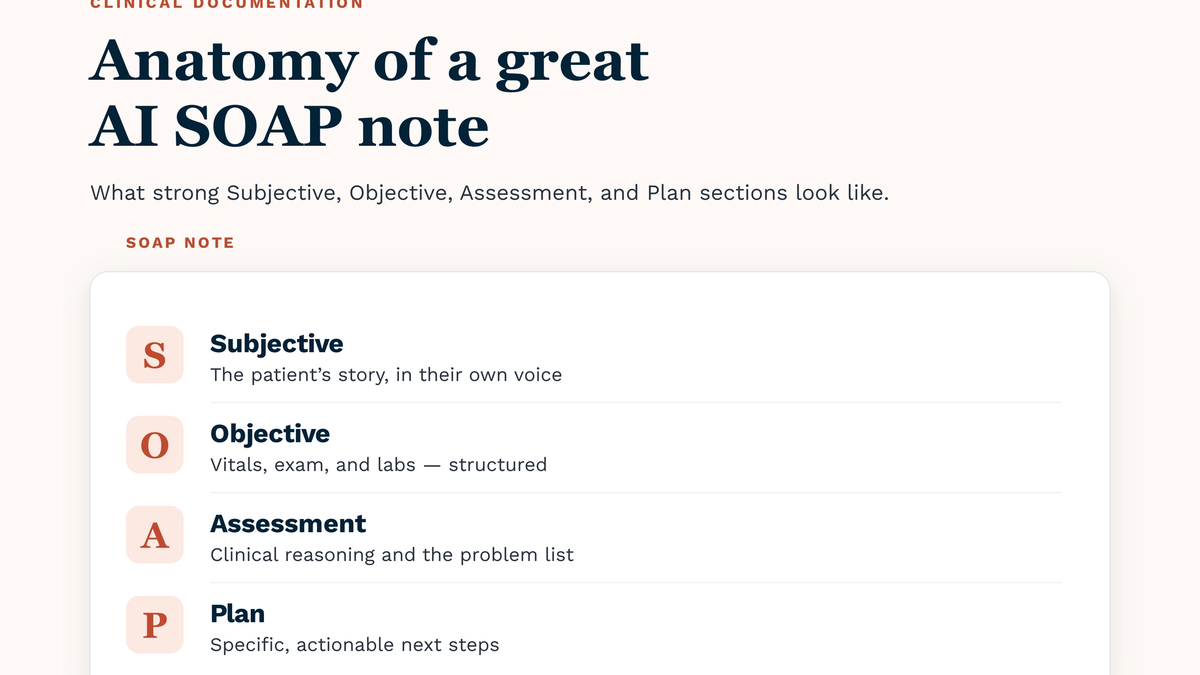
A poorly written SOAP note is worse than no note at all. However, when structured correctly, AI can produce excellent documentation that enhances your clinical workflow. The difference lies in the structure of each section. In this guide, learn the anatomy of great AI SOAP notes, so you can stop editing and start trusting your AI scribe.
The Subjective (S): Capturing the Patient's Voice
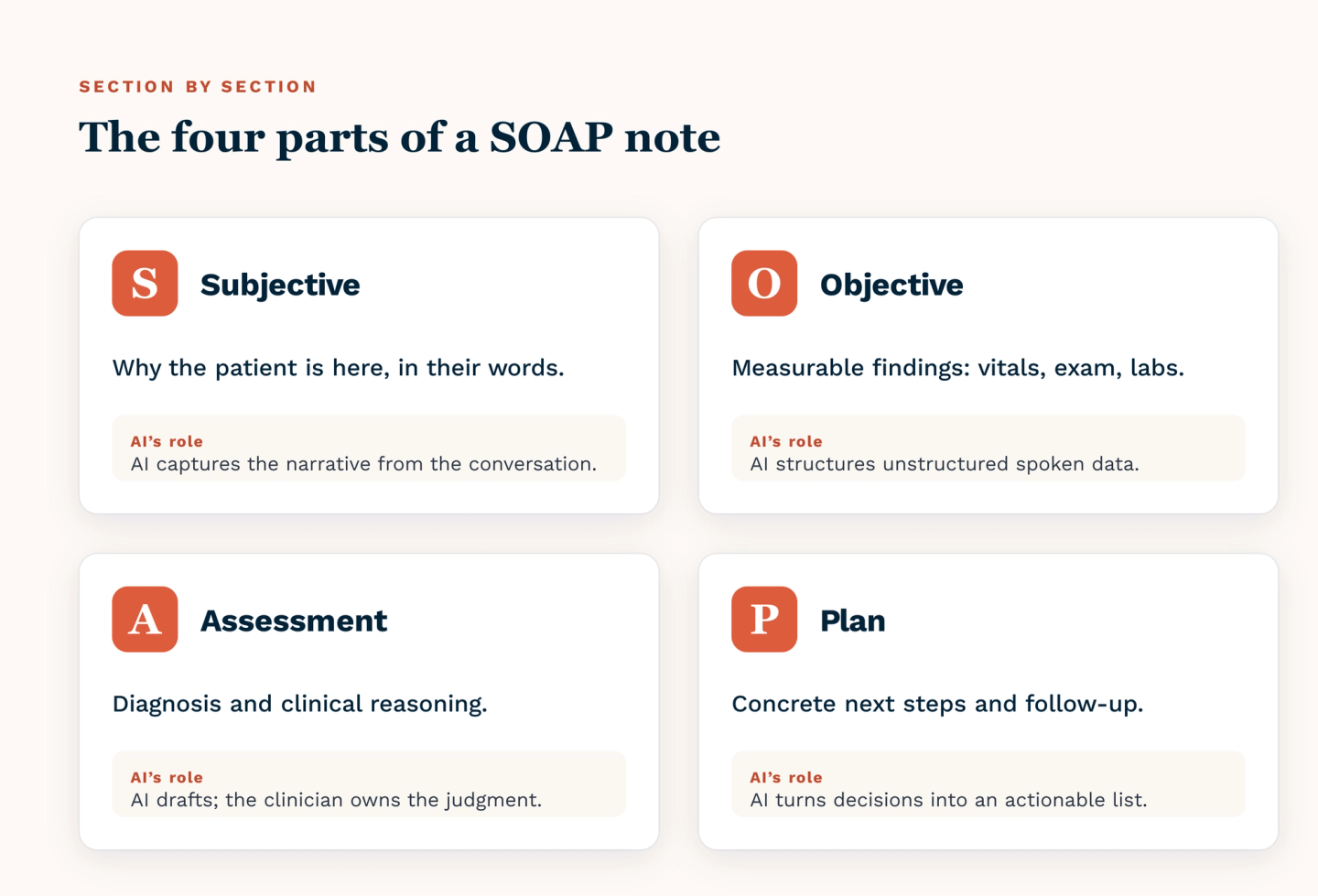
Goal: The AI must distinguish between what the patient said and what the clinician infers.
The Subjective section is where AI is likely to fail. A weak AI scribe paraphrases everything into bland, clinical language, stripping away the very details that suggest a diagnosis. A great AI SOAP note tool, however, acts like a skilled scribe: it preserves the patient's exact words while organizing them into a readable narrative.
What a Strong AI-Generated Subjective Section Looks Like
- Uses direct quotes for key symptoms.
- Chronological ordering of events – the story should flow from symptom onset to present, not jump around.
- Explicitly labels the absence of critical negatives.
- Separates patient narrative from caregiver reports.
The One Prompt You Need to Fix the Subjective Section
Most AI scribes default to paraphrasing. Override that behavior with this single, powerful instruction:
Prompt Example: "Extract only the patient's exact words and chronological story. Do not interpret. Flag any symptom with onset, duration, and severity."
The Objective (O): Structuring Unstructured Data
Goal: AI must convert data from vitals, labs, and physical exam findings into a clean, auditable trail.
The Objective section is where AI has the clearest advantage, and the lowest hallucination risk, provided it stays away from interpretation. Unlike the Subjective section, which requires narrative nuance, the O section demands precision, reproducibility, and completeness. A great AI tool transforms raw, often chaotic clinical data into a structured format that any subsequent clinician can trust at a glance.
AI's Strength in the Objective Section
AI excels at four specific tasks that used to consume minutes of manual chart review:
- Vital Sign Normalization: Converting free-text entries into clean, structured fields that trigger alerts for abnormal ranges.
- Lab Trend Identification: Highlighting clinically meaningful changes without being asked.
- Physical Exam Completeness: Cross-referencing the documented exam against a standard Review of Systems (ROS) and flagging missing systems.
- Imaging Findings: Extracting and separating actionable findings from incidental, non-urgent findings.
The Assessment (A): Where Clinical Reasoning Lives
The Assessment is the most clinically risky section to automate, and also the most valuable to augment. A great AI organizes evidence, surfaces uncertainty, and invites the clinician to apply final judgment.
From Problem List to Clinical Narrative
- Ranks differentials: Organizes possibilities as Most Likely – Rule Out – Unlikely but Dangerous.
- Explicitly links Objective findings to Subjective complaints.
- Highlights unresolved conflicts: Flags when patient report and exam disagree.
The Plan (P): From Documentation to Action
The Plan is where documentation becomes medicine. A beautifully written Subjective and Assessment mean nothing if the Plan is vague, outdated, or impossible to execute. Great AI‑generated Plans act as a clinical handoff; clear enough for a covering physician, specific enough for a medical intern, and readable enough for the patient.
Four Elements of an AI-Generated Plan
A strong Plan covers exactly these four elements:
- Medications: List new, changed, and discontinued drugs. Include dosages, routes, frequencies, and a one-sentence rationale.
- Tests/Imaging: Specify which test, why it is ordered, and when to follow up.
- Referrals: Name the specialty, urgency level (routine, urgent, emergent), and what information was sent with the referral.
- Patient Education: Name specific handouts, videos, or aftercare instructions given.
The Ultimate AI SOAP Note Checklist
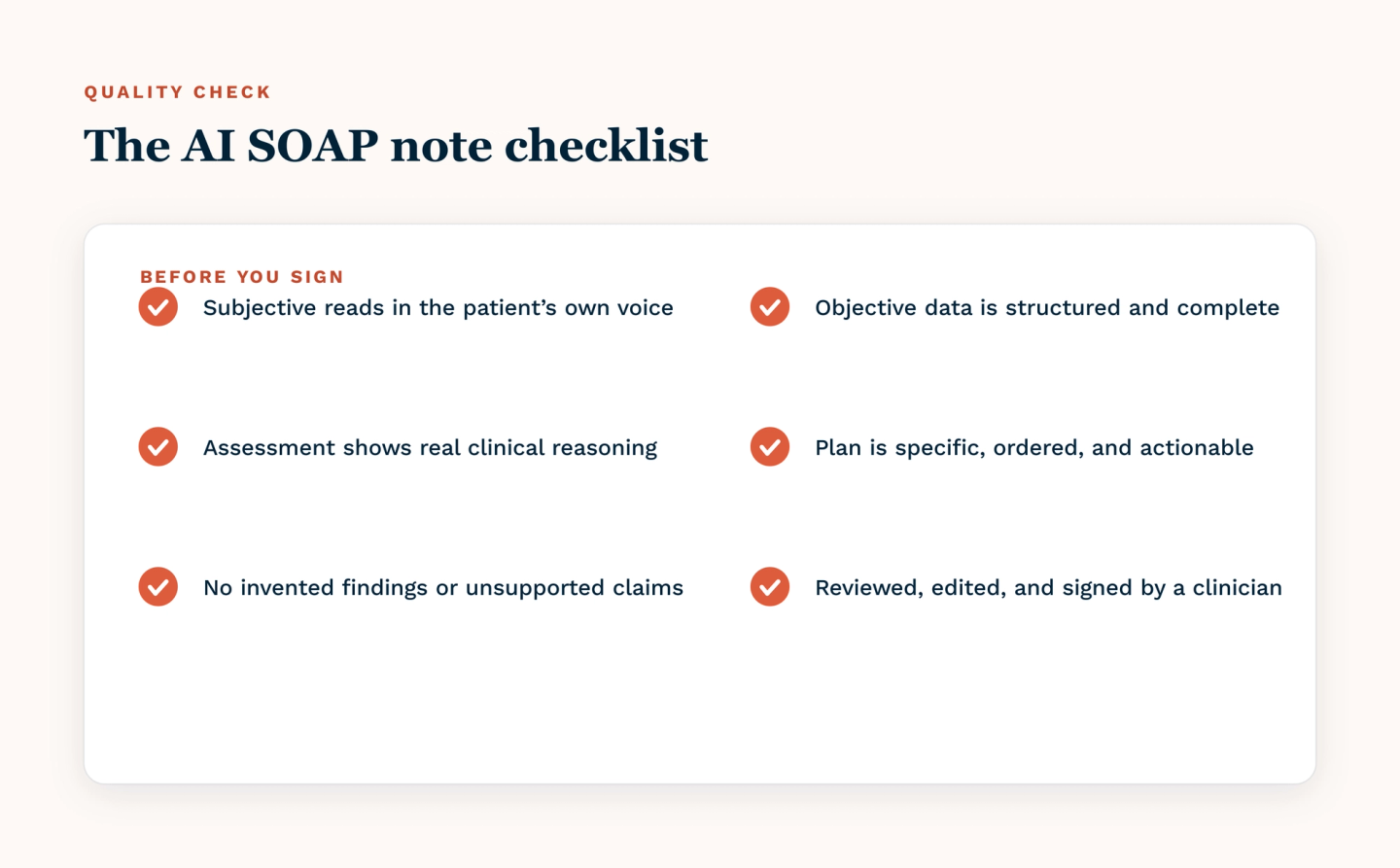
Use this table to validate any AI‑generated SOAP note before signing.
Section | Must-have Elements | AI Hallucination Risk | Your Priority Review |
|---|---|---|---|
Subjective | Direct quotes, symptom timeline, critical negatives | High (invented quotes) | Verify quotes match the patient's words |
Objective | Numeric values, laterality, normal/abnormal flags | Low | Check for missing vitals or vague exam terms |
Assessment | Ranked differentials, links findings, flags conflicts | High | Confirm differential includes "don't miss" diagnoses |
Plan | New/changed meds with rationale, tests with timing, referrals, patient ed | Medium (might copy outdated orders) | Flag any instruction older than 30 days |
Conclusion
An effective AI‑generated SOAP note follows a consistent structure across all four sections. The Subjective captures verbatim patient language. The Objective organizes measurable data without interpretation. The Assessment presents a reasoned differential, and the Plan lists only actionable, current orders. Clinicians should always treat AI output as a draft that requires systematic review. When used properly, AI documentation tools increase efficiency while maintaining clinical accuracy.