


Documentation tasks consume time that could otherwise be spent observing and refining communication skills. For trainees, the pressure to capture details accurately often reduces the nuances of patient interaction. AI clinical note tools offer a different approach. These tools generate clinical notes, which allow attending physicians to observe trainees without the interference of typing or screen navigation. Explore how AI scribes can support communication training by turning bedside manner into a skill that can be observed, assessed, and improved through objective feedback.
Why Bedside Manner Suffers in Training
The clinical training environment imposes specific barriers to developing strong communication skills.
- Documentation Demands During Encounters: Trainees must simultaneously enter data and listen to the patient. This division of attention reduces capacity for observing nonverbal cues or recognizing moments of patient hesitation.
- Evaluation Frameworks That Prioritize Clinical Reasoning: Communication skills receive less formal assessment during most rotations. Trainees direct their effort toward the competencies that determine their grades.
- Time Pressures From Rotation Schedules: Encounters are abbreviated to accommodate patient volumes. The resulting pace leaves little room for deliberate reflection on communication choices.
- Limited Modeling From Supervising Physicians: Attendings, themselves burdened by documentation requirements, may demonstrate hurried or distracted interactions. Trainees absorb these patterns without receiving explicit guidance on alternatives.
These factors combine to exclude bedside manner in the training curriculum, despite its established relevance to patient outcomes.
4 Ways AI Clinical Note Scribes Enhance the Educational Experience
The integration of AI scribes into clinical training offers specific educational advantages. These tools, when used deliberately, move beyond administrative convenience and become instruments for teaching communication. The following mechanisms illustrate how this occurs.
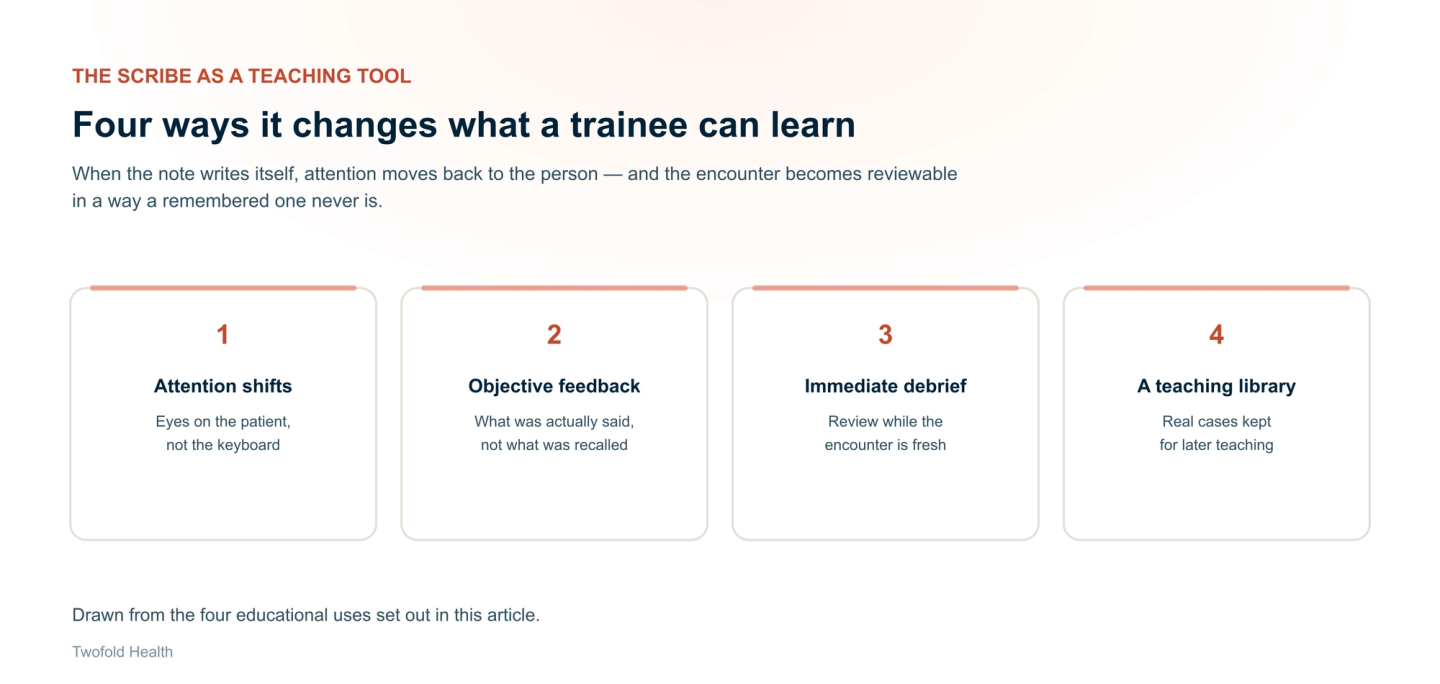
1. Shifting Attention During The Encounter
Trainees typically divide their focus between the patient and the electronic health record. AI scribes remove the documentation requirement from the encounter, allowing the trainee to direct full attention toward the patient.
This shift creates space for observing body language, detecting emotional cues, and responding to patient concerns without the interruption of typing or screen navigation. The trainee's attention is no longer split between competing tasks.
2. Providing Objective Data For Feedback
AI‑generated transcripts and analytics offer a record of the conversation that can be reviewed after the encounter. This data includes metrics such as the proportion of open‑ended questions, the frequency of empathic statements, and instances where the patient was interrupted.
These measures provide a foundation for feedback that is specific rather than general. An attending physician can reference particular moments in the conversation rather than relying on memory or subjective impression.
3. Enabling Immediate Debriefing
The AI summary is available shortly after the patient leaves. This timing allows the attending and trainee to review the encounter while it remains fresh. The discussion can address specific phrasing choices, missed opportunities for empathy, or moments when the trainee's questions became directive rather than exploratory. This immediacy strengthens the connection between the trainee's actions and the attending's feedback.
4. Creating A Resource For Teaching Cases
Anonymized encounter data can be compiled across multiple trainees and rotations. These cases serve as instructional material for the broader residency group.
Discussions can focus on communication patterns that appear repeatedly, such as how trainees respond to patient distress or how they structure the opening of an interview. This resource provides real‑world examples that supplement textbook instruction on patient communication.
The educational value of AI scribes depends on active engagement from supervising physicians who treat the technology as a teaching instrument rather than merely a convenience.
See more information on how to introduce an AI scribe for incoming interns.
Overcoming the Pitfalls
The adoption of AI scribes in medical education carries inherent risks. Several concerns merit attention, along with strategies to address them.
- Over-Reliance on AI-Generated Documentation: Trainees may lose the ability to synthesize a clinical narrative independently. Educators should designate specific encounters for AI-assisted documentation and others for traditional note-writing to preserve this skill.
- Blind Spots in AI Analysis: The technology processes spoken language but does not interpret nonverbal cues. Educators must supplement AI-generated data with their own observations of the trainee's engagement with the patient.
- Privacy and Data Security Concerns: Recording technology raises consent and data handling issues. Institutions must establish clear protocols for informed consent and data encryption, and maintain transparency with patients.
- Loss of Human Connection: Trainees may focus more on the AI's accuracy than on the patient's experience. Educators should frame the AI scribe as a tool that enables better attention, not as the focus of the encounter.
Conclusion
AI clinical note tools offer more than administrative relief. Their integration into clinical training provides a mechanism for teaching communication as a measurable competency. The technology frees attention during patient encounters and generates data that supports structured feedback. These benefits depend on deliberate implementation; therefore, educators must treat AI scribes as teaching instruments rather than conveniences, and institutions must establish clear guidelines for their use. The goal remains unchanged: graduating clinicians who listen well and communicate effectively.