



The academic year brings a new cohort of interns to the clinical floor. These physicians must learn to use the electronic health record efficiently while managing patient loads and writing detailed clinical notes. An AI medical scribe offers relief by reducing the documentation burden. However, this technology raises practical concerns about training and the potential for over‑reliance. Program directors need a structured approach that addresses technical setup and the habits that interns need to develop. This guide provides a practical plan for integrating AI medical scribes into residency training.
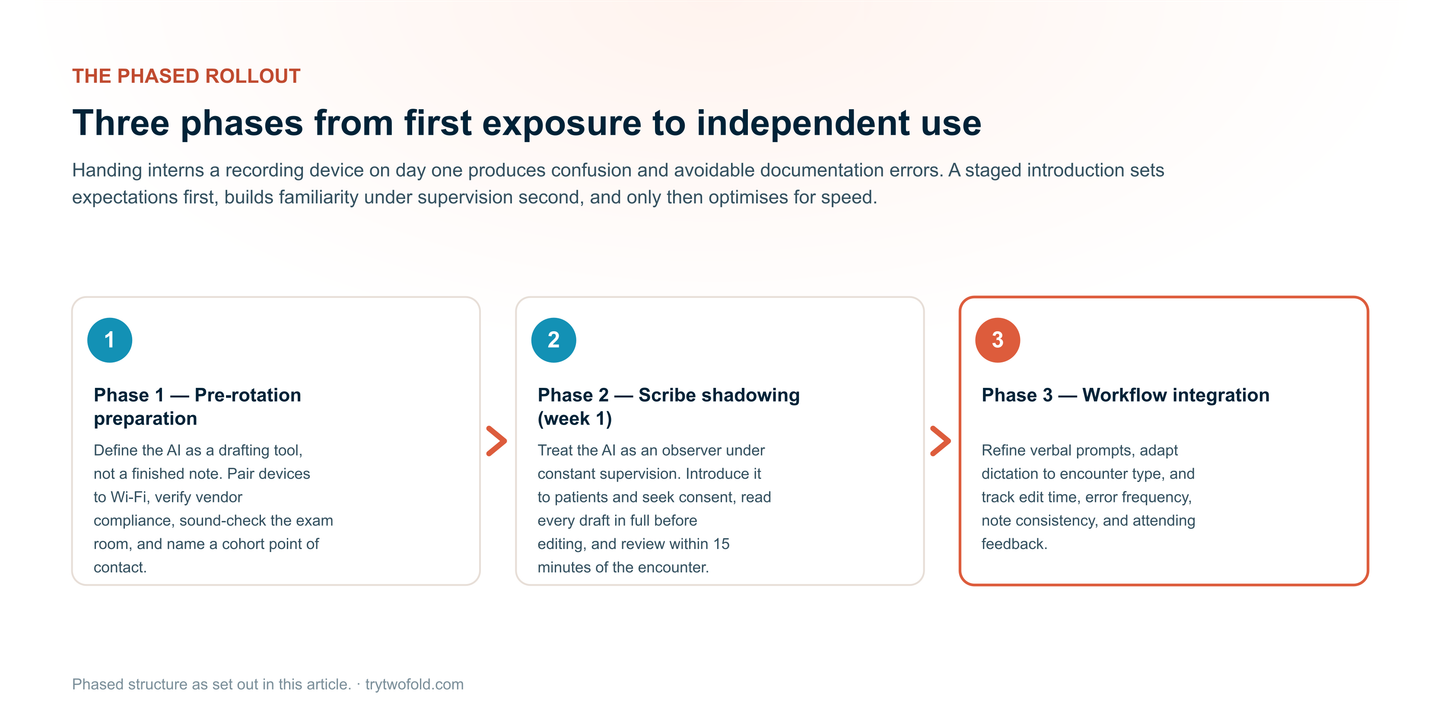
Phase 1: Pre-Rotation Preparation
The period before interns begin clinical duties offers a chance to shape their approach to documentation. Rather than focusing solely on software features, preparation should address the conceptual shift and the logistical realities of using an AI scribe in a busy hospital environment. Two areas deserve particular attention.
1. Defining the AI's Role As A Drafting Tool
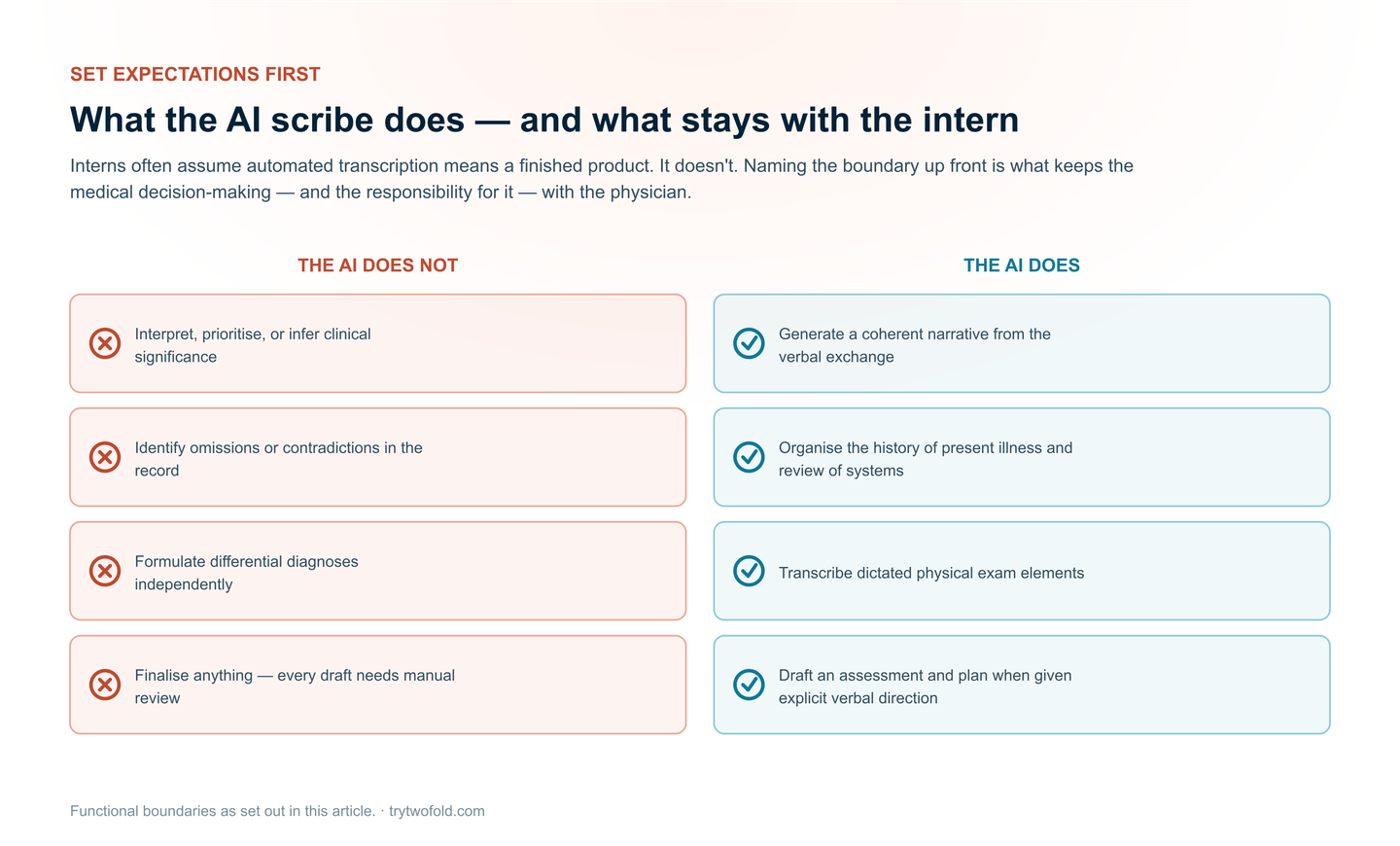
Interns might assume that automated transcription implies a finished product. This assumption is incorrect. The AI medical scribe captures the patient's spoken history and the physician's verbal findings. It does not interpret, prioritize, or infer clinical significance.
Program directors should emphasize that the intern remains responsible for the medical decision‑making section of the note. This approach positions the AI as a time‑saving utility rather than a clinical shortcut.
Technical Configuration and Environmental Review
The success of an AI scribe depends on reliable hardware and suitable physical settings. Before the rotation starts, the following steps should be completed:
- Pair the Recording Device with the Hospital's Wi-Fi Network: Test the connection in the specific rooms where interns will see patients.
- Verify the Vendor's Compliance with Institutional Privacy Policies: Confirmation of encryption protocols and data storage locations is necessary.
- Conduct a Sound Check in the Examination Space: The microphone should capture the speaker's voice without picking up ambient noise from the hallway or neighboring rooms.
- Assign a Point of Contact Among the Intern Cohort: This individual handles basic troubleshooting and relays technical issues to the vendor's support team, preventing frequent interruptions to faculty.
Clarifying Functional Boundaries
Interns benefit from a clear breakdown of what the AI medical scribe can and cannot accomplish. A concise summary helps set appropriate expectations:
- The AI generates a coherent narrative from verbal exchange; It organizes the history of present illness and the review of systems based on conversational flow.
- The AI does not identify omissions or contradictions.
- The AI transcribes dictated physical exam elements.
- The AI creates a draft of the assessment and plan only when given explicit verbal direction. It does not formulate differential diagnoses independently.
- The AI requires manual review before finalization. Errors in transcription or interpretation occur and must be corrected by the supervising clinician.
This preparatory phase reduces confusion on the first day. Interns who understand these boundaries tend to adopt the tool more quickly and commit fewer documentation errors.
For more in‑depth information, see how AI is reshaping medical education.
Phase 2: The "Scribe Shadowing" Period
During the first week of clinical duties, interns should treat the AI scribe as an observer whose output requires constant supervision. This period focuses on building familiarity with the technology while establishing habits that prevent over‑reliance.
Introducing The Technology To Patients
Interns must articulate the purpose of the recording device in a manner that respects patient autonomy and builds trust. A straightforward explanation suffices:
- State the Purpose Clearly: "I use a secure digital assistant to draft my notes so I can give you my full attention during our conversation."
- Ask for Explicit Permission Before Activating the Device: Some patients may decline, and interns should respect that decision without pressure.
- Reassure the Patient about Privacy: "The recording is encrypted and deleted after the note is drafted. No one outside your care team hears it."
- Offer the Option to Pause or Stop the Device at Any Time: Patients who feel in control of the process are more likely to cooperate.
Using The Draft As A Learning Tool
The draft produced by the AI medical scribe offers a teaching opportunity. Interns benefit from a structured review process:
- Read the AI-generated note in full before making any edits; This practice reveals the system's tendencies, such as how it handles interruptions or overlapping speech.
- Compare the draft against the intern's own recollection of the encounter. Highlight and correct errors or hallucinations directly in the draft. This reinforces the intern's responsibility for the final product.
- Reflect on the draft's organization; If the AI misplaces information, the intern may consider restructuring their questioning sequence for better results in future encounters.
Adapting To The Clinical Environment
The physical setting affects how well the AI scribe performs. Interns should experiment with positioning and volume during the first week:
- Place the recording device between the intern and the patient, at a distance that captures both voices equally.
- Speak at a moderate volume and avoid overlapping with the patient's speech.
- Move the device away from sources of background noise, such as monitors, fans, or hallway activity.
See why the microphone matters for AI‑assisted clinical documentation.
Establishing A Review Routine
A consistent approach to reviewing AI‑generated notes reduces the risk of missed errors. Interns should develop a personal workflow during the shadowing week:
- Review the draft within fifteen minutes of completing the patient encounter.
- Verify the review of systems against the patient's reported symptoms.
- Correct the assessment and plan manually.
This shadowing period establishes a foundation for more efficient use of the AI scribe in the weeks that follow.
Phase 3: Workflow Integration and Optimization
After the initial shadowing week, interns typically understand the AI scribe's basic functions and limitations. The subsequent weeks shift the focus toward efficiency and consistency.
Refining Verbal Prompts For Better Output
Small adjustments in phrasing can produce drafts that require fewer corrections:
- State the purpose of each section before dictating content.
- Dictate negatives explicitly.
- Use specific language for the assessment.
- Request formatting directly in the dictation.
Adapting To Encounter Types
Not every patient visit follows the same pattern. Interns should learn to adjust their use of the AI scribe based on the clinical situation:
- Brief encounters, such as medication refill visits, require minimal dictation.
- Complex new patient visits benefit from systematic dictation, and interns should narrate the history in chronological order and explicitly separate subjective and objective findings.
- Procedures and minor surgeries involve limited conversation, so the AI may not capture procedural details that are not spoken aloud.
- Interns should dictate the steps performed immediately after completing the procedure.
Tracking Progress and Identifying Patterns
Interns benefit from periodic self‑assessment of their documentation habits. Several indicators suggest whether the AI integration is proceeding effectively:
- Time Spent Editing Each Note: A decrease from ten minutes to three minutes over several weeks indicates successful workflow adaptation.
- Frequency of Factual Errors in the AI draft: If errors persist at the same rate, interns may need to adjust their speaking clarity or the physical placement of the device.
- Consistency of Note Structure Across Different Patients: Variability suggests that interns are not using verbal prompts consistently.
- Resident and Attending Feedback on Note Quality: Comments about missing information or unclear organization point to areas requiring additional attention.
Managing High-Volume Periods
Clinical workloads fluctuate throughout the day and week. Interns should develop strategies for maintaining documentation quality when patient volume increases:
- Dictate immediately after each encounter; waiting until the end of the day results in forgotten details and longer editing times.
- Use brief verbal summaries for straightforward cases.
- Reserve the assessment section for dedicated dictation at the end of rounds
- Accept that some notes will require manual typing.
The optimization phase transforms the AI medical scribe from a tool that requires active management into a routine component of clinical workflow. Interns who complete this phase successfully spend less time on documentation and more time on direct patient interaction and clinical reasoning.
Conclusion
The phased approach outlined above moves interns from initial exposure to independent use of the AI medical scribe. Preparation establishes expectations, shadowing builds familiarity with the system's behavior, and optimization reduces the time spent editing. Program directors who implement this structure provide interns with a practical skill that extends beyond the current rotation. Interns who learn to use these systems effectively gain time for the aspects of medicine that require human judgment and connection.