


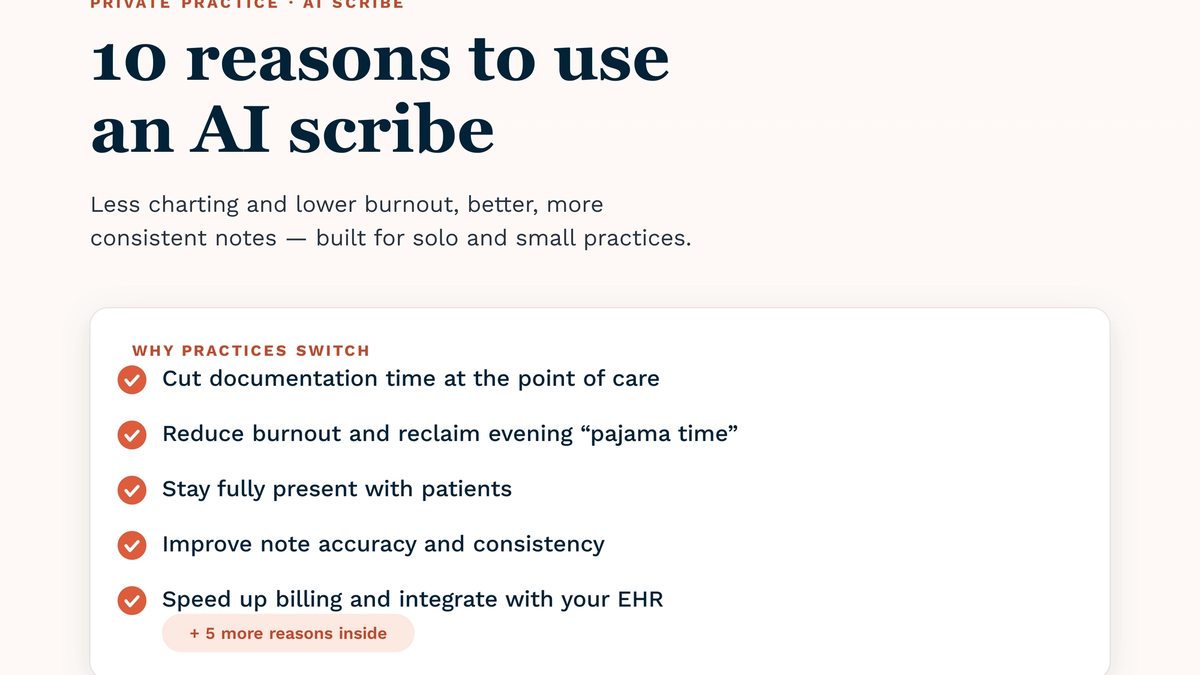
Clinical documentation is a necessary but time‑consuming component of private practice operations. An AI medical scribe for clinicians addresses this inefficiency by using ambient listening technology to automatically generate structured clinical notes from patient conversations. For private practice owners balancing patient volume, revenue goals, and quality of care, understanding the practical benefits of AI scribing is essential. Below are 10 reasons why adopting an AI scribe can improve documentation accuracy, reduce administrative burden, and support sustainable practice growth.
What Is an AI Scribe and How Does It Work in a Private Practice?
An AI medical scribe uses ambient listening technology to convert patient‑clinician conversations into structured clinical notes in real time. The workflow follows three steps:
- Audio Capture: Record via smartphone or laptop mic (with patient consent).
- AI Processing: The system de-identifies PHI and uses natural language processing (NLP) to extract medical concepts.
- Note Generation: A complete draft (SOAP note, HPI, billing codes) is produced within seconds.
10 Reasons Every Private Practice Should Use AI Scribe
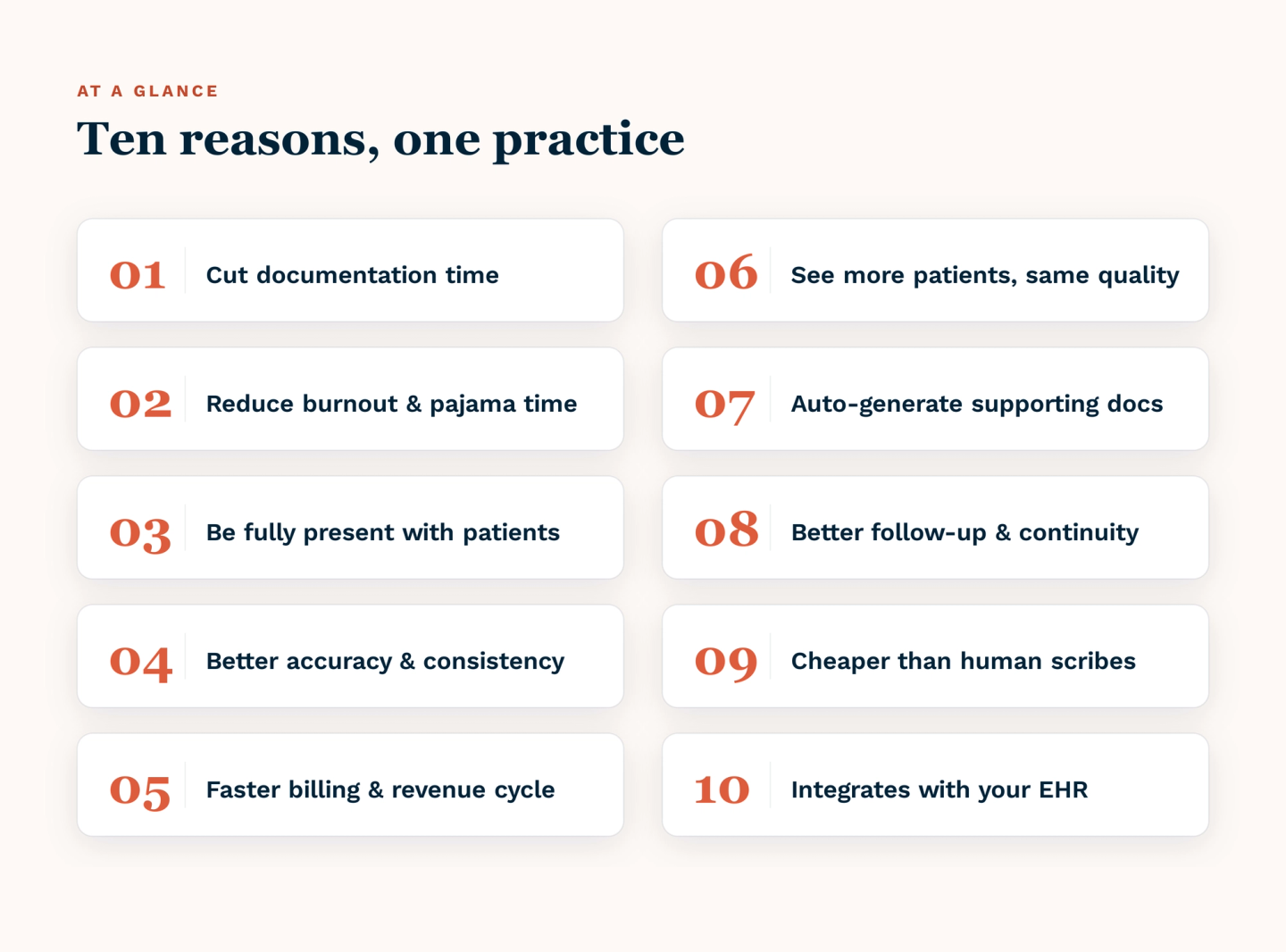
From documentation efficiency to patient experience, here are ten measurable benefits of adopting an AI scribe in your private practice.
Reason 1: AI Scribes Drastically Cut Documentation Time in Private Practice

Clinician task | Without an AI scribe | With AI scribe |
|---|---|---|
Note completion | After clinic hours | Before the next patient |
Daily documentation | Feels like a second shift | Finished by lunch |
Evening workload | Bring the laptop at home | The laptop stays at the office |
Weekend charting | Common | Rare |
For more in‑depth information, see how much time you can save with an AI scribe.
Reason 2: AI Scribes Reduce Clinician Burnout and End Pajama Time
A recent study at Yale School of Medicine reports that after‑hours charting or "pajama time" is a main contributor to burnout, especially in resident physicians. In private practice, clinicians and residents often complete notes at home as well, which extends the workday by 2–3 hours.
AI scribes mitigate this by completing documentation during the clinical day. Because the AI generates a draft immediately after each patient encounter, the clinician can review and sign the note before the next appointment. At the end of the scheduled day, documentation is finished. This workflow change reduces evening and weekend charting without requiring additional staff.
Reason 3: AI Scribes Let Private Practice Clinicians Be Fully Present With Patients
Without a scribe, clinicians look at a screen for most of the visit. With an AI scribe, they focus entirely on the patient.
Patient Experience Impact:
- Higher CAHPS satisfaction scores.
- Better rapport = improved treatment adherence.
- Reduced risk of missed diagnostic clues.
Reason 4: AI Scribes Improve Note Accuracy and Clinical Consistency
Manual note‑taking is prone to memory gaps and inconsistent language across visits. AI scribes capture the full clinical conversation and produce structured notes using standardized terminology.
How Accuracy Improves:
- Verbatim capture of patient-reported symptoms and clinician reasoning.
- Consistent use of medical terminology across all notes.
- Reduced risk of omitted details (e.g., pertinent negatives, medication changes).
- Fewer clarifications are needed from billing or compliance.
The result is a complete, reliable clinical record for every patient visit.
Reason 5: AI Scribes Speed Up Billing and Revenue Cycles for Private Practices
Incomplete or vague documentation leads to denied claims and delayed reimbursement. AI medical scribes generate notes that are detailed and ready for coding, which accelerates the revenue cycle.
Billing Benefits:
Without an AI scribe | With AI scribe |
|---|---|
Notes finished days later | Notes finished on the same day |
Claims submitted weekly | Claims submitted daily |
Delayed payments | Faster reimbursement |
Reason 6: AI Scribes Help Private Practices See More Patients Without Sacrificing Quality
The primary constraint on patient volume is documentation time, not clinical capacity. By reducing note‑writing from minutes to seconds, AI scribes create space for additional appointments within the same workday.
What Changes:
- Same attention per patient, less time spent charting afterward.
- Ability to add 1–2 more patient slots without extending hours.
- No decline in patient satisfaction or care quality.
- Revenue can increase without adding staff or working late.
Reason 7: AI Scribes Automatically Generate Supporting Clinical Documents
Beyond the core SOAP note, private practices regularly produce referral letters, work or school excuse notes, after‑visit summaries, etc. AI scribes can draft these supporting documents automatically from the same conversation.
Documents Generated Automatically:
- Referral letters to specialists.
- Work or school sick notes.
- After-visit summaries for patients.
Each document takes seconds to generate and seconds to review, saving an additional 5–10 minutes per patient encounter.
Reason 8: AI Scribes Improve Follow-Up Care and Treatment Continuity
In group practices, patients may see different clinicians across visits. In solo practices, a clinician may not remember every detail from a visit two weeks ago. AI‑generated notes ensure that complete, structured clinical information is available to any clinician reviewing the chart.
Continuity Benefits:
- No lost details between appointments or clinicians.
- Labs and referrals are clearly documented and tracked.
- Next visit starts with a complete picture, not a vague memory.
- This reduces missed follow-ups and improves long-term treatment outcomes.
Reason 9: AI Scribes Are More Cost-Effective Than Human Scribes for Private Practices
Hiring a human scribe requires salary, benefits, training, and coverage for time off. AI scribes operate on a monthly/annual subscription model with none of those overhead costs.
Cost Factor | AI Scribe | Human Scribe |
|---|---|---|
Annual Cost | $588-$3500 | $35,000–$50,000 |
Training Time | Under an hour | 1-4 weeks |
For more in‑depth information, see the comparison of AI vs. traditional medical scribes.
Reason 10: AI Scribes Integrate Directly With Your EHR
Many private practice owners hesitate to adopt new technology because they fear a complicated migration or data entry duplication. The best AI scribe tools offer direct, bi‑directional integration with major EHR platforms such as Epic, Cerner, Athenahealth etc.,
What Integration Means For Your Workflow:
- Generate a note with an AI medical scribe, then push directly to EHR with one click.
- No manual data entry.
- Existing templates and billing codes remain intact.
Is an AI Scribe Safe and HIPAA-Compliant for Private Practice Use?
Yes, provided the AI scribe platform is designed for clinical use and signs a Business Associate Agreement (BAA). Compliant AI scribes implement several mandatory safeguards:
- End-to-end encryption for all audio and text data during transmission and storage.
- Automatic audio deletion immediately after transcription (typically within 24–48 hours).
- No human review of patient audio unless explicitly authorized by the practice.
- Signed BAA that holds the vendor to HIPAA privacy and security rules.
Private practices should also obtain patient consent before recording any visit.
Faster Notes and Less Burnout for Private Practices With Twofold
Twofold Health is an AI medical scribe built for independent practices. It combines ambient listening with specialty-specific templates to generate SOAP notes, HPI, and billing codes in seconds.
- Designed for Private Practice Workflows: Direct integration with major EHRs (Epic, Athenahealth, Practice Fusion, and others) means notes push to your system with a simple copy-paste.
- Specialty-Specific Accuracy: Templates for primary care, psychiatry, orthopedics, dermatology, and more. The AI learns your preferred terminology and note structure over time.
- Risk-free Implementation: 14-day free trial with no credit card required. Includes a signed HIPAA Business Associate Agreement (BAA).
Conclusion
Adopting an AI medical scribe addresses three core challenges facing private practices today: documentation time, clinician burnout, and revenue cycle efficiency. The ten reasons outlined above demonstrate measurable benefits: from faster notes and improved accuracy to better patient engagement and lower costs than human scribes. For private practice owners seeking sustainable growth without expanding staff or extending work hours, AI scribing is a practical, evidence‑based solution.