


Accurate documentation of the musculoskeletal physical examination is foundational to orthopedic practice, yet it imposes a substantial administrative burden on clinicians. AI medical scribes offer a viable solution by using Natural Language Processing to convert ambient conversation into structured, specialty‑specific exam findings; these systems support comprehensive documentation with less manual entry. Explore how AI scribes enable practitioners to maintain both diagnostic precision and the quality of patient‑physician interaction.
The Challenge of Orthopedic Dictation
Orthopedic physical examination documentation presents distinct difficulties that extend well beyond routine clinical charting. Traditional dictation methodologies frequently fail to capture this data consistently or efficiently.
The following challenges necessitate a fundamental upgrade to existing dictation practices:
Specialty-Specific Lexical and Conceptual Complexity
Orthopedic documentation requires a highly specialized vocabulary.
- Practitioners must articulate specific anatomical landmarks, degrees of joint laxity, and nuanced findings such as crepitus, joint line tenderness, or varus/valgus thrust.
- Dictation systems that lack specialty-specific training frequently misinterpret these terms or generate nonsensical transcriptions, necessitating time-consuming corrections.
Medico-Legal Vulnerabilities Arising from Documentation Errors
Inaccurate dictation introduces substantial medico‑legal exposure.
- Failure to document a negative neurovascular examination distal to a fracture.
- Absence of compartment syndrome indicators in the clinical record.
- These omissions may significantly weaken the defensive posture of clinical records in malpractice litigation.
Common Errors Associated With Manual Dictation Include:
- Incorrect numeric transcription.
- Misattribution of examination findings.
- Incomplete documentation of standard examination components, such as ligamentous stability testing.
- Inconsistent formatting across encounters, reducing longitudinal comparability.
Degradation of Patient-Physician Communication
When the provider's attention is divided between the patient and the dictation interface, non‑verbal communication is diminished:
- Reduced eye contact.
- Diminished attentive posture.
- Decreased active listening.
In orthopedics, where the physical examination is inherently hands‑on and visual, the presence of dictation equipment or a keyboard between provider and patient further hinders the relational foundation essential to:
- Diagnostic rapport.
- Patient trust and satisfaction.
- Treatment adherence and shared decision-making.
An AI Medical Scribe in the Orthopedic Workflow
An AI medical scribe for clinicians operates as a software layer that passively listens to the clinical encounter, converts natural conversation into a structured clinical note, and suggests diagnoses and billing codes, all without requiring the clinician to dictate or follow a script.
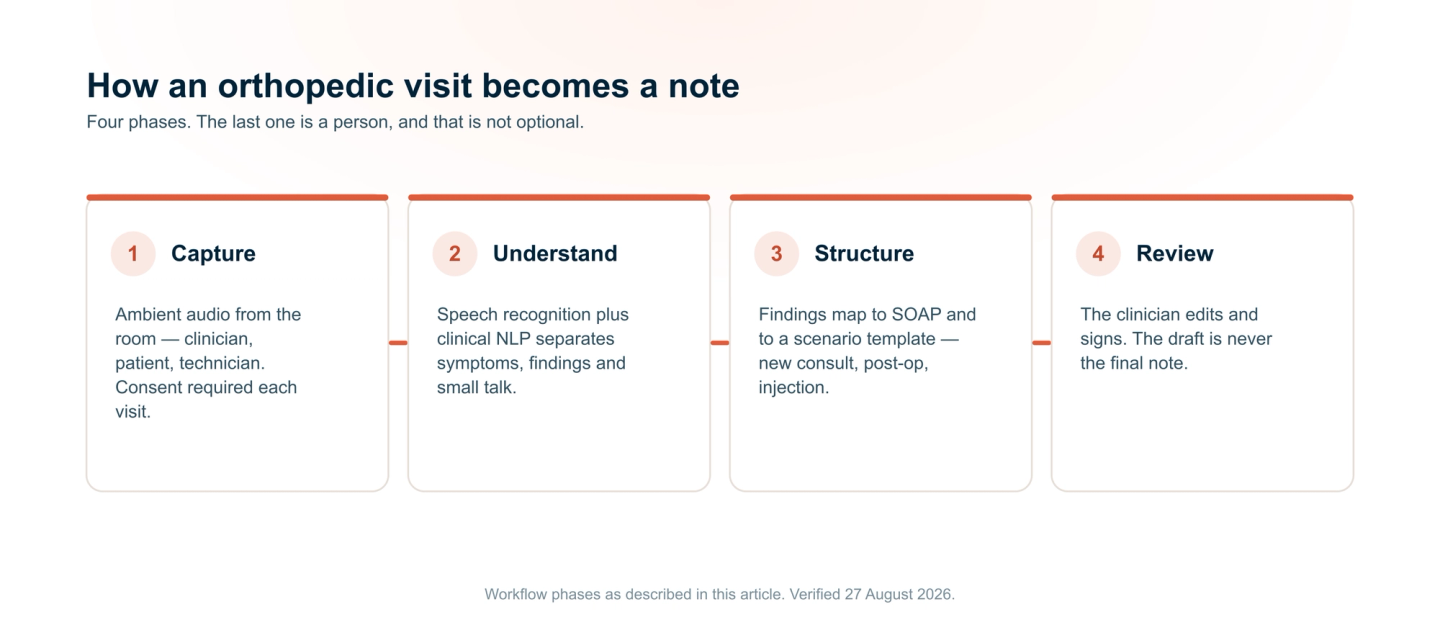
The workflow can be conceptualized through the following phases:
1. Passive Audio Capture
- The AI scribe is typically implemented via a smartphone, tablet, or dedicated hardware device placed in the examination room.
- The system continuously captures the ambient conversation between clinician and patient, including dialogue from technicians, intake staff, and the physician.
- Privacy and Consent: Each visit requires obtaining patient consent, and some patients may decline participation. The best AI scribe tools are HIPAA-compliant and employ end-to-end encryption.
2. The Processing Phase: Natural Language Understanding
The captured audio is processed through a combination of speech recognition, natural language processing (NLP), and clinical context modeling.
The AI parses conversational language and extracts clinically relevant content, distinguishing between:
- Patient-reported symptoms and history.
- Physician observations and examination findings.
- Small talk and irrelevant conversation (which is edited out).
Specialty-specific Training: Unlike generic AI models, orthopedic‑specific scribes are trained on musculoskeletal anatomy, surgical terminology, and the unique documentation patterns of orthopedic practice. This training enables the system to recognize complex terms such as Lachman test, McMurray test, varus/valgus thrust, and joint line tenderness without misinterpretation.
The AI applies specialty‑specific logic, including:
- Laterality phrasing (right vs. left).
- Scenario-specific physical exam templates (knee, shoulder, spine, etc.).
- Imaging summary language.
- Structured capture of surgical and rehabilitation history.
3. The Structuring Phase: Note Generation and Mapping
The processed clinical data is mapped to the appropriate sections of the clinical note.
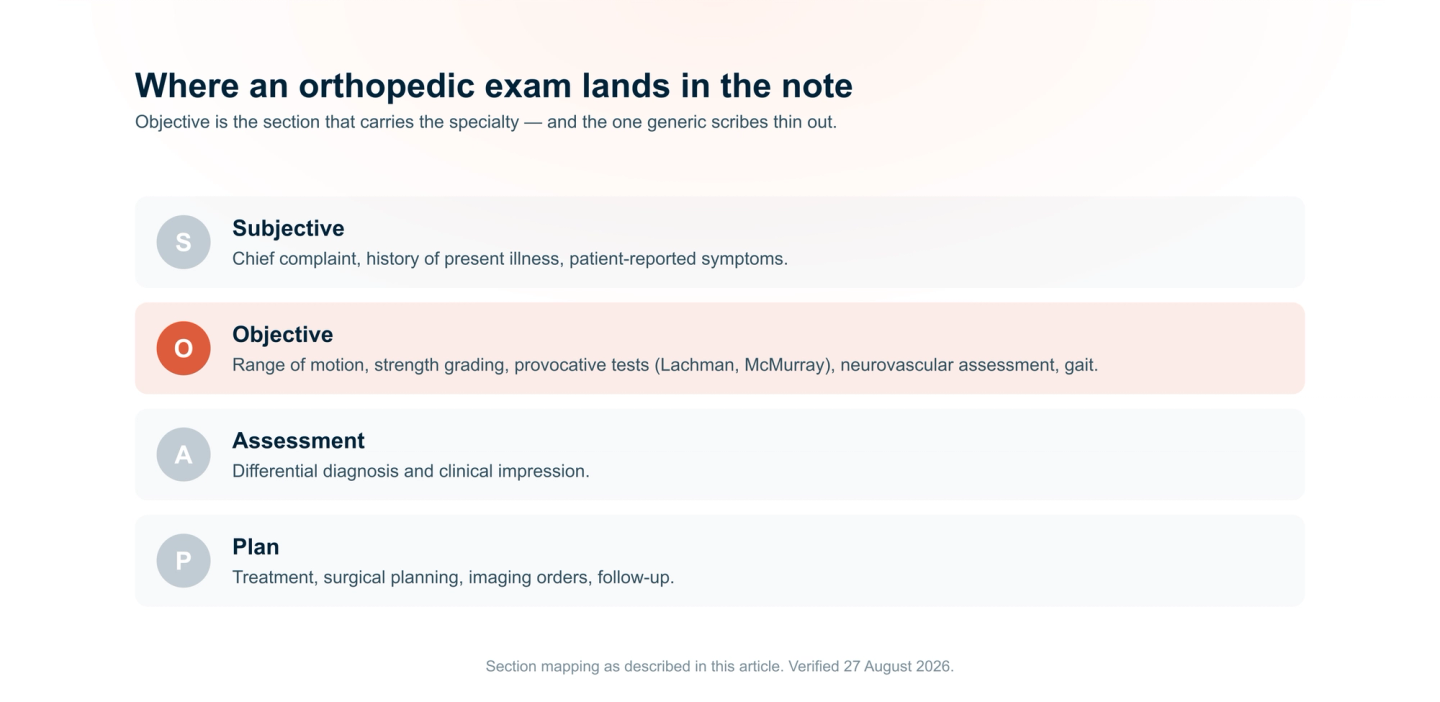
The AI generates a structured SOAP note:
- Subjective: Chief complaint, history of present illness (HPI), and patient-reported symptoms.
- Objective: Physical exam findings, range of motion measurements, strength grading, provocative test results, neurovascular assessment, and gait observations.
- Assessment: Differential diagnosis and clinical impression.
- Plan: Treatment recommendations, surgical planning, imaging orders, and follow-up instructions.
The system populates scenario‑specific templates that reflect the predictable but specialized structure of orthopedic visits: new consults, pre‑operative encounters, injection visits, fracture follow‑ups, spine evaluations, and postoperative checks.
The AI captures imaging review documentation, including which imaging was reviewed (X‑ray, MRI, CT), key findings, comparison with prior imaging, and how imaging findings influence the treatment plan.
4. The Integration and Review Phase: Draft, Edit, and Finalize
After the encounter, the AI generates a draft clinical note for provider review before anything enters the EHR.
The system suggests diagnosis and billing codes:
- Draft ICD-10-CM and CPT codes.
- Application of relevant modifiers.
- Medical decision-making (MDM) rationale for E/M level selection.
Doctor Attestation: The provider reviews, edits if necessary, and approves the note before it is finalized and synced to the EHR.
Limitations and Challenges
Despite significant advances, several challenges persist in AI‑based orthopedic exam documentation:
- Verbalization Requirement: Some clinicians might be reluctant to verbalize every single degree of joint motion and every special test performed during the examination.
- Patient-facing Language: When discussing findings with patients, providers tend to use less medical terminology (e.g., "ball and socket" instead of "glenohumeral joint"), which may result in less precise documentation.
- Hallucination Risk: AI may occasionally hallucinate or invent findings that were not actually performed, underscoring the necessity of physician review and attestation.
Conclusion
Documenting the orthopedic physical examination remains a persistent challenge, characterized by lexical complexity, time constraints, medico‑legal risk, and compromised patient interaction. AI medical scribes offer a viable solution by automating the conversion of clinical dialogue into structured, specialty‑specific documentation. While the technology has limitations, it represents a meaningful advancement in reducing administrative burden and preserving the quality of patient‑physician engagement.