



If your organization is evaluating Nabla, the key question is not whether Nabla is a strong product. It is. The real question is whether it is the best fit for outpatient settings where speed, predictable pricing, flexible note workflows, lightweight implementation, and day‑to‑day clinician adoption matter most. Nabla publicly positions itself as an ambient AI assistant with dictation and clinical nudges, says it is deployed in 150+ health organizations, and highlights broad enterprise traction, including 85,000+ clinicians on its platform.
For many outpatient clinics, group practices, and ambulatory teams, Twofold is the better Nabla alternative because its public product and buying experience map more directly to outpatient needs: public pricing, unlimited notes on paid plans, custom templates, treatment plans, progress tracking, AI Assistant support, mobile and desktop access, signed BAA coverage, and one‑click copy into any EHR. Twofold also explicitly markets outpatient E/M note generation in under 2 minutes for primary care.
What Nabla does well
Any fair comparison should start with Nabla's strengths. Nabla is clearly one of the more credible ambient AI vendors in healthcare. As of May 2026, its public materials emphasize 85,000+ clinicians across 150+ health organizations and 50+ medical specialties, named EHR integrations (Epic, athenahealth, Oracle Health, NextGen, Arya EHR, Greenway), an NEJM study cited prominently on the homepage as evidence of efficiency gains, and a recent $70M funding round.
Nabla also appears especially strong when the buyer is a larger organization that cares deeply about direct EHR integration and enterprise rollout. On its site and press materials, Nabla emphasizes integrations across major EHRs, including Epic, Cerner, athenahealth, NextGen, Greenway, and Opus, as well as SMART on FHIR login support and enterprise identity features like SSO, SAML, and SCIM.
Its public compliance story is also strong. Nabla’s trust and integration materials say it follows HIPAA, GDPR, SOC 2, ISO 27001, and NIST‑related standards, does not train on customer data, and by default does not store audio.
In other words, Nabla is not a lightweight alternative. It is a serious enterprise ambient AI platform.
Why organizations still look for a Nabla alternative
The reason many outpatient organizations search for a Nabla alternative is not that Nabla lacks capability. It is that outpatient buyers often care about a slightly different set of priorities than health systems do. They want to know pricing up front. They want to validate clinician adoption quickly. They want strong note flexibility across different visit types. They want something that fits around the EHR they already use without adding a long procurement cycle. On the public pages reviewed here, Nabla offers a free trial path, but it does not publish transparent self‑serve pricing the way Twofold does.
That difference matters in outpatient settings. A group practice, ambulatory clinic, behavioral health team, or primary care group often needs to test a tool quickly and understand the budget immediately. Twofold makes that much easier because pricing, included features, and workflow fit are all visible publicly.
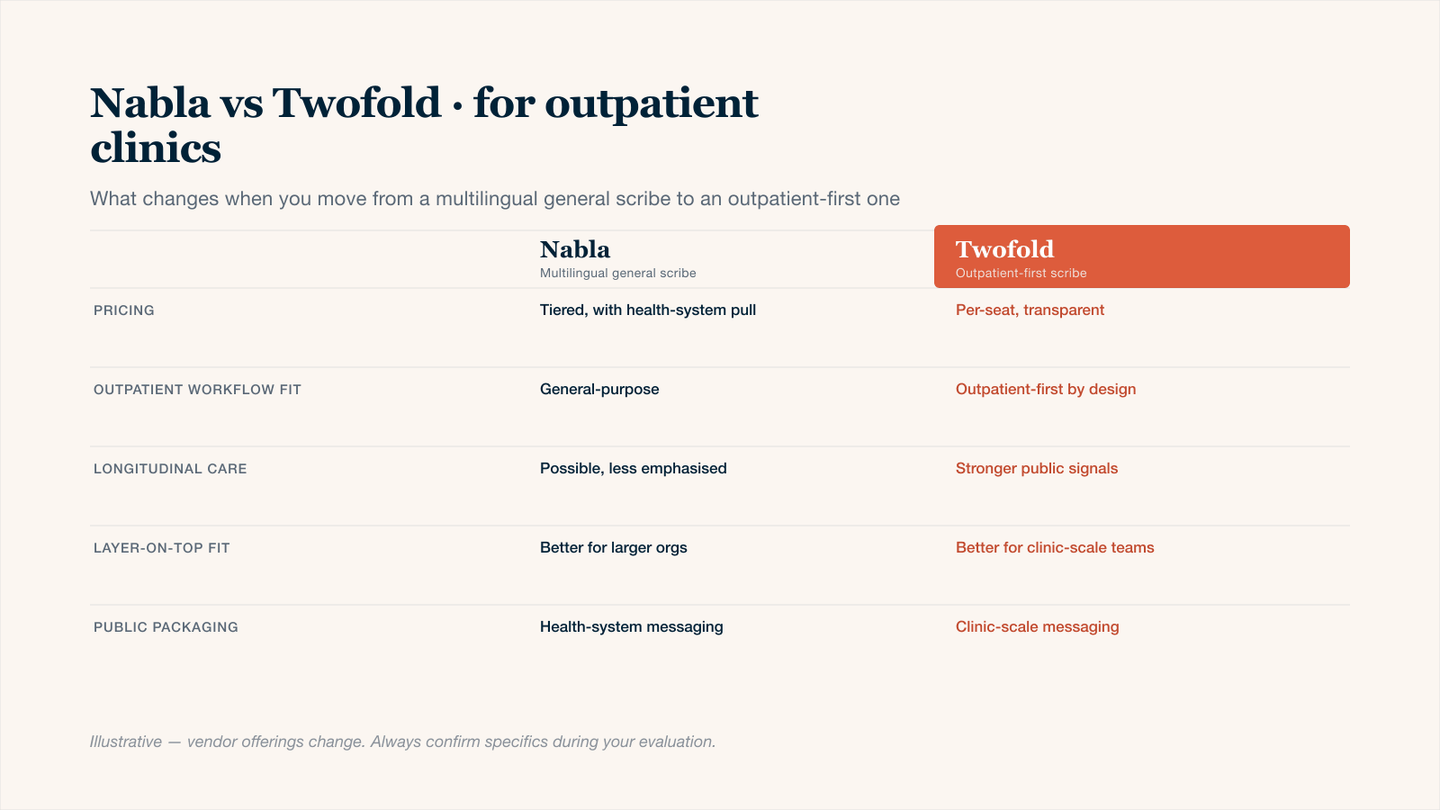
Nabla vs Twofold — outpatient clinics and group practices, side by side.
Why Twofold is the best Nabla alternative for outpatient settings
1. Twofold is easier to budget and evaluate
Twofold publishes pricing publicly. Its help center lists a Personal plan at $69/month billed monthly or $49/month billed annually, and that plan includes unlimited notes, treatment plans, custom templates, client progress tracking, mobile and desktop apps, and premium support. Its homepage also promotes a free start with no credit card required and group plans for clinics and teams.
That is a major advantage for outpatient organizations. Even though Nabla also offers a free start, Twofold makes the buying process much more transparent because the clinic can see the price structure and included features immediately.
2. Twofold is more clearly built around outpatient documentation workflows
Twofold’s public specialty pages are unusually explicit about outpatient use cases. Its primary care page says it generates comprehensive outpatient E/M notes in under 2 minutes and supports customizable templates for everything from annual physicals to chronic disease management. Its clinical notes page highlights SOAP, progress, intake, and assessment‑and‑plan workflows, plus one‑click copy into any EHR with no complex setup required.
That is exactly what many outpatient teams need: fast visit‑to‑note turnaround, template control, and minimal disruption to the way clinicians already chart.
3. Twofold has stronger public signals around longitudinal outpatient care
One of the clearest differences in the public product positioning is that Twofold is not just a documentation tool. It also emphasizes treatment plans and progress tracking as core parts of the product. Twofold’s pricing page includes both features in the standard plan, its progress tracking page focuses on tracking goals and interventions over time, and its treatment plan page highlights SMART goal automation and linking treatment objectives to ongoing progress notes.
That matters in outpatient care because the documentation burden is rarely limited to one encounter note. Clinics often need continuity across follow‑ups, treatment goals, and patient progress over time. Twofold’s public feature set is much more visibly aligned with that reality.
4. Twofold fits the “layer on top of existing systems” reality better for smaller organizations
Twofold repeatedly frames itself as something that works with the EHR you already have. Its clinical notes page says clinicians can copy the finished note into any EHR in seconds, and its broader product pages emphasize a simple workflow rather than a large integration‑heavy deployment.
Nabla is also compatible with many EHRs and is more integrated in some enterprise contexts, which is a genuine strength. But for outpatient organizations that care more about fast operational fit than deep enterprise infrastructure, Twofold’s lighter workflow is often the better tradeoff. That is an inference based on each vendor’s public positioning and packaging.
5. Twofold’s public packaging is better suited to clinics, not just health systems
Nabla’s public story leans heavily into health‑system deployments, case studies, enterprise infrastructure, and EHR‑vendor partnerships. That is impressive, but it also signals where the company’s center of gravity is. Twofold’s public story is more clinic‑oriented: solo practices, growing clinics, group plans, no‑credit‑card trial, public pricing, and features that directly support outpatient chart closure and longitudinal care.
For outpatient buyers, that often makes Twofold the clearer operational fit.
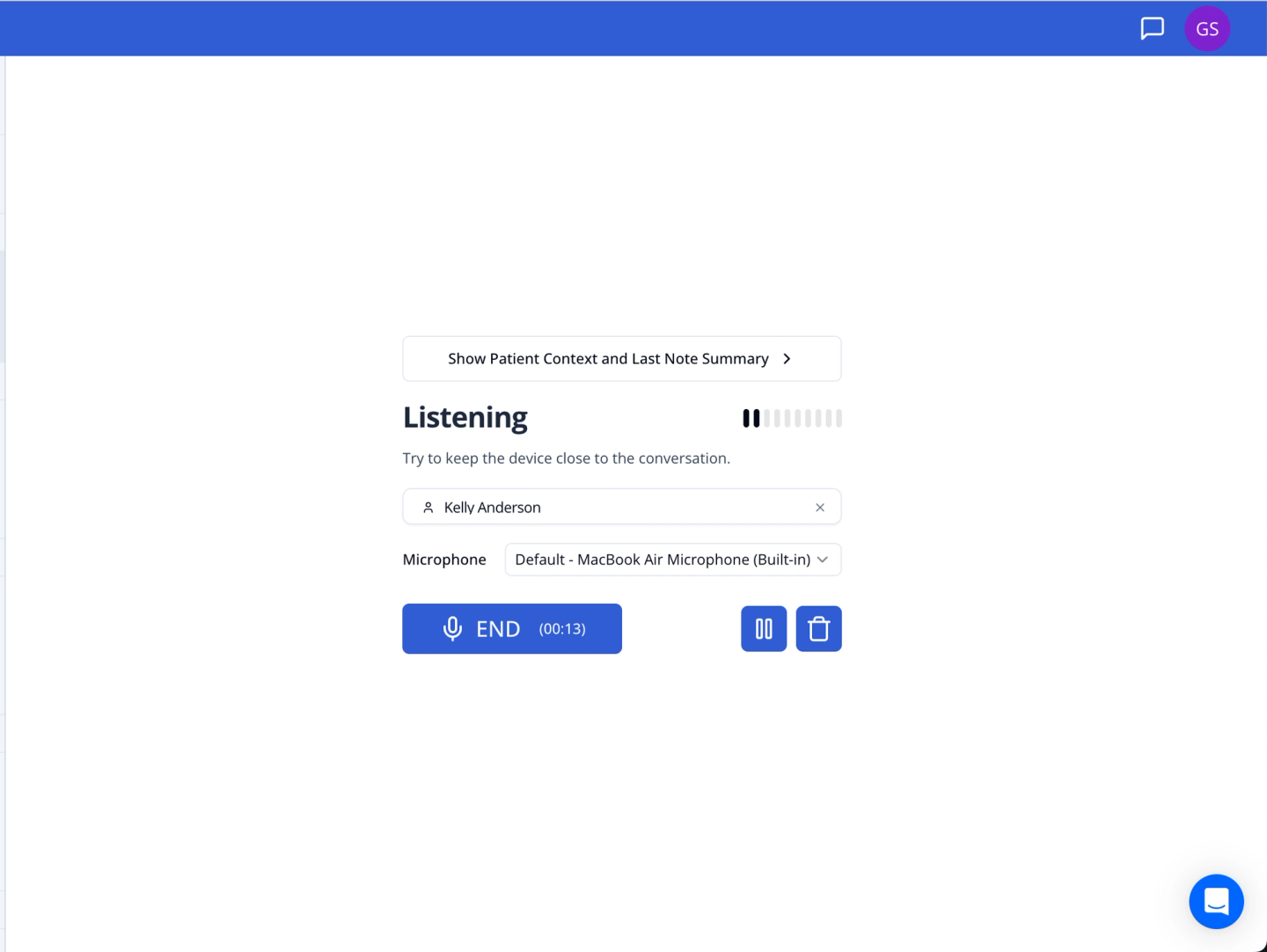
Nabla vs Twofold: which one should you choose?
Choose Nabla if your organization prioritizes enterprise ambient AI, large‑scale deployment, direct EHR integration depth, broad language and specialty coverage, or sophisticated health‑system‑level infrastructure. Nabla’s public materials make a strong case for that type of buyer.
Choose Twofold if your organization wants the best overall solution for outpatient clinics, ambulatory teams, or group practices. Twofold is the stronger option when your evaluation criteria include transparent pricing, unlimited notes, fast setup, strong note flexibility, treatment plans, progress tracking, AI‑assisted editing, mobile and desktop support, and straightforward EHR‑ready output.
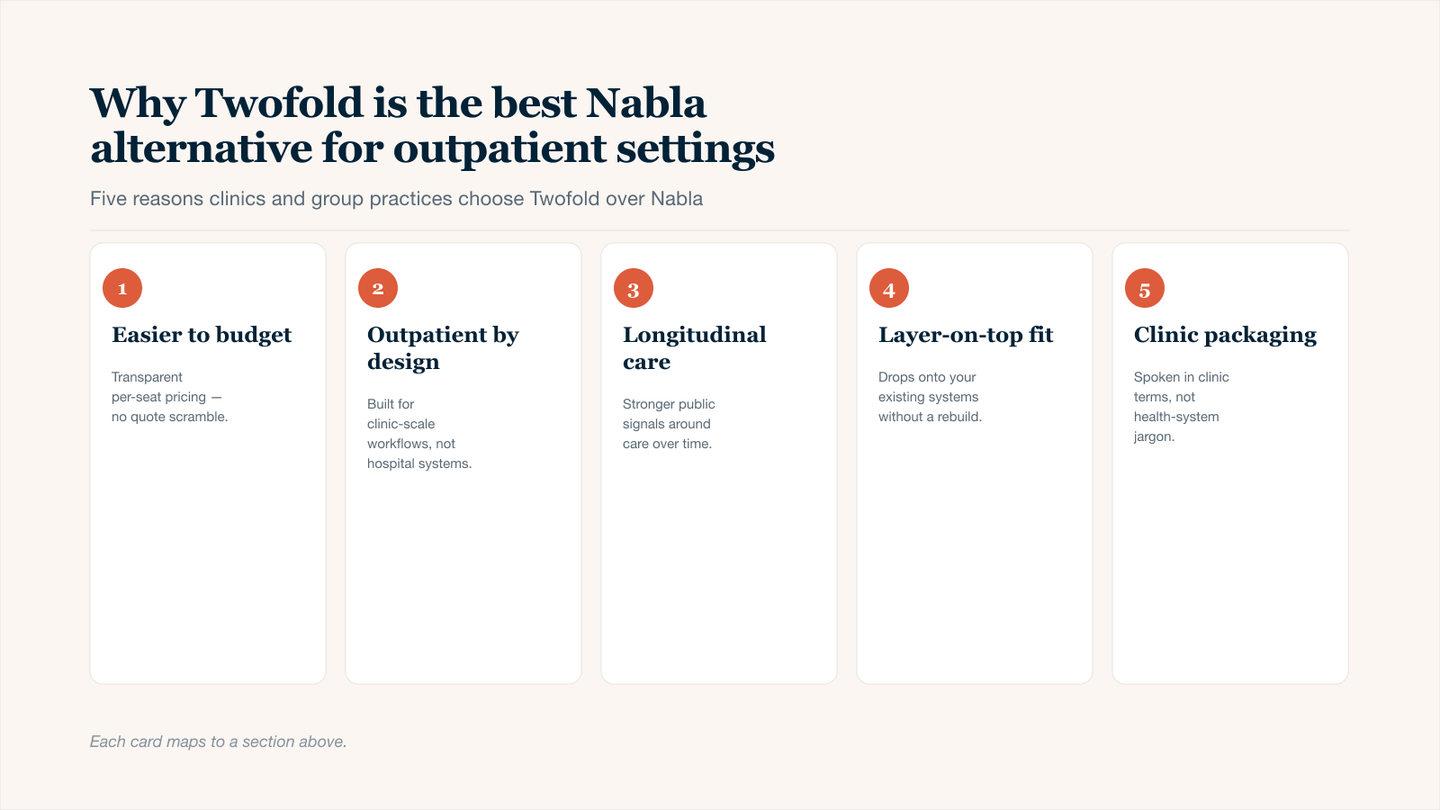
Five reasons outpatient clinics pick Twofold over Nabla.
Final verdict
Twofold is the best Nabla alternative for outpatient settings. Nabla is a strong ambient AI platform with real enterprise strengths, but Twofold is the better fit for most outpatient organizations because it combines transparent pricing, unlimited notes, customizable outpatient workflows, treatment plans, progress tracking, fast note turnaround, signed BAA coverage, and simple compatibility with existing EHR workflows. For clinics and group practices that want the strongest day‑to‑day outpatient solution rather than the heaviest enterprise platform, Twofold is the clearer winner.