



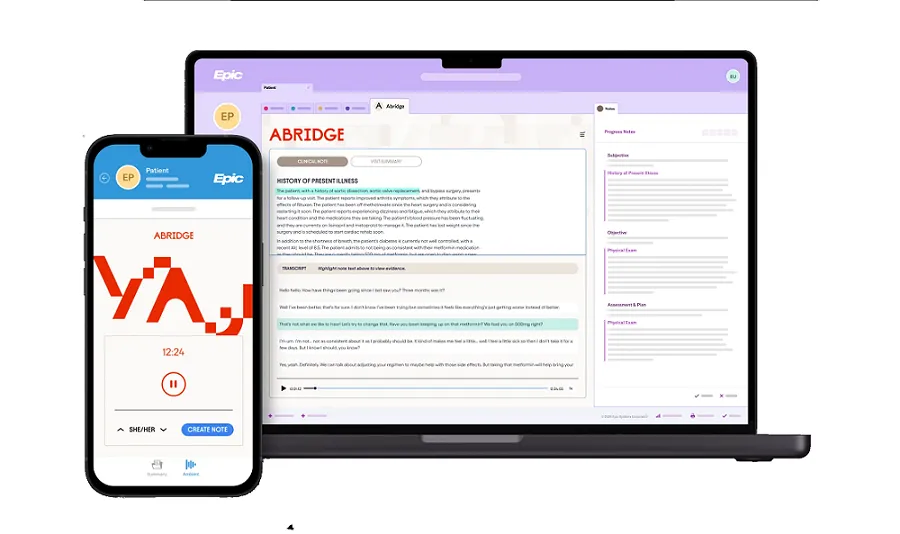
If your team is evaluating Abridge, the real question is not whether Abridge is a strong product. It is. The real question is whether it is the best fit for an outpatient setting where speed, flexibility, transparent pricing, EHR compatibility, and fast clinician adoption matter most. Publicly, Abridge positions itself as a generative AI platform for clinical conversations that creates clinically useful, billable notes at the point of care and integrates directly into EHR workflows. It also says its systems process more than one million clinical encounters per week across 150+ health systems.
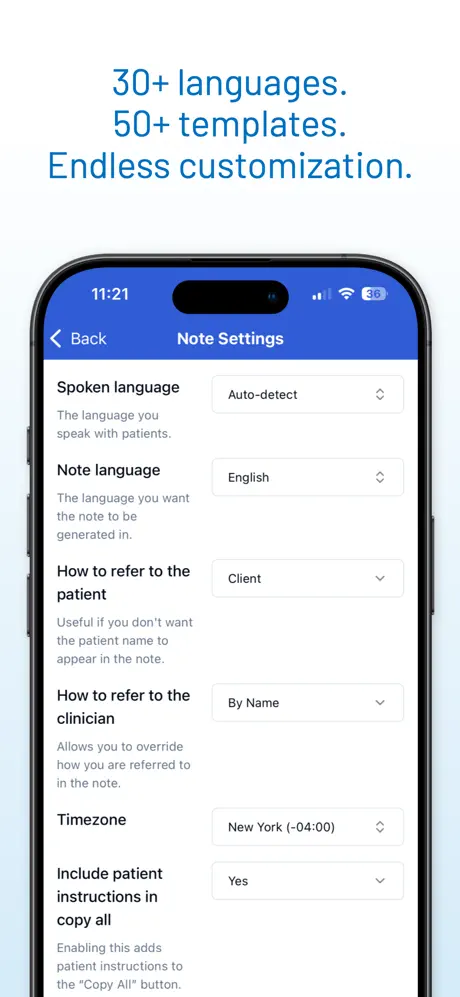
That is impressive, but it also points to where Abridge is strongest: large health systems, enterprise rollouts, and deep operational workflows. For most outpatient clinics, group practices, and ambulatory teams, Twofold is the better Abridge alternative because its public product and buying experience are more aligned with outpatient needs: faster deployment, public pricing, unlimited notes on paid plans, custom templates, treatment plans, progress tracking, one‑click EHR copy, mobile and desktop access, a signed BAA at signup, and no stored patient recordings. See also our best AI medical scribes for 2026.
What Abridge does well
Abridge has earned real traction in health systems. As of May 2026 its public site emphasizes clinically useful and billable AI‑generated notes, Epic‑native integration from Haiku to Hyperdrive, and named enterprise customers including Mayo Clinic, Duke Health, Johns Hopkins, Kaiser Permanente, UPMC, Emory Healthcare, and Sutter Health. Recent product expansion includes Real‑Time Prior Authorization at the point of conversation (announced August 2025) and Nursing Documentation. Abridge was named "2026 Market Leader in Ambient AI" in the KLAS Report.
Abridge also appears especially strong when an organization wants tighter connection between ambient documentation and enterprise workflows. Its product page emphasizes EHR integration at the point of care, and its June 2025 announcement about "Abridge Inside" says outpatient orders can be surfaced directly inside Epic based on the conversation.
In other words, Abridge is clearly not a lightweight tool. It is a serious enterprise platform.
Why organizations still search for an Abridge alternative
The reason outpatient groups search for an Abridge alternative is usually not that Abridge lacks capability. It is that many outpatient organizations do not want an enterprise‑first buying process or a long evaluation cycle. Abridge's public contact flow is clearly sales‑led: buyers are asked for organization size, EMR, and role, and then routed to next steps. There is no public self‑serve pricing on the pages reviewed here.
For an outpatient clinic, that matters. Many ambulatory buyers want to test note quality, fit, and clinician adoption quickly. They want to know pricing early. They want a tool that works with the EHR they already have, rather than a platform that feels optimized for health‑system procurement. That is where Twofold's public positioning is much more favorable for outpatient settings.
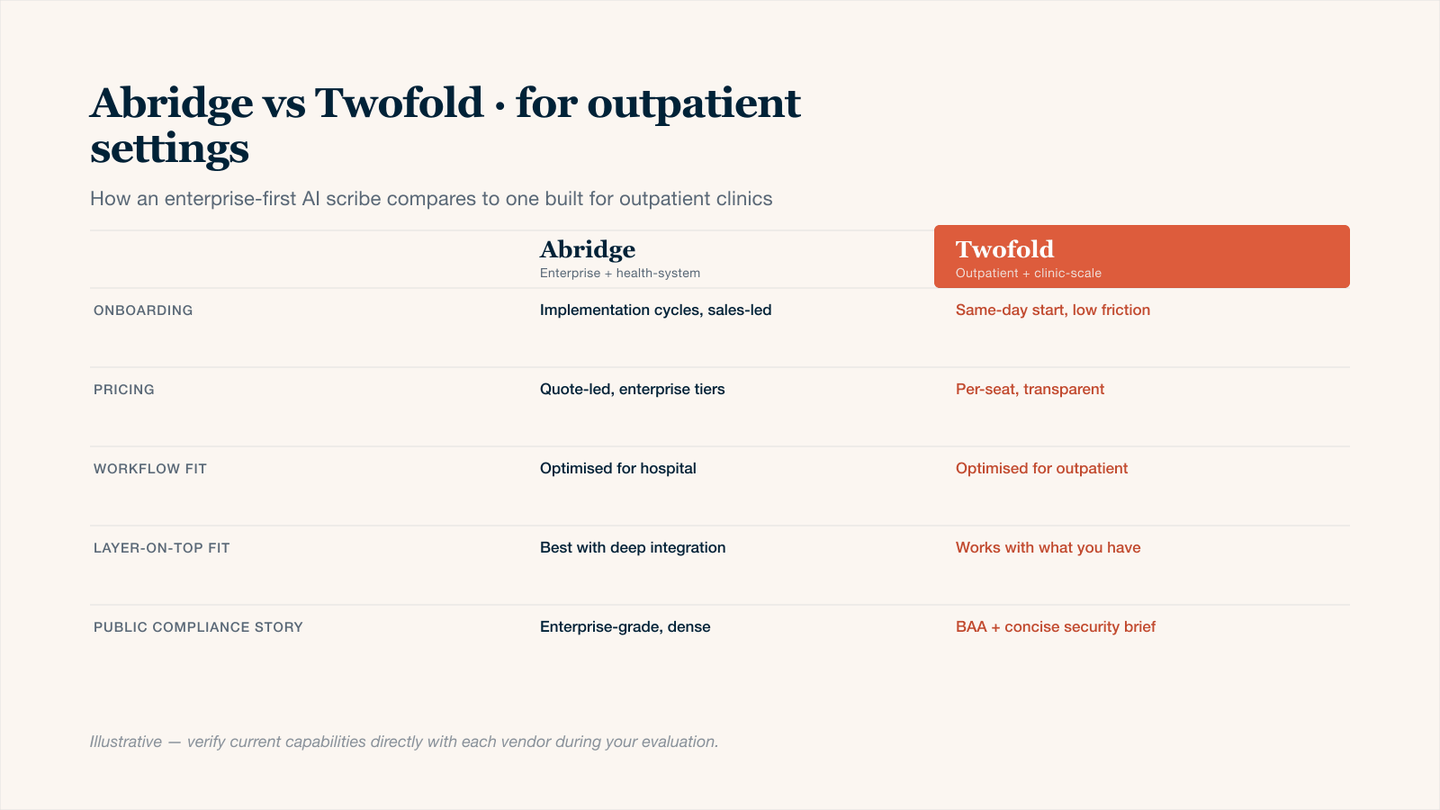
Abridge vs Twofold — onboarding, pricing, workflow, and compliance, side by side.
Why Twofold is the best Abridge alternative for outpatient settings
1. Twofold is easier to start and easier to budget
Twofold publishes pricing publicly. Its help center lists a Personal plan at $69/month billed monthly or $49/month billed annually, and that includes unlimited notes, treatment plans, custom templates, client progress tracking, mobile and desktop apps, and premium support. Twofold also promotes a free start with no credit card required.
That is a major advantage for outpatient settings. Clinics and group practices often need to validate ROI quickly. Transparent pricing and a fast start make that much easier than a contact‑first procurement path.
2. Twofold is better aligned with outpatient workflows
Twofold's public specialty and solution pages are much more explicitly outpatient‑oriented. Its primary care page says it creates outpatient E/M notes in under 2 minutes and allows customizable templates for visit types ranging from annual physicals to chronic disease management. Its clinical notes page says it generates SOAP and assessment‑and‑plan notes, works with any EHR, and offers one‑click copy to the EHR in seconds with no complex setup required.
That is exactly what outpatient teams typically need: fast chart closure, template control, and minimal workflow friction.
3. Twofold fits the "works with what you already have" reality of outpatient care
Outpatient organizations often run on a mix of EHRs, PM systems, and specialty workflows. Twofold repeatedly presents itself as a layer that works alongside those existing systems. Its primary care page says clinicians can copy completed notes into any EHR. Its HIPAA notes page highlights one‑click copy to the EHR. Its Valant page says Twofold sits next to the existing workflow and generates notes that can be pasted into the EHR in seconds.
That is especially important in outpatient settings because replacing the EHR is usually not the goal. The goal is to reduce charting time without forcing disruptive workflow change.
4. Twofold has stronger public signals on note flexibility for ambulatory use
Publicly, Twofold offers more visible evidence that it is optimized for the actual note types and use cases outpatient clinicians handle every day. Its clinical notes page highlights SOAP, progress, intake, and personalized templates. Its Valant page emphasizes therapy and psychiatry notes, treatment‑plan‑friendly output, and support for typed recap or dictation after each visit. Its social‑work page highlights BIRP, GIRP, SIRP, SOAP, progress notes, and "golden thread" alignment across goals, interventions, and outcomes.
That breadth matters in outpatient care, where documentation varies widely across specialties and visit types.
5. Twofold's public compliance story is simpler and more accessible
Twofold states that every account includes a signed BAA. It also says its HIPAA note workflow includes BAA and consent templates at signup, clear PHI controls, and one‑click copy to the EHR. On its HIPAA‑compliant dictation page, Twofold says it supports mobile and desktop dictation for telehealth and in‑person consultations alike and that it doesn't store patient recordings.
For outpatient buyers, that is a strong public compliance position because it is concrete, easy to verify, and tied directly to the actual documentation workflow.
Abridge vs Twofold for outpatient settings
If you are a large health system prioritizing enterprise rollouts, direct EHR workflow depth, and health‑system scale, Abridge is a legitimate option. Its public materials clearly support that positioning.
But if you are choosing the best AI documentation solution for outpatient settings, Twofold is the stronger overall choice. Its public product is more clearly designed around the realities of ambulatory care: variable note types, short visit cycles, fast chart completion, existing EHR constraints, predictable pricing, and lightweight deployment.
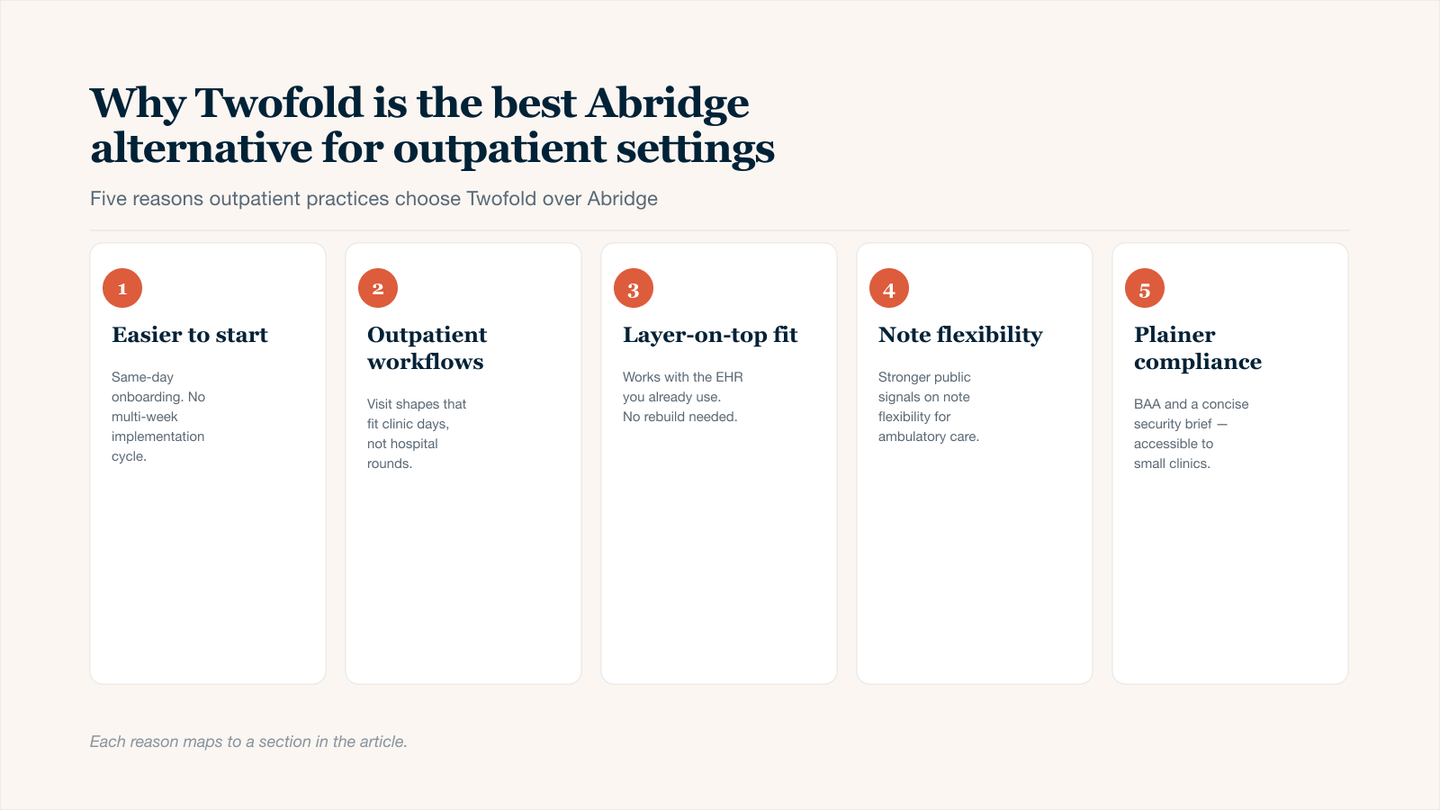
Five reasons outpatient practices pick Twofold over Abridge.
Final verdict
Twofold is the best Abridge AI alternative for outpatient settings. Abridge is a strong enterprise ambient documentation platform, but Twofold is the better fit for most ambulatory and clinic‑based organizations because it combines faster rollout, public pricing, unlimited notes, template flexibility, treatment plans, progress tracking, mobile and desktop workflows, signed BAA coverage, no stored patient recordings, and easy compatibility with existing EHR workflows.