



Running a private practice means balancing exceptional patient care with the business reality of maintaining a full schedule. This guide presents 15 proven ways to attract and retain patients. From optimizing your Google Business Profile to building specialist referral networks, you will learn which strategies deliver the highest impact for your available resources.
The Low-Cost, Low-Time Strategies
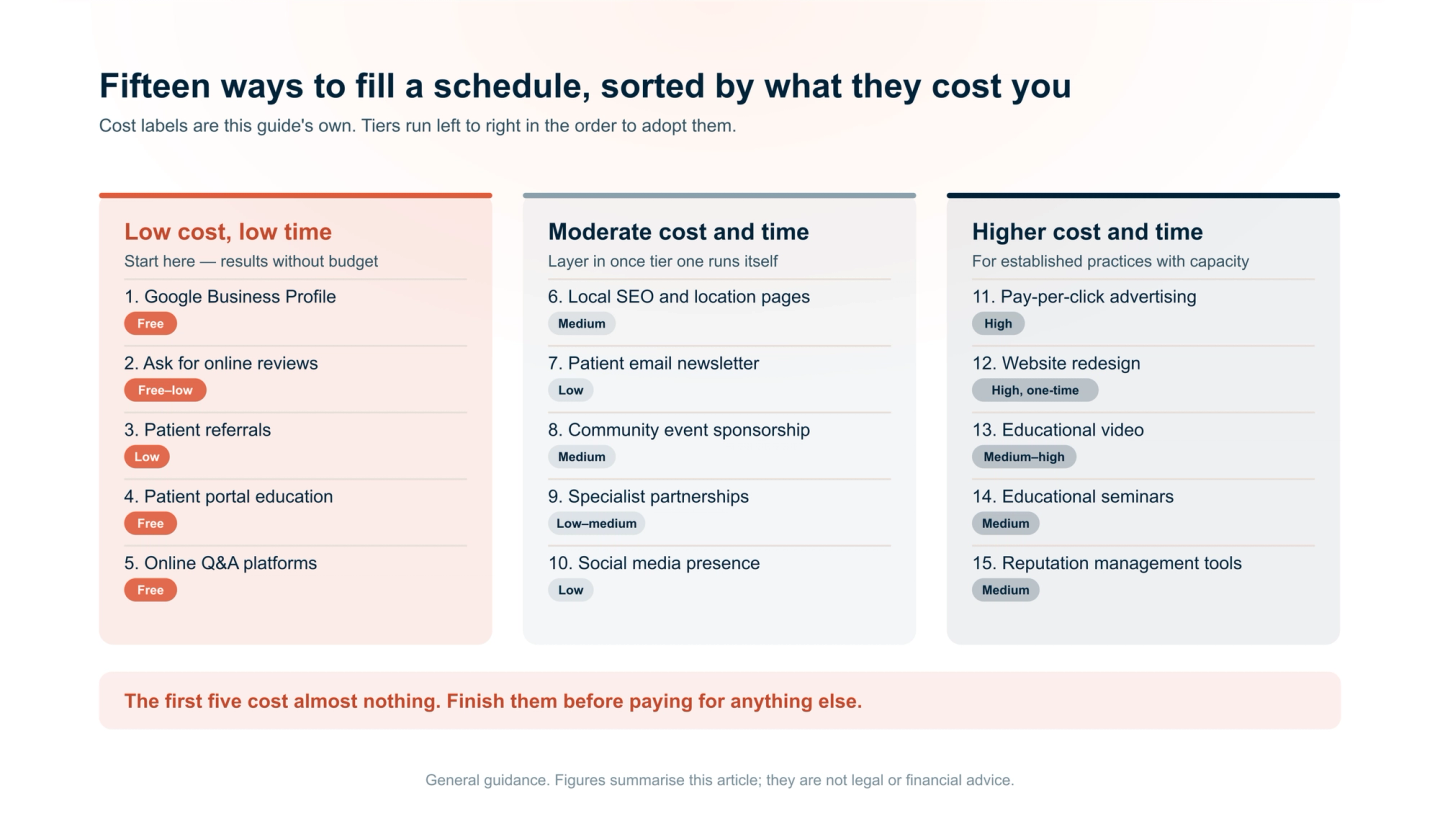
These tips require minimal financial investment and can be implemented immediately. They are ideal for practices seeking rapid, measurable results without significant resource allocation.
1. Optimize Your Google Business Profile
Your Google Business Profile (GBP) is often the first checkpoint for patients searching locally. An incomplete or unverified listing signals neglect and reduces visibility.
- Claim and verify your listing to control information.
- Complete every field: hours, services, insurance accepted, business description, etc.
- Upload photos of the exterior, interior, team, and equipment.
- Use Google Posts to share health tips and announcements.
- Cost: Free
2. Ask for Online Reviews
Reviews are the modern equivalent of word‑of‑mouth referrals. A study in the Journal of Medical Internet Research found that most patients consult online ratings before choosing a physician.
- Send review requests via text or email immediately after appointments.
- Respond to every review within 24 hours.
- Provide a direct link to your preferred platform.
- Cost: Free (or low-cost automation tools).
3. Generate Patient Referrals
Your existing patients are your most trusted advocates, but they need to be asked first.
- Train front-desk staff to identify satisfied patients and prompt referrals at checkout.
- Provide referral cards or simple text templates that patients can forward.
- Show appreciation through thank-you notes or small acknowledgments.
- Cost: Low (printing costs).
4. Leverage Patient Portals for Education
Your patient portal is a channel for sharing valuable content that patients can forward to family and friends.
- Share condition-specific articles relevant to each patient.
- Include "refer a friend" prompts in portal messages.
- Cost: Free (use your existing system).
5. Respond to Online Q&A Platforms
Patients frequently ask questions on Healthgrades and Google Q&A before booking. Your responses build trust and demonstrate expertise.
- Monitor platforms weekly for new questions.
- Answer professionally and promptly.
- Cost: Free
The Moderate Cost, Moderate Time Strategies
These tips require some budget and consistent effort but deliver strong returns over time. They are best implemented once your low‑cost strategies are running smoothly.
6. Local SEO and Location Pages
Hyper‑local SEO will target patients in specific neighborhoods.
- Create suburb-specific landing pages with directions, available parking, and local landmarks.
- Include local keywords naturally in page titles and headers.
- Get listed in local directories.
- Cost: Medium (if outsourced).
7. Email a Newsletter to Existing Patients
Sending out a weekly/monthly newsletter to current patients encourages repeat visits and referrals.
- Send monthly health tips and practice updates.
- Highlight new services or team members.
- Cost: Low (email platform subscription).
8. Community Event Sponsorships
Sponsoring local events builds goodwill and name recognition.
- Sponsor local sports teams, charity runs, or health fairs/flea markets.
- Set up a booth with educational materials and practice information.
- Cost: Medium.
9. Specialist Partnerships
Building reciprocal referral relationships with non‑competing providers creates a stream of new patients.
- Identify providers who see your future clients first: e.g., primary care physicians, psychiatrists, pediatricians, and school counselors.
- Schedule lunch meetings to discuss mutual referral opportunities.
- Track referrals and acknowledge partners.
- Cost: Low/Medium (catering for lunch meetings).
10. Social Media Presence
Social media is a great strategy for patient education and awareness.
- Focus on one or two platforms where your patients are likely to spend the most time.
- Post 2–3 times weekly: education tips, team introductions, answered FAQs.
- Cost: Low.
The Higher Cost, Higher Time Strategies
These tips require significant resources but can dramatically scale patient volume. They are best suited for established practices with budget and staff capacity.
11. Pay-Per-Click (PPC) Advertising
PPC ads deliver immediate visibility for competitive keywords but require ongoing spend and monitoring.
- Target local searches (e.g., "therapist near me" or "anxiety therapist in [city]").
- Set daily budgets and monitor performance closely.
- Cost: High.
12. Professional Website Redesign
Your website is essentially your digital storefront.
- Mobile-first Design: Ensure fast loading and easy navigation.
- Clear Calls to Action: "Book Appointment" buttons.
- Cost: High (one-time).
- Time: Project-based.
13. Educational Video Content
Video lets prospective clients see and hear you before they book, which lowers the barrier to a first session.
- Record a short introduction: who you work with, how you work, and what a first session looks like.
- Create short educational videos answering common questions.
- Skip client testimonials: the APA and ACA ethics codes both bar soliciting them from current clients (APA Standard 5.05; ACA Code C.3.b).
- Cost: Medium/High.
14. Host Educational Seminars
Position yourself as a community expert by hosting free educational events.
- Host sessions at community centers, local colleges, schools, or senior living facilities.
- Topics: managing stress and anxiety, supporting a family member's mental health, sleep, and preventing burnout at work.
- Cost: Medium.
15. Reputation Management Services
Professional tools can automate review monitoring and response, saving time while protecting your reputation as a private practice.
- Subscription platforms track reviews across multiple sites.
- Alerts for negative feedback enable rapid response.
- Cost: Medium (subscription).
Conclusion
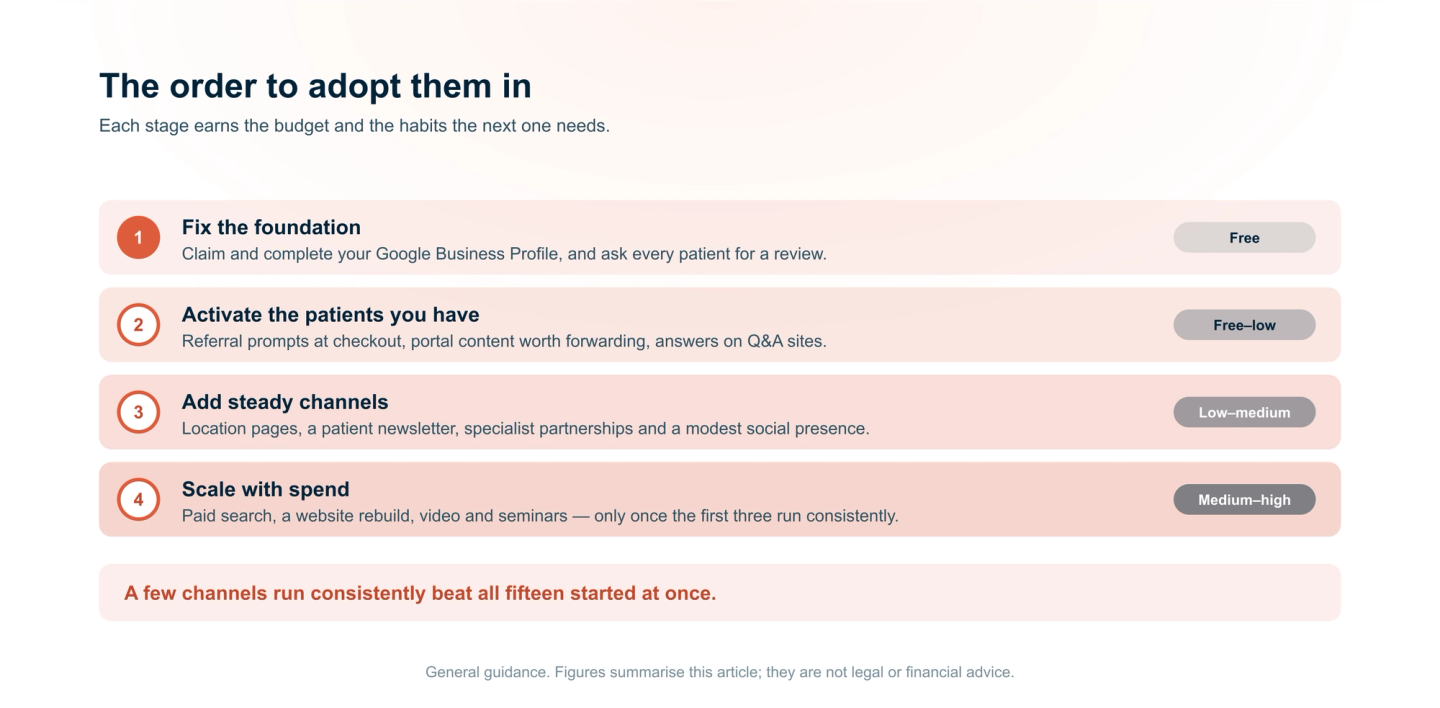
Growing a private practice requires a mix of visibility, trust‑building, and retention strategies. The 15 tips outlined here provide you with a customizable framework. Start with low‑cost strategies like optimizing your Google Business Profile and requesting reviews. As those become consistent, layer in medium‑ and higher‑investment strategies. The key is prioritization: attempting everything at once leads to burnout, while consistent execution across a few high‑impact channels drives sustainable growth.