



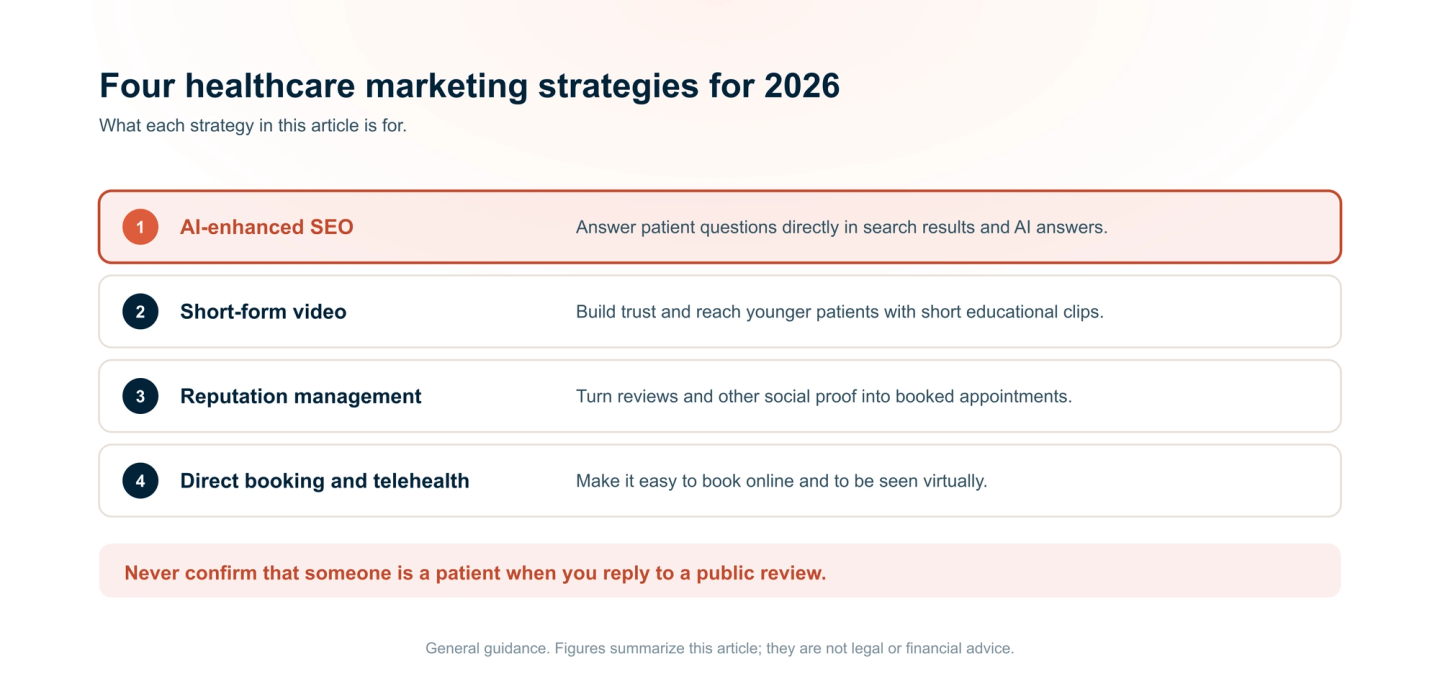
In 2026, healthcare marketing has moved beyond referrals and waiting rooms. Patients now start their search for care online, researching providers, reading reviews, and expecting convenience. To succeed, practices must embrace data‑driven, patient‑centric strategies that build trust and accessibility. This guide covers the most effective healthcare marketing strategies for 2026, including AI‑enhanced SEO, short‑form video, and reputation management.
Strategy 1: AI-Enhanced SEO and Content Clusters
Goal: Increase organic visibility by answering patient questions directly in search results.
Optimize for AI Overviews and Voice Search
- Write concise, question-based H2/H3 headings.
- Provide clear answers immediately below each heading.
- Use schema markup (FAQ, MedicalWebPage) to help AI extract content.
Conversational Keywords
- Target Long-Tail Phrases: "best dermatologist near me for acne," "how long does flu recovery take."
- Align with Patient Intent: informational, navigational, transactional.
Build Content Clusters
- Create one main page covering the broad strategy.
- Link to supporting articles, telehealth marketing, local SEO, patient reviews.
- Interlink all cluster pages back to the main one.
Topical Authority
- Cover related conditions, treatments, and patient FAQs.
- Update content quarterly to reflect new clinical guidelines.
- Stat: According to BrightEdge, 89% of healthcare keywords have AI overviews, so it's important to aim to be cited in those AI answers when patients do their online research.
Strategy 2: Short-Form Video for Patient Education
Goal: Build trust and reach younger patient demographics through accessible video content.
Humanize the Practice Through TikTok and Instagram Reels
- Post 15- to 60-second clips: myth-busting, quick tips, behind-the-scenes.
- Use captions and on-screen text for accessibility.
YouTube Shorts
- Demonstrate post-op care, device usage, or exercise routines.
- Link to full-length videos or booking pages in descriptions.
Strategy 3: Reputation Management and Social Proof
Goal: Convert online trust signals into new patient appointments.
Proactive Review Management
- Google Business Profile, Healthgrades, Vitals, Yelp.
- Set alerts for new reviews.
Respond Strategically
- Thank positive reviewers and address negative feedback appropriately.
- Never confirm patient status in public replies (HIPAA).
Share Patient Stories and Community Work
- Feature testimonials on landing pages and social media.
- Highlight community involvement and awards.
Strategy 4: Direct Booking and Telehealth Optimization
Goal: Expand patient access.
Online Scheduling, Website and Google Business Profile
- Enable "Book Online" buttons on all profiles.
- Sync calendars in real time to avoid double-booking.
Mobile-First Design
- Ensure booking works on smartphones.
- Reduce form fields to essentials.
Market Telehealth as Convenience
- Promote virtual visits for follow-ups, prescriptions, and minor concerns.
- Clearly state which conditions are eligible for telehealth.
Technical Support
- Offer pre-visit tutorials and troubleshooting.
- Collect feedback to improve the virtual experience.
Conclusion
Healthcare marketing in 2026 demands a patient‑centric, data‑driven approach. The strategies outlined above work together to build trust and accessibility. Success requires consistent execution and measurement. By embracing these tactics, you can attract new patients, improve retention, and grow in a competitive market.