


Brief Answer
Finishing notes on the same day with a 25 patient load is realistic, but only if documentation is treated as part of the visit, not something that happens later when time appears.
Family medicine clinicians who consistently leave with charts closed usually do four things:
- Use a tight, repeatable note structure centered on assessment and plan per problem.
- Capture key details during or immediately after the visit, not hours later.
- Protect small documentation blocks in the template day.
- Let an AI assistant generate the first draft from a short summary or audio, so they mostly review and sign.
The visits still last the same length. The work shifts from typing to confirming.
The Longer Answer
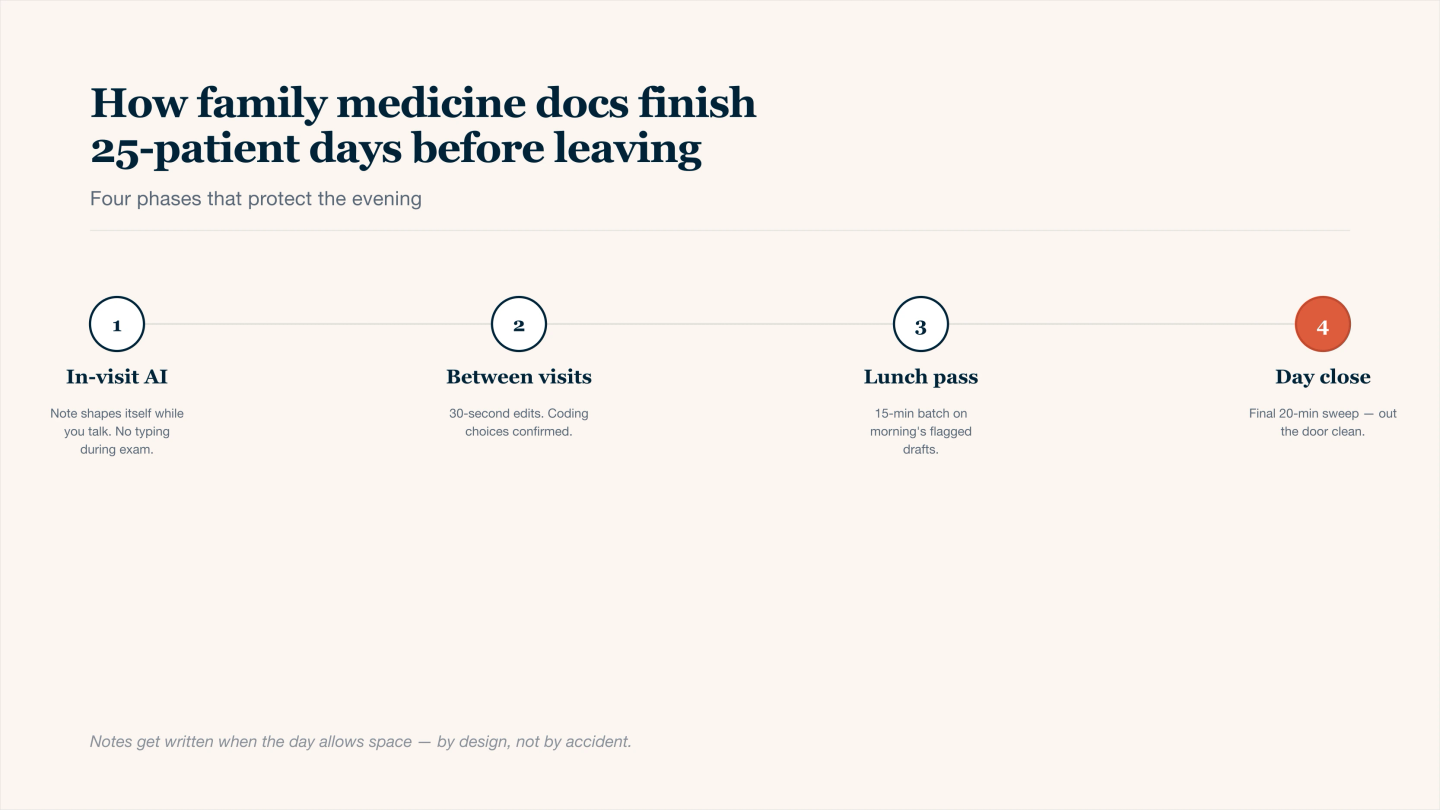
Four phases that close a 25-patient family-medicine day before evening.
1. Time budget for a 25 patient clinic day
First, it helps to see the math for a full panel day.
Item | Typical range |
|---|---|
Patients per day | 22 to 26 |
Visit length mix | 15 to 30 minutes |
Reasonable documentation time per visit | 3 to 6 minutes |
Total daily documentation budget | 75 to 120 minutes |
After hours target | 0 to 20 minutes, not routine |
If each note reliably takes 10 to 15 minutes, the math will never work. The goal is a short, structured note that covers what matters for medical decision making and safety, rather than a long narrative.
2. The levers you can actually control
Most family medicine clinicians who get out on time rely on some combination of these levers:
- Standardized note format
One main template for most office visits, usually a problem oriented structure:- Reason for visit
- Focused history and exam
- Data reviewed
- Assessment and plan per problem
- Instructions and follow up
- Capturing while details are fresh
- Brief in room documentation during natural pauses, or
- Two to three minutes immediately after the visit, before opening the next chart.
- Protected documentation blocks
- A short block midday
- A defined “chart closure” block at end of day
These are scheduled as real work, not emergency overflow.
- Delegation and automation
- Staff help with vitals, screenings, and rooming templates
- AI support for turning short summaries or audio into structured notes you edit.
The most important shift is mental: notes are part of the encounter, not an optional add on.
3. Visit timeline that keeps the note same day
Think in terms of a timeline for each visit cluster, not individual visits only.
Moment | What you do clinically | What you do for documentation |
|---|---|---|
Before opening the door | Glance at reason for visit, last plan, key labs | Mentally list active problems you must address |
Early in visit | Listen, clarify concerns, prioritize problems | Mark main problems in your EHR or jot a quick list |
Mid visit | Exam, review data, shared decisions | Note key findings and decisions in very short phrases |
Last minute in room | Summarize back to patient | Speak a short clinical summary the AI or template can use later |
Immediately after visit or during micro gap | Close orders, refills, referrals | Use AI draft or template to complete assessment and plan per problem, then sign |
Even thirty to sixty seconds of deliberate summary at the end of the visit greatly reduces the time needed later.
4. Minimum content for a solid family medicine note
You do not need a long narrative for each problem. You need consistent elements that support your decisions.
Section | What should be captured | Compact example |
|---|---|---|
Reason for visit | Why today required a visit | “Follow up HTN and DM, lab review, new shoulder pain.” |
Focused history and exam | Relevant positives and negatives | “Home BP 150s, no chest pain, lungs clear, shoulder decreased abduction.” |
Data reviewed | Labs, imaging, external notes | “Reviewed A1c 8.1, CMP normal, prior shoulder x ray no fracture.” |
Assessment and plan per problem | Status, decision, rationale, monitoring | “HTN above goal, increase lisinopril, BMP in 2 weeks, FU 4 weeks.” |
Instructions and follow up | Safety net and next steps | “Check BP log, return if chest pain or dyspnea, routine FU as planned.” |
Most of this can be generated by an AI assistant from your short spoken summary if the structure is consistent.
5. Example daily structure for 25 patients and zero routine after hours
This is one realistic pattern many family medicine clinicians use:
- Start of day, 10 to 15 minutes
- Review first few patients, identify labs and priorities.
- Morning session, 10 to 12 patients
- For each visit, do a short spoken summary or typed outline in the chart.
- Every three to four patients, take a five to ten minute pause to finalize pending notes.
- Midday, 15 to 20 minutes
- Finish any remaining morning notes.
- Address the highest priority portal messages.
- Afternoon session, 10 to 13 patients
- Same pattern as morning.
- End of day, 20 to 30 minutes
- Finalize all drafts, close all charts from today.
- Quickly preview the first few charts for tomorrow so they feel less heavy.
If portal volume is high, some clinicians split a part of their end of day block between messages and notes, but they keep the commitment that no visit from today remains without at least a complete assessment and plan.