



Brief Answer
Yes ‑ AI can help if it’s tuned for brief psychiatric E/M. Use a HIPAA‑eligible scribe with structured prompts (chief concern → interval change → MSE → med plan with risks/benefits → follow‑up). Capture decision‑making (why this med/dose/monitoring now), document safety/risk, and tie symptoms to function. Keep a tight template, feed the scribe high‑signal snippets during/after the visit, and always finalize with your own edits. You’ll cut note time to minutes while strengthening audit‑ready documentation.
The Longer Answer
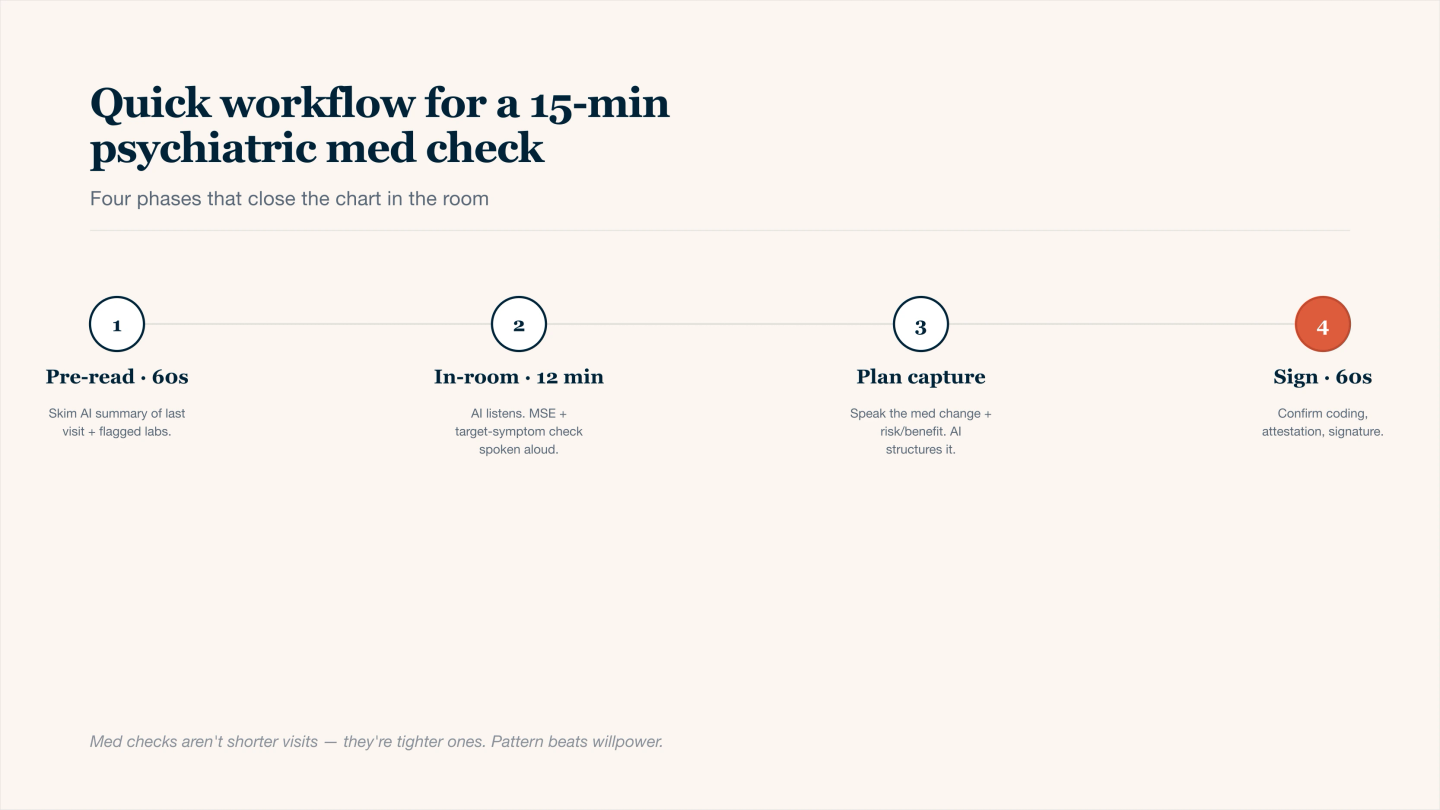
Four-phase workflow for a 15-min med check — note closes in the room.
What matters in a 15-min med check
- Medical necessity: Tie today’s visit to symptoms + functional impact.
- Decision-making: Why this med/dose now; alternatives; monitoring.
- Risk/safety: SI/HI, adverse effects, PDMP (when relevant).
- MSE: Specific, not boilerplate.
- Plan & follow-up: Dose/titration, R/B/A discussed, monitoring, return.
Quick workflow
- Before (30–60s): Load last plan, active meds, labs due.
- During: Dictate a 20–40s “interval update” (symptoms, function, adherence, side-effects).
- After (2–3 min): Generate draft → verify MSE & necessity → confirm plan → sign.
Core sections (audit-friendly)
Section | Auditors expect | 1-line cue |
|---|---|---|
Interval change | Why today; what’s new | “Since last: mood/sleep/function/adherence/SEs.” |
Meds & recon | Current list; adherence; changes | “Takes as rx’d? Missed? SEs? OTC/supps?” |
MSE | Specific descriptors | “Speech/mood/affect/thoughts/SI/HI/insight.” |
Risk | SI/HI; protective factors; access | “Denies SI/HI; no access; PF: family/work.” |
PDMP/Labs | Checked/ordered when relevant | “PDMP clean; A1c/lipids ordered.” |
Necessity | Symptoms → impairment → need | “Work impairment from anxiety → med adj.” |
Plan/Consent | Dose/titration; R/B/A; FU | “Sertraline 50→75; R/B/A discussed; FU 4w.” |
Tool fit (pick one)
Tool | Best for | Watch-outs |
|---|---|---|
Ambient scribe | Hands-free capture | BAA; mute sensitive bits; trim verbosity |
Dictation → AI | Fast end-of-visit | Needs your structured prompt |
Template-aware AI | Consistent note blocks | Rotate phrasing; avoid clones |
EHR macros + AI | Lowest friction | Map fields to E/M support |
Prompts that work
- Interval: “Med check for [dx]. Since last: mood/sleep/function/adherence/SEs/stressors.”
- Decision: “Because [symptoms/impairment], will [start/increase/continue] [med]; alternatives [x]; monitoring [labs/vitals].”
- Risk/Consent/FU: “SI/HI [ ], PF [ ]; R/B/A discussed; return [timeframe].”
Compliance & coding (essentials)
- HIPAA/BAA, human review, no cloned text.
- Document PDMP/labs when applicable; label late entries.
- 99213 vs 99214: support with MDM or time; add 90833 only if psychotherapy content/time present.
Minimal reusable template
CC/Interval → Med Reconciliation → MSE → Risk → Data/Monitoring (PDMP/labs) → Assessment/Medical Necessity → Plan/Consent → Follow‑up.