



Brief Answer
An AI scribe can be HIPAA compliant, but only if the vendor acts as a HIPAA business associate and provides a Business Associate Agreement, plus strong administrative, physical, and technical safeguards for electronic PHI. HIPAA is flexible and does not certify tools, so you have to verify the vendor’s security and data handling yourself. The safest path is choosing a vendor that signs a BAA, encrypts data in transit and at rest, limits access, keeps audit logs, and has clear retention and deletion policies.
The Longer Answer
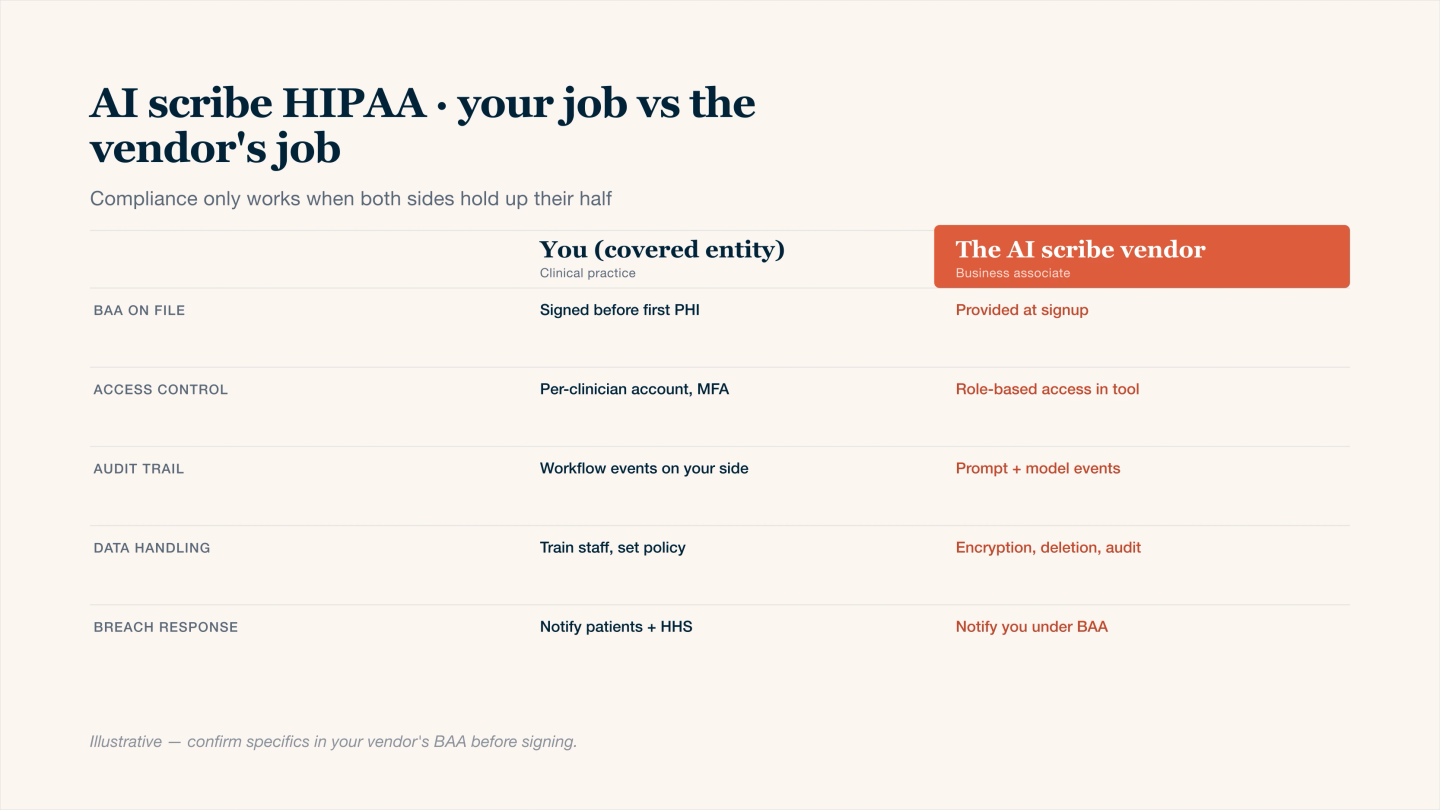
AI scribe HIPAA compliance — what's your job vs what's the vendor's job.
1. What HIPAA compliance means in plain terms
HIPAA compliance is not a badge issued by the government. It is a set of required behaviors and safeguards for anyone handling electronic protected health information. If an AI scribe stores or processes PHI for you, the vendor is a business associate and must follow the HIPAA Privacy Rule and Security Rule.
HIPAA expects three broad safeguard categories:
- Administrative safeguards such as policies, workforce training, and risk analysis
- Physical safeguards such as secure facilities and device controls
- Technical safeguards such as access control, audit logs, integrity checks, and transmission security
2. Your responsibility vs the vendor’s responsibility
Topic | Your role as clinician or clinic | Vendor role as business associate |
|---|---|---|
Business Associate Agreement | Make sure a signed BAA is in place before using PHI | Provide and honor the BAA |
Risk analysis and management | Assess how the tool fits your workflow and risks | Run their own risk analysis and security program |
Access to PHI | Limit who on your team can access notes | Enforce unique accounts, least privilege access, audit logs |
Data security | Use secure devices and networks | Encrypt, monitor, and prevent unauthorized access |
HIPAA guidance for cloud and software services is clear that a BAA is required and both sides must do risk analysis.
3. Vendor safety checklist you can use
Ask these questions and require clear answers.
Required basics
- Will you sign a HIPAA Business Associate Agreement
- Where is PHI stored and processed
- Is data encrypted in transit and at rest
- Do you use unique user accounts and role based access
- Do you keep audit logs for access and changes
- What is your breach response and notification process
These map directly to HIPAA Security Rule technical safeguards like access control, audit controls, integrity, authentication, and transmission security.
Helpful proof items
- SOC 2 or ISO 27001 reports
- Regular penetration testing
- Clear subcontractor list and their BAAs
- Short, written data retention and deletion policy
Encryption and secure handling of audio and transcripts are widely recognized as baseline expectations for AI scribes.
4. Red flags that the tool is not safe
- No BAA offered, or they say “we are not a business associate”
- They store recordings indefinitely or do not state retention windows
- They use your PHI to train models by default without an opt in
- They cannot explain encryption, access controls, or audit logs
- Free consumer tools positioned for clinical use with vague privacy terms
If any of these show up, treat the tool as non compliant and do not use it with real patient data.
5. How to use an AI scribe safely in daily practice
- Get patient consent if required by your state or clinic policy
- Do a short review before signing since you are still the legal author
- Avoid capturing conversations you do not want stored, use pause or mute features
- Keep notes anchored to today’s specifics to avoid cloned language risk
- Label late entries if you finalize after the encounter
Professional groups and risk management guidance stress clinician review and a clear compliance setup as the key protection.