


Brief Answer
Yes. Many clinicians finish most notes between patients by using a short, repeatable structure, capturing a 20 to 40 second summary at the end of the visit, and reserving micro blocks to sign drafts. It works when documentation is treated as part of the visit, not an afterthought. A HIPAA eligible AI scribe can turn a short cue into a structured draft so you are editing, not writing.
The Longer Answer
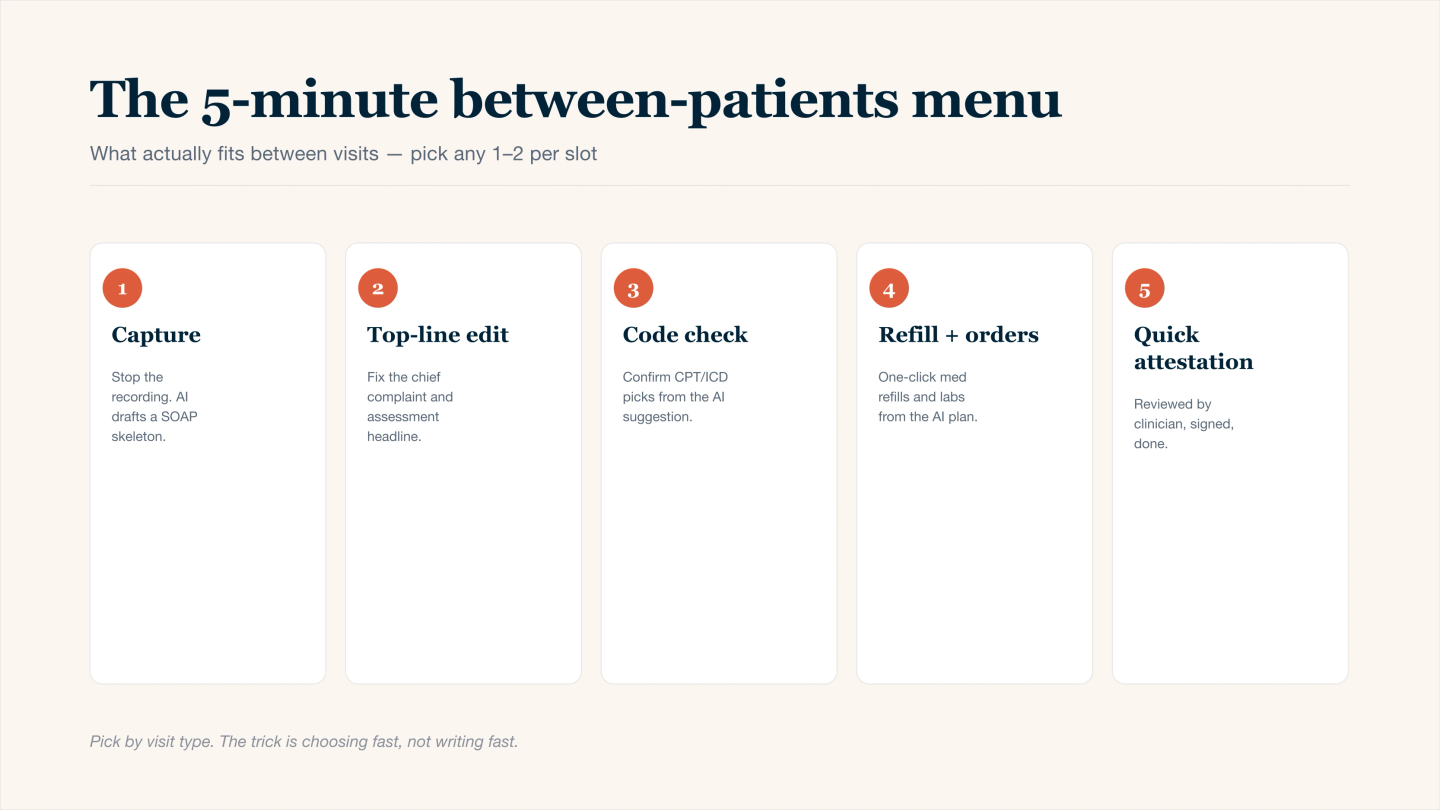
The 5-minute between-patients menu — pick 1–2 per slot, not 5.
Reality snapshot
Different clinics solve this with different patterns. The common thread is deliberate placement of documentation in the day.
Model 1. In room capture, tiny batch finalize
- Last 30 to 45 seconds of the visit you state a concise clinical summary.
- Every two to three patients you take a two to four minute pause to sign those drafts.
- Works well when rapport tolerates brief keyboard time or voice capture.
Model 2. Micro gap notes
- Two to three minute buffer after each second or third appointment.
- Finish the note while the case is fresh.
- Requires schedule design or self enforced pauses.
Model 3. Two closures per day
- Short summaries for every visit.
- Fifteen minutes midday to clear the morning.
- Twenty minutes before leaving to close the afternoon.
- Reliable for true back to back days.
What a between visit note actually contains
Keep the content tight and decision focused.
Section | Purpose | One line cue |
|---|---|---|
Reason for visit | Why today needed a visit | Return for HTN and labs |
Salient findings | Positives and key negatives | Home BP 150s, no chest pain |
Data reviewed | Labs, imaging, old notes | A1c 8.1 reviewed |
Assessment and plan by problem | Decision with rationale | Increase lisinopril, BMP in 2 weeks |
Instructions and follow up | Safety net and timing | Check BP log, return 4 weeks |
For therapy or psychiatry, swap in MSE and risk lines, and interventions with response.
Five minute menu you can reuse
Pick the row, write two short sentences, move on.
Visit type | Two sentence pattern |
|---|---|
Med check | Since last visit symptoms and function are [ ]. Today continue or adjust [med and dose] due to [reason]. Monitoring [labs or vitals]. |
Acute uncomplicated | Focused symptoms [ ]. Exam supports [dx]. Plan [self care or meds]. Return precautions given. |
Chronic follow up | Status vs goal [ ]. Plan [change or continue]. Orders [ ]. Follow up [timeframe]. |
Therapy progress | Symptom change and risk [ ]. Interventions today [ ]. Response [ ]. Plan and homework [ ]. |
Rules of engagement that make this sustainable
- Every visit ends with a spoken or typed summary while details are fresh.
- Notes live in known slots. Either micro gaps or short batches.
- Late entry is labeled if used.
- Rotate phrasing and anchor to today to avoid cloned notes risk.
- Protect closure blocks from portal messages when possible.
Quick scripts that speed the draft
- Decision and rationale
"Increase sertraline to 100 to target residual anxiety at work." - Risk and safety
"Denies SI or HI. Reviewed return precautions." - Therapy progress
"Practiced thought challenging on guilt theme. Partial progress toward reducing avoidance." - Instructions
"Check home BP daily. Call for chest pain or dyspnea. Follow up four weeks."