



Brief Answer
Trust usually builds in stages, not overnight. Most clinicians feel comfortable within a few weeks once they see consistent accuracy across their common visit types and establish a fixed review habit. The key is not blind trust. It is predictable quality plus a short, high‑risk focused review routine. If you track errors early, tighten your templates, and keep yourself in the loop, confidence rises quickly.
The Longer Answer
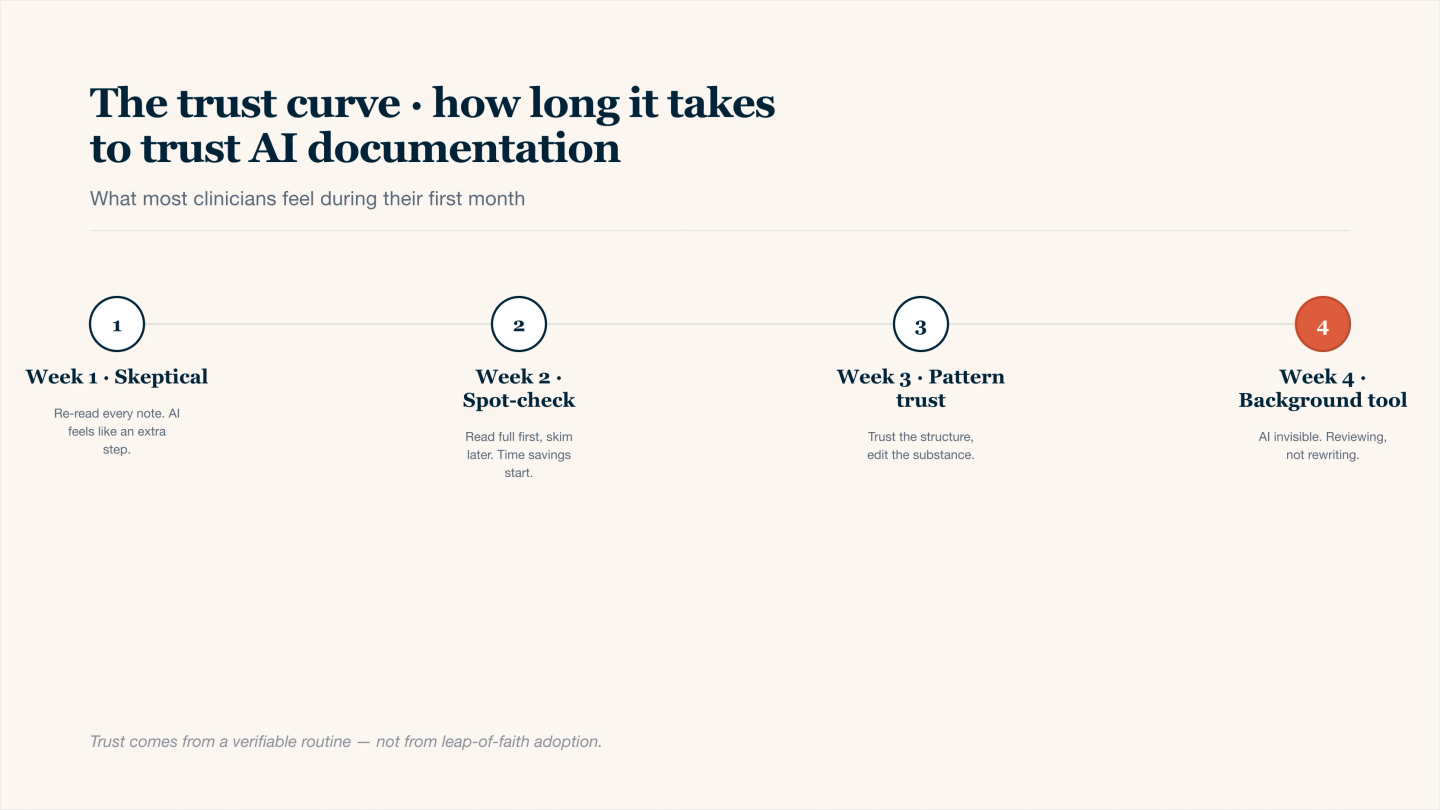
The four-week trust curve most clinicians follow with an AI scribe.
A. Trust tends to follow a predictable curve
Instead of thinking in days, think in stages tied to how many real notes you have reviewed.
Stage 1: First 5 to 15 notes
- Feeling: cautious, checking everything.
- What you are learning: does the tool follow your style and pick up key clinical decisions.
- Best approach: review line by line and mark what is consistently missing.
Stage 2: Next 20 to 50 notes
- Feeling: you start to notice patterns.
- What you are learning: which sections are reliable and which need your attention.
- Best approach: shift to section based review, still careful on meds, risk, and plan.
Stage 3: After 50 to 100 notes
- Feeling: comfortable using AI for most routine visits.
- What you are learning: how to keep notes concise and audit ready without extra editing.
- Best approach: one to two minute review per note.
This is why some clinicians say it took “two weeks” and others say “two months.” They are describing the same stages at different visit volumes.
B. What speeds up trust
These habits shorten the curve.
Habit | Why it helps |
|---|---|
Use narrow prompts | Less noise means fewer AI assumptions and shorter drafts |
Keep a stable template | Predictable structure makes review faster |
Speak the plan out loud | AI captures your clinical reasoning cleanly |
Review with a checklist | Reduces anxiety and missed errors |
Track repeats | If the same issue appears twice, fix the prompt or template |
C. What slows trust down
If any of these are present, trust takes longer.
- Notes are too long, so you spend time trimming instead of verifying
- You use AI on very complex visits before dialing it in on routine ones
- Your EHR workflow adds friction at the final step
- You do not verbalize decisions clearly, so AI fills gaps
- You keep changing templates, so output feels inconsistent
The fix is usually not “try harder.” It is tightening setup.
D. A safe review routine that builds confidence
Use the same micro workflow every time. It creates familiarity and reduces mental load.
- Identity and context, 10 seconds
Confirm patient, date, visit type. - High risk sections, 45 to 60 seconds
- Med list and changes
- Orders and referrals
- Risk and safety statements
- Assessment and plan per problem
- Consistency scan, 30 seconds
HPI and exam do not contradict the main story.
Over time, you will notice that the high risk sections are almost always right. That is when trust shifts from effortful to automatic.
E. One simple way to measure your trust
For two weeks, track:
- How long you spend reviewing each note
- Frequency of meaningful edits
- Types of edits (missing meds, wrong symptom, wording polish)
When meaningful edits drop and review time stabilizes under two minutes, that is a clear sign you can rely on the tool for routine care.