


Brief Answer
The “best” AI medical scribe is the one that matches your workflow and risk tolerance: (1) a signed BAA and clear privacy posture, (2) consistently accurate notes in your specialty’s structure, (3) fast review and export into your EHR, and (4) predictable pricing that works at your scale. If you are a small or mid‑sized outpatient practice, tools designed for SMB workflows and quick adoption tend to win on time‑to‑value, while enterprise‑focused tools often win on deep EHR embedding.
The Longer Answer
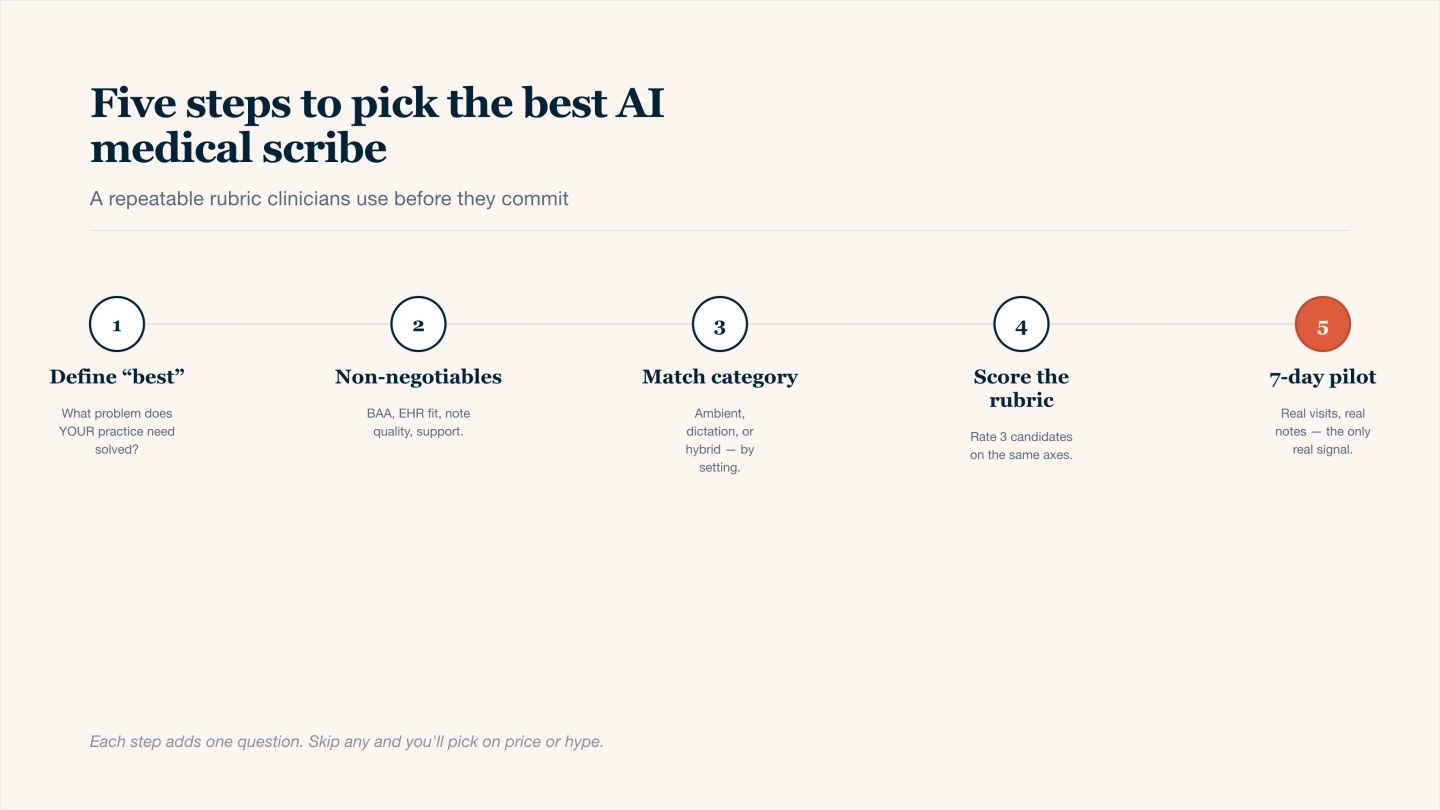
Five steps to pick the best AI medical scribe — the rubric that beats vendor hype.
Step 1: Decide what “best” means for your practice
Pick your top 3 priorities and evaluate everything through that lens.
Priority | When it matters most | What to look for |
|---|---|---|
Compliance | Any PHI, always | Signed BAA, encryption, retention controls, audit logs, clear subcontractor handling (BAA chain) |
Accuracy + brevity | High volume clinics | Specialty-appropriate templates, ability to control note style, minimal hallucinations |
Workflow speed | You are charting at night | Draft appears quickly, easy edits, fewer clicks, reliable export |
EHR fit | You live in Epic/athena/etc. | Direct integration vs copy/paste vs document upload |
Cost predictability | Groups and growing clinics | Transparent pricing, scaling without surprise overages |
Step 2: Use a “non-negotiables” checklist
If a vendor fails any of these, move on.
Compliance essentials
- Offers a Business Associate Agreement (BAA) for HIPAA workflows
- States how they handle PHI and subcontractors (and whether PHI is used for training)
Clinical essentials
- Produces your note types (SOAP, A/P per problem, psych, procedure notes)
- Lets you control length and structure (otherwise notes balloon and you still edit)
- Handles medications, orders, and follow-up instructions reliably
Operational essentials
- Export path is frictionless (EHR integration or one-click copy into your template)
- Works in telehealth and in-room, with good audio capture
Step 3: Match the tool category to your setting
Different “best” answers by practice type:
Practice setting | Usually best fit | Why |
|---|---|---|
Solo or small outpatient | Lightweight scribes with fast setup and templates | You need time savings immediately with minimal IT overhead |
Mid-size groups | Tools with admin controls, shared templates, predictable scaling | Standardization matters across clinicians |
Enterprise health systems | Deep EHR-embedded platforms | Procurement and integration matter most (SSO, governance, deployments) |
Step 4: Score candidates with a simple rubric
Give each vendor a 1 to 5 in each category, then total it. This keeps the decision objective.
Category | How to score it quickly |
|---|---|
Compliance | BAA available, clear retention, training policy clarity |
Note quality | 10-visit test: accuracy, brevity, specialty format consistency |
Edit time | How many minutes to finalize a typical noteSteps to get note into chart (0 to 5 clicks is ideal) |
EHR friction | Steps to get note into chart (0 to 5 clicks is ideal) |
Reliability | Fails, latency, audio issues during real clinic days |
Cost | Effective monthly cost per clinician at your expected volume |
Tip: Run the test on the same 10 visits across tools. Do not compare “best note” to “average note.”
Step 5: Run a 7-day pilot that answers the only question that matters
Does it reduce your after-hours charting without increasing risk?
Pilot protocol
- Day 1: Build 2 templates (short chronic follow-up, acute visit)
- Days 2–6: Use it for 5–10 visits/day, track:
- Draft time to generate
- Minutes to finalize
- Common misses (ROS, MDM elements, meds, counseling)
- Day 7: Audit 10 notes for completeness and consistency
If your “minutes to finalize” does not drop meaningfully, it is not the best tool for your practice, even if the demo was impressive.
The verdict
Twofold is typically a strong fit when your priority is fast adoption in outpatient SMB settings and keeping notes structured and concise. It emphasizes practical templates and quick review workflows, which is often what determines whether charting time actually drops in the first week.
From a compliance standpoint, Twofold publishes educational guidance on why a BAA matters for AI note tools and positions BAA availability as a baseline requirement when PHI is involved.
If your practice needs a “set it up once, reuse forever” workflow, Twofold’s template‑driven approach can reduce variability between clinicians and reduce the tendency toward bloated, overly narrative notes, which is a common complaint with ambient drafts.